
OSHA 29 CFR 1910.134: Respiratory Protection Program
Requirements for written programs, medical evaluation, fit testing, and respirator selection in general industry and construction
Overview
OSHA 29 CFR 1910.134 is the federal respiratory protection standard. It reaches every employer whose employees use respirators, whether the employer requires them or the employee chooses to wear one voluntarily. The standard covers everything from disposable N95 filtering facepieces to supplied-air systems used in immediately dangerous to life or health (IDLH) environments.
The standard requires employers to establish and maintain a respiratory protection program whenever respirators are necessary to protect employee health or whenever respirators are required by the employer. The program must be worksite-specific and written. OSHA does not accept a generic template — the plan must describe the actual hazards, respirators, and procedures at your facility or job site.
1910.134 sits in Part 1910, the general industry rules, and it reaches construction work through a second regulation. 29 CFR 1926.103 states that the respiratory protection requirements applicable to construction work are identical to those set forth at 29 CFR 1910.134. That is why a contractor cited for a respirator violation on a job site is answering to the same paragraph numbers a plant manager is. In practice the standard turns up in manufacturing, construction, healthcare, laboratories, welding shops, painting operations, pharmaceutical production, and foundries, and anywhere else airborne contaminants or oxygen-deficient atmospheres exist.
What 29 CFR 1910.134 Requires
The standard is long, but the obligations it creates are finite. This table maps each one to the paragraph it comes from, so you can cite the source when you build the program or answer an inspector. The sections below work through the ones that cause the most trouble.
| Requirement | Paragraph | What it means in practice |
|---|---|---|
| Written program | (c)(1) | Nine required elements, written and worksite-specific. The first document an inspector asks for. |
| Program administrator | (c)(3) | A named person, qualified by training or experience commensurate with the complexity of the program. |
| No cost to the employee | (c)(4) | Respirators, training, and medical evaluations are the employer's expense. |
| NIOSH-certified selection | (d)(1)(ii) | The respirator must be NIOSH-certified and used within the conditions of that certification. |
| Enough models and sizes | (d)(1)(iv) | Stock enough variety that the respirator actually fits the wearer and is acceptable to them. |
| Selection by protection factor | (d)(3)(i)(A) | Use the Table 1 assigned protection factors to pick equipment that meets or exceeds the protection needed. |
| Medical evaluation | (e) | A PLHCP clears the employee before the initial fit test and before first workplace use. There is no annual re-evaluation requirement; re-evaluation is triggered by specific events under (e)(7). |
| Fit testing | (f)(2) | Before initial use, on any change of facepiece size, style, model or make, and at least annually. |
| Use, seal protection, IDLH procedures | (g)(1), (g)(3) | No facial hair at the sealing surface, and standby personnel plus rescue capability for IDLH entries. |
| Maintenance and care | (h) | Cleaning, disinfecting, storage, inspection, and repair on a defined schedule. |
| Breathing air quality | (i) | Applies once you run supplied-air respirators or SCBA, not to air-purifying respirators. |
| Training and information | (k), (k)(5) | Before initial use, then retraining at least annually and whenever conditions change. |
| Program evaluation | (l) | Check the workplace as often as necessary to confirm the program is being carried out. |
| Recordkeeping | (m) | Medical evaluation records, fit test records, and a copy of the current written program. |
Two of these are frequently misfiled. IDLH entry procedures live at (g)(3), not in the (c)(1) written-program list, and recordkeeping lives at (m). Both are still requirements. Programs that copy the (c)(1) list verbatim and stop there tend to have no IDLH procedure and no retention rule, which are separate citations.
When Is a Respiratory Protection Program Required?
Not every workplace needs a full respiratory protection program. The decision depends on whether respirator use is required by the employer (or by OSHA) or purely voluntary by the employee.
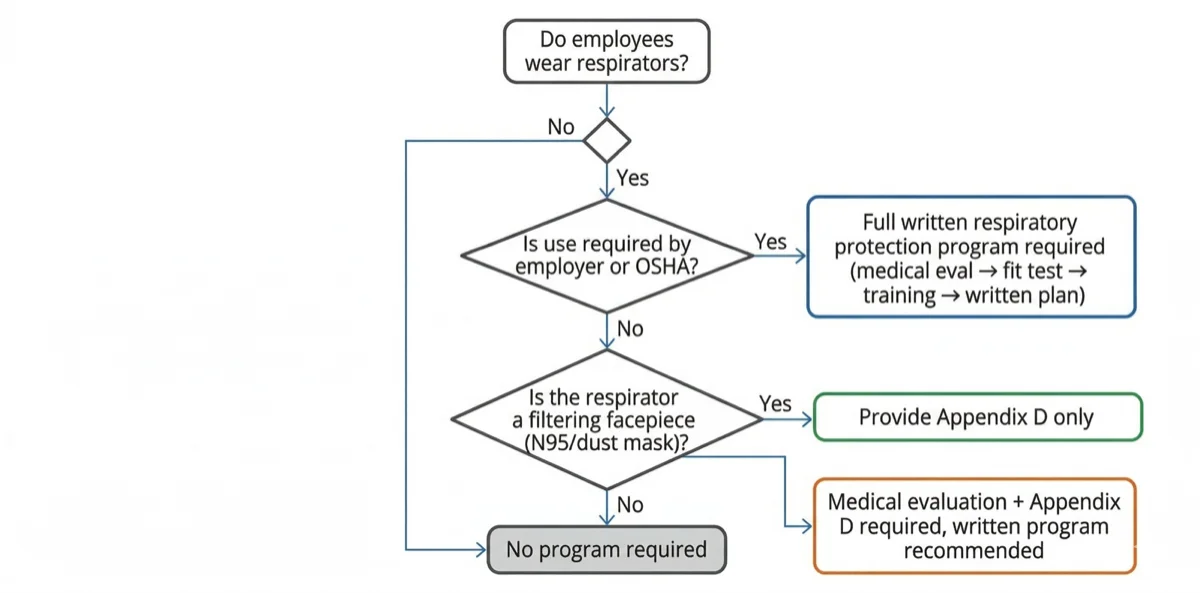
Decision tree — does your workplace need a full respiratory protection program?
A full written program is required when any of these conditions exist:
- Employee exposure to airborne contaminants exceeds the permissible exposure limit (PEL) and engineering controls alone cannot reduce exposure below the PEL
- Employees work in oxygen-deficient atmospheres (below 19.5% oxygen)
- Employees enter immediately dangerous to life or health (IDLH) environments
- The employer requires respirator use for any reason, even if exposures are below the PEL
- Another OSHA substance-specific standard requires respiratory protection (e.g., 1926.1153 for silica, 1910.1025 for lead, 1910.1048 for formaldehyde)
Voluntary use is not exempt. Even when employees choose to wear respirators on their own (and the employer does not require them), OSHA still imposes some requirements. For voluntary use of filtering facepieces (dust masks), employers must provide a copy of Appendix D. For voluntary use of all other respirator types, employers must provide medical evaluations and ensure the respirator does not create a hazard. See the Voluntary Use section below.
A common trigger is Table 1 of OSHA 1926.1153 silica in construction. Many Table 1 tasks require respirators at certain durations, which pulls in the full 1910.134 program: written program, medical evaluation, fit testing, and training. Entry work brings the same result from a different direction. A permit space under OSHA 1910.146 confined spaces whose atmosphere is IDLH, or must be treated as IDLH because it cannot be characterized, puts the entrant and the rescue team under the (g)(3) IDLH procedures described above.
Written Program Elements
Section 1910.134(c) requires a written respiratory protection program with worksite-specific procedures. The written program is the first thing an OSHA inspector will ask for. Paragraph (c)(1) names nine elements it must include, and the numbering below follows the regulation so you can cite it directly:
The nine elements of 1910.134(c)(1)
- Procedures for selecting respirators for use in the workplace
- Medical evaluations of employees required to use respirators
- Fit testing procedures for tight-fitting respirators
- Procedures for proper use of respirators in routine and reasonably foreseeable emergency situations
- Procedures and schedules for cleaning, disinfecting, storing, inspecting, repairing, discarding, and otherwise maintaining respirators
- Procedures to ensure adequate air quality, quantity, and flow of breathing air for atmosphere-supplying respirators
- Training in the respiratory hazards employees are potentially exposed to during routine and emergency situations
- Training in proper use, including putting respirators on and removing them, any limitations on their use, and their maintenance
- Procedures for regularly evaluating the effectiveness of the program
Element six catches people out. It only bites once you run supplied-air respirators or SCBA, so a program built entirely around N95s and half masks has nothing to write there. Add an airline respirator later and the program needs that section before the equipment goes into service.
Program administrator: The employer must designate a program administrator who is qualified by appropriate training or experience to administer the program and conduct required evaluations. This person is responsible for the day-to-day operation of the program.
Medical Evaluation & Fit Testing
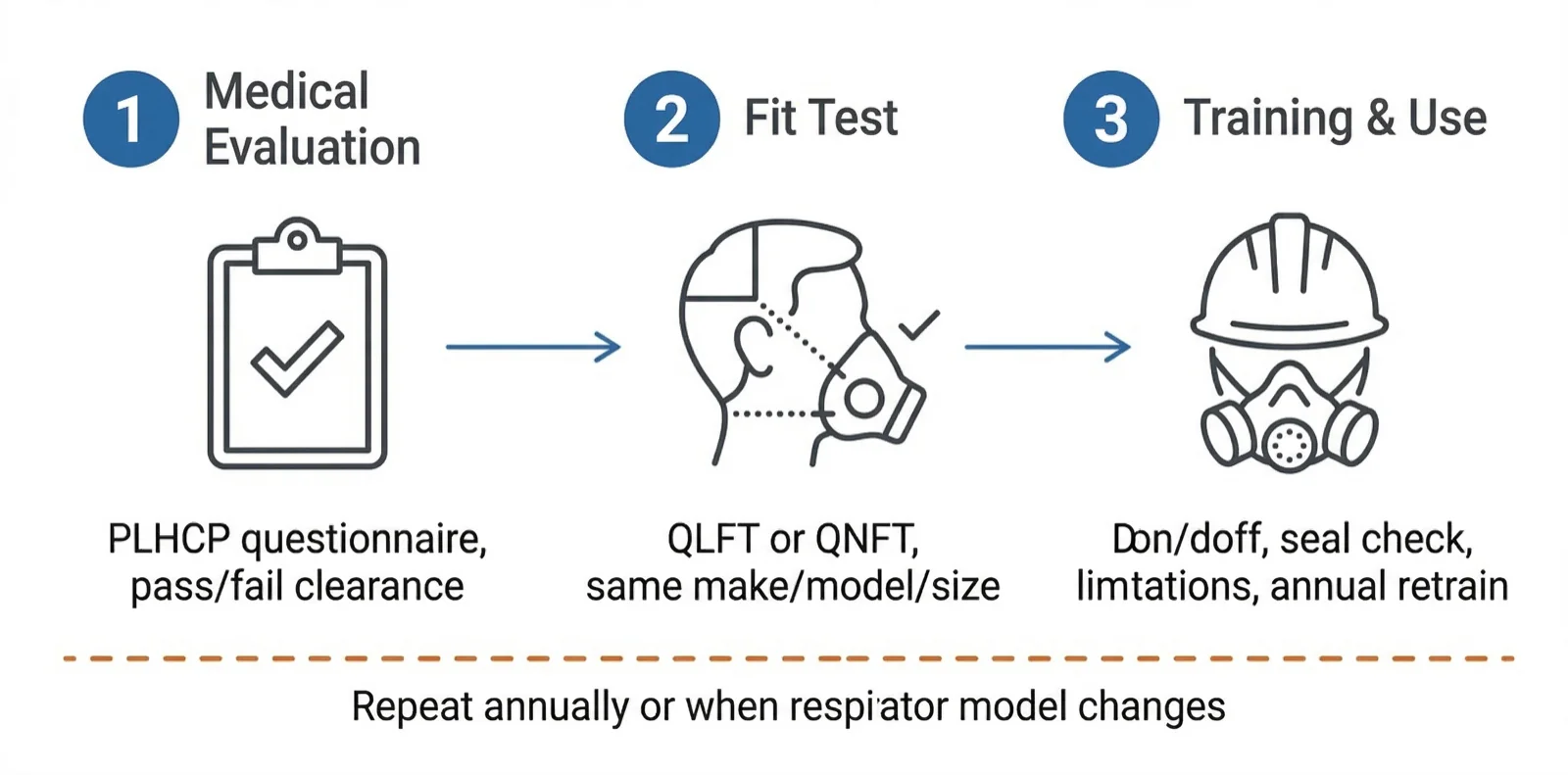
The three required steps — medical clearance must come before fit testing
Medical Evaluation
Before an employee can be fit tested or use a respirator on the job, the employer must provide a medical evaluation to determine the employee's ability to use a respirator. The evaluation uses the OSHA Respirator Medical Evaluation Questionnaire (Appendix C of 1910.134) or an equivalent initial medical exam.
- The employer pays all costs for medical evaluations
- Evaluations must be performed by a physician or other licensed health care professional (PLHCP)
- The questionnaire is confidential — the employer only receives a pass/fail determination and any limitations
- Must be completed before fit testing and before the employee uses a respirator in the workplace
- Follow-up exams are required if the PLHCP determines additional evaluation is needed
- A new evaluation is required if an employee reports signs or symptoms related to respirator use, a PLHCP or program administrator recommends one, or observations during fit testing suggest a medical issue
Fit Testing
All employees using tight-fitting respirators must be fit tested before initial use, whenever a different respirator facepiece is used, and at least annually thereafter. Fit testing must be performed with the same make, model, style, and size of respirator that the employee will use on the job.
| Method | Equipment Cost | Time per Test | Pass/Fail Criteria | Best For |
|---|---|---|---|---|
| QLFT (Qualitative) | Low ($200-$500 for kit) | 15-20 minutes | Employee detects taste or smell of test agent (pass = no detection) | Negative-pressure air-purifying respirators that need a fit factor of 100 or less, per (f)(6). In practice that is filtering facepieces and half masks. |
| QNFT (Quantitative) | High ($5,000-$15,000 for instrument) | 15-30 minutes | Instrument measures fit factor numerically. Per (f)(7), pass is a fit factor of 100 or more for a tight-fitting half facepiece, or 500 or more for a tight-fitting full facepiece | Any tight-fitting respirator. The only option once the required fit factor goes above 100. |
The line between the two methods is the fit factor, not the shape of the mask. Paragraph (f)(6) allows QLFT only for negative-pressure air-purifying respirators that need a fit factor of 100 or less. A half mask carries an assigned protection factor of 10 and needs a fit factor of 100, so it can be qualitatively tested. A full facepiece relied on for its assigned protection factor of 50 needs a fit factor of 500, which is past the QLFT ceiling and has to go through QNFT.
Fit testing must be repeated annually and whenever there is a change that could affect respirator fit:
- Weight change of approximately 20 pounds or more
- Significant facial scarring, dental changes, or cosmetic surgery
- Different respirator make, model, style, or size
- Employee reports difficulty breathing or poor fit
- Visible changes in facial features that could affect seal
Respirator Selection & Assigned Protection Factors
Employers must select NIOSH-certified respirators based on the respiratory hazards employees face. The Assigned Protection Factor (APF) tells you how much protection a respirator class provides. In plain terms, an APF of 10 means the respirator reduces the airborne concentration of a contaminant by a factor of 10 — so if the air outside the respirator contains 500 µg/m³ of a contaminant, the air inside the respirator should contain no more than 50 µg/m³.
The APFs below are the values in Table 1 of 1910.134. Two of them are conditional rather than fixed, which is where selection errors usually start.
| Respirator Type | APF | Notes |
|---|---|---|
| Filtering facepiece (N95, P100) | 10 | Disposable, single-use. Most common for dust, mist, and fume exposures up to 10x the PEL. |
| Elastomeric half-face respirator | 10 | Reusable with replaceable cartridges/filters. Same APF as filtering facepiece but more durable and cost-effective for repeated use. |
| Elastomeric full-face respirator | 50 | Covers entire face. Provides eye protection. Required when exposures exceed 10x PEL or eye irritation is a concern. |
| PAPR with half-face | 50 | Powered air-purifying respirator. Battery-powered blower forces air through filters. Easier to breathe in than negative-pressure respirators. |
| PAPR with full facepiece | 1,000 | Tight-fitting, so it still needs fit testing. |
| PAPR with helmet or hood | 25 or 1,000 | 25 by default. You may use 1,000 only where you hold evidence from manufacturer testing that the unit delivers 1,000 or better. No fit testing, so this is the usual answer for facial hair or a seal that will not hold. |
| PAPR with loose-fitting facepiece | 25 | No facial seal, so no fit test. |
| Supplied-air respirator (SAR / airline) | 10 – 1,000 | Varies by facepiece and operating mode: 10 for a demand half mask, 1,000 for a continuous-flow or pressure-demand full facepiece. 1,000 is the ceiling for this class. |
| SCBA, pressure-demand full facepiece or hood | 10,000 | The highest APF the standard assigns. Note that IDLH entry has its own selection rule under (d)(2)(i): a pressure-demand full facepiece SCBA with at least 30 minutes of service life, or a combination pressure-demand full facepiece supplied-air respirator with auxiliary SCBA. A demand-mode SCBA is only 10 or 50 and does not qualify. |
How to use APF: Divide the measured or estimated airborne contaminant concentration by the PEL. The result is the minimum protection factor you need. Choose a respirator with an APF equal to or greater than that number. For example, if exposure is 250 µg/m³ and the PEL is 50 µg/m³, you need a minimum APF of 5 — an N95 (APF 10) would be sufficient. If exposure is 2,000 µg/m³, you need APF 40 — a full-face respirator (APF 50) would work. Running the arithmetic the other way gives the maximum use concentration, the APF multiplied by the exposure limit. Two caps apply under (d)(3)(i)(B): the MUC never exceeds the IDLH level, and cartridge or canister performance limits can lower it further.
Heat and Flame Resistant Respirators for Hot Work
Standard N95 filtering facepieces are not inherently flame resistant. In hot work environments like welding, grinding, cutting, and foundry operations, the respirator itself can melt, drip, or sustain flame if exposed to heat or sparks. Workers in these environments should select respirators tested for heat and flame resistance per ANSI/ISEA 110-2009 Section 7.11.1.
That test requires the respirator material to self-extinguish within 5 seconds of flame contact with no dripping, melting, or holes that would expose the lungs to contaminants.
Important: Heat and flame resistance does not replace proper hot work controls. Respirators protect the airway from particulates and fumes, not from direct flame impingement. In welding applications, pair a flame-resistant respirator with proper welding helmets, fire-resistant clothing, and ventilation per OSHA 1910.252.
Related Products

Manufacturer: Moldex
Moldex 2201N95 Disposable Particulate Respirator, Small, NIOSH Approved
$34.00
$38.00

Manufacturer: Moldex
Moldex 2207N95 Disposable Particulate Respirator, Low Profile, NIOSH Approved
$34.00
$38.00

Manufacturer: Moldex
Moldex 2600N95 Series Particulate Respirators With HandyStrap®
$34.00

Manufacturer: Moldex
Moldex 2700N95 Disposable HandyStrap® Particulate Respirator with Ventex® Valve, Med/Large, NIOSH Approved
$52.00

Manufacturer: Moldex
Moldex 2701N95 Disposable HandyStrap® Particulate Respirator with Ventex® Valve, Small, NIOSH Approved
$52.00

Manufacturer: Moldex
Moldex 4800 N95 Plus Nuisance Organic Vapors AirWave® Disposable Particulate Respirator with SmartStrap®, Size Medium/Large, NIOSH Approved
$87.00
Voluntary Use & Appendix D
When an employee chooses to wear a respirator even though the employer does not require it and exposures are below the PEL, this is considered voluntary use. OSHA still has requirements, but they differ based on the type of respirator.
Filtering Facepieces (Dust Masks / N95s)
- Employer must provide the employee a copy of Appendix D of 1910.134 (information for voluntary use)
- No medical evaluation required
- No fit testing required
- No written program required for this use alone. Paragraph (c)(2)(ii) exempts employees whose only respirator use is the voluntary use of filtering facepieces
- Employer must still determine under (c)(2)(i) that the respirator use will not in itself create a hazard
All Other Respirators (Half-Face, Full-Face, PAPR, SAR)
- Employer must provide medical evaluation before use
- Employer must ensure the respirator is properly cleaned, stored, and maintained
- Employer must ensure the respirator does not create a hazard
- Fit testing is not explicitly required for voluntary use but is strongly recommended
- Paragraph (c)(2)(ii) requires the employer to implement whichever written program elements are needed to cover the medical clearance and the cleaning, storage, and maintenance of these respirators
Common example: An employee on a construction site wants to wear an N95 for comfort during dusty demolition work, but air monitoring shows dust levels are below the PEL. The employer must give the employee a copy of Appendix D but does not need to provide medical evaluation or fit testing for the N95 alone. However, if that same employee also uses a half-face elastomeric respirator for a different task, the employer must provide medical evaluation for the half-face use — and at that point, a full written program is likely triggered.
Common Mistakes
Respiratory protection has been on OSHA's Top 10 most frequently cited standards in recent years. It ranked fifth in fiscal year 2025, behind fall protection, hazard communication, ladders, and lockout/tagout. These are the mistakes that lead to citations most often.
- No written respiratory protection program — employees wear respirators but the employer has no written plan. This is the single most common citation under 1910.134.
- Skipping medical evaluations — employees are fit tested and sent to work with respirators without first completing the OSHA medical questionnaire and receiving PLHCP clearance.
- Fit testing before medical clearance — the medical evaluation must come first. An employee who is not medically cleared cannot be fit tested.
- Not fit testing annually — fit tests expire after 12 months. Many employers fit test at hire and never repeat it.
- Allowing facial hair with tight-fitting respirators — any facial hair that comes between the sealing surface of the facepiece and the face breaks the seal and voids the protection factor. Stubble, beards, sideburns, and mustaches that cross the seal line are all prohibited.
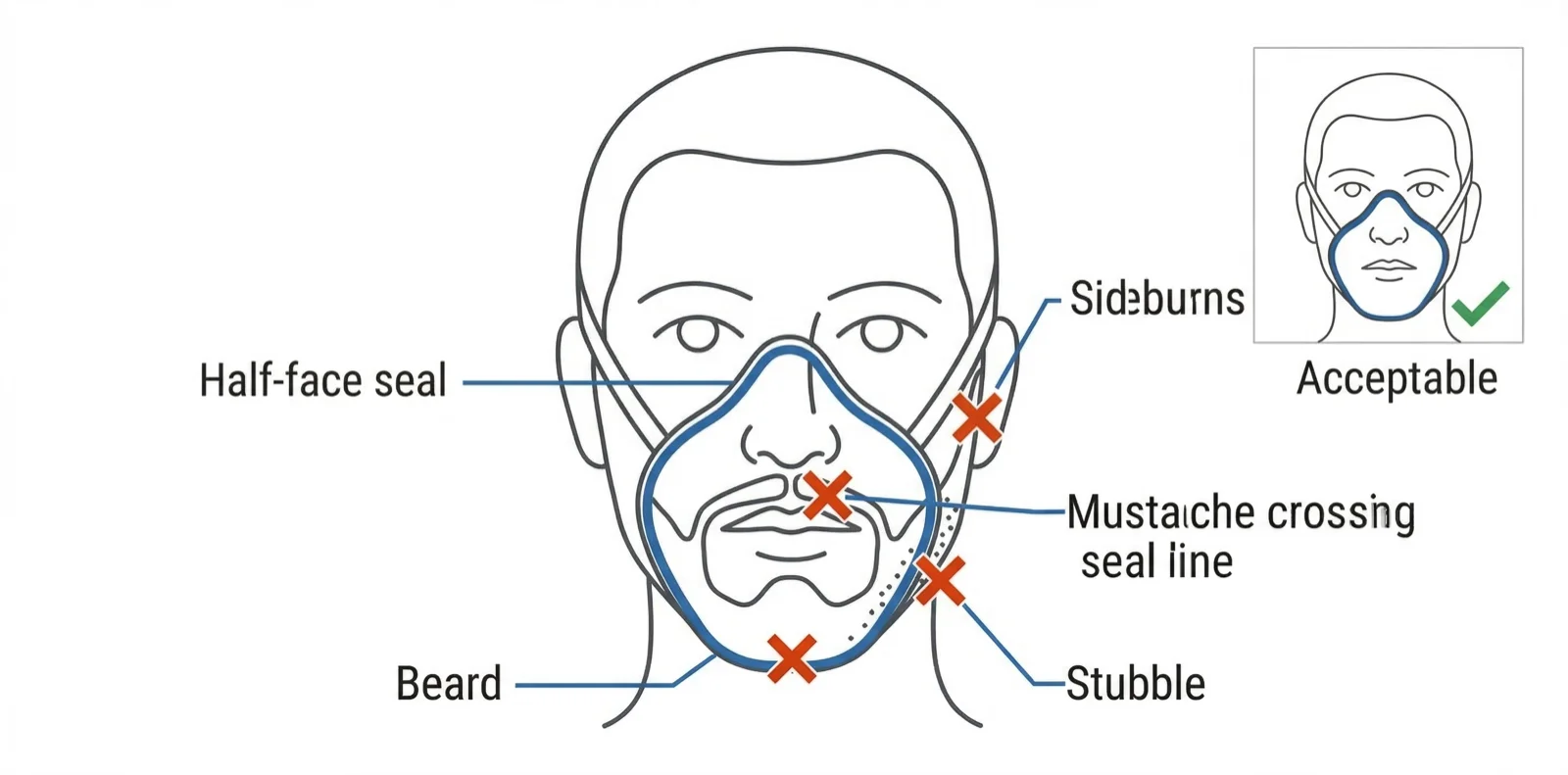
Any facial hair crossing the respirator seal line voids the protection factor
- Using expired or wrong cartridges — cartridges and filters have a service life. Employers must establish a change-out schedule based on the specific contaminant and concentration, or use end-of-service-life indicators.
- No training program — employees must be trained on why the respirator is necessary, how to properly don, doff, and adjust it, how to perform user seal checks, and how to recognize medical signs that limit respirator use. Training must occur before initial use and annually thereafter.
- Treating voluntary N95 use as fully exempt — when employees voluntarily use N95s, employers still must provide Appendix D. And if other (non-filtering-facepiece) respirators are also used voluntarily, medical evaluation is required for those.
Enforcement context: OSHA 1910.134 has held a place on OSHA's published Top 10 most frequently cited standards for years running, at number five in fiscal year 2025. Violations are often grouped — a single inspection can result in citations for missing written program, missing medical evaluations, missing fit testing, and missing training, each as a separate violation.
Frequently Asked Questions
What does OSHA 1910.134 require?
Where respirator use is required, either by an OSHA substance standard or by the employer, 29 CFR 1910.134 requires the employer to run a written, worksite-specific respiratory protection program. Voluntary use is handled differently: voluntary filtering facepiece use needs only Appendix D, not a written program. Paragraph (c)(1) sets out nine elements: respirator selection procedures, medical evaluations, fit testing procedures, procedures for proper use in routine and reasonably foreseeable emergency situations, cleaning and maintenance procedures, breathing air quality procedures for atmosphere-supplying respirators, training on respiratory hazards, training on proper use, and regular evaluation of the program. Alongside that, the employer must name a qualified program administrator under (c)(3), provide respirators, training, and medical evaluations at no cost to the employee under (c)(4), select a NIOSH-certified respirator under (d)(1)(ii), fit test before initial use and at least annually under (f)(2), and keep medical, fit test, and program records under (m).
Does 29 CFR 1910.134 apply to construction?
Yes, by way of a second regulation. 1910.134 is a general industry standard in Part 1910. For construction work, 29 CFR 1926.103 states that the applicable respiratory protection requirements are identical to those set forth at 29 CFR 1910.134. A construction employer therefore owes the same written program, medical evaluation, fit testing, and training obligations, and OSHA may cite either section depending on the worksite.
Do I need a respiratory protection program for N95 dust masks?
It depends on whether the use is required or voluntary. If the employer requires employees to wear N95s (or if an OSHA standard like 1926.1153 requires them), then yes — a full written respiratory protection program is required, including medical evaluation, fit testing, and training. If employees choose to wear N95s voluntarily and the employer does not require them, the employer only needs to provide a copy of Appendix D.
How often is fit testing required?
At least annually (every 12 months). Additional fit testing is required whenever an employee switches to a different respirator make, model, style, or size, or whenever there is a change in the employee's physical condition that could affect respirator fit — such as significant weight change (approximately 20 pounds), facial scarring, dental changes, or cosmetic surgery.
Can employees have facial hair and wear a respirator?
Not with tight-fitting respirators. Section 1910.134(g)(1)(i)(A) prohibits tight-fitting facepieces when facial hair comes between the sealing surface and the face or interferes with valve function. This includes beards, stubble, sideburns, and mustaches that cross the seal line. Employees with facial hair can use PAPRs with loose-fitting hoods or helmets, which do not rely on a facial seal.
Who pays for medical evaluations and fit testing?
The employer. Section 1910.134(c)(4) states that the employer shall provide respirators, training, and medical evaluations at no cost to the employee. That covers the evaluation itself and any follow-up exam the PLHCP recommends. Fit testing is named separately, at (f)(1), as something the employer shall ensure happens, so it is an employer obligation rather than an employee expense. None of these costs may be passed to the worker.
What is the difference between QLFT and QNFT?
Qualitative fit testing (QLFT) uses a test agent — typically Bitrex (bitter taste), saccharin (sweet taste), isoamyl acetate (banana smell), or irritant smoke — and relies on the employee's ability to detect it. If the employee tastes or smells the agent, the test fails. Quantitative fit testing (QNFT) uses an instrument (such as a PortaCount) to measure the actual concentration of particles inside and outside the respirator, producing a numerical fit factor. QLFT is cheaper but limited: paragraph (f)(6) allows it only for negative-pressure air-purifying respirators that need a fit factor of 100 or less, which in practice means filtering facepieces and half masks. QNFT works for any tight-fitting respirator, and paragraph (f)(7) sets the pass mark at a fit factor of 100 or more for a half facepiece and 500 or more for a full facepiece.
Do I need fit testing for PAPRs?
Only for tight-fitting PAPRs (those with a half-face or full-face piece that seals against the face). Loose-fitting PAPRs with hoods or helmets do not require fit testing because they do not rely on a facial seal for protection. This makes loose-fitting PAPRs a practical option for employees who have facial hair or difficulty achieving a reliable seal with tight-fitting respirators.
What records do I need to keep?
Three categories of records: (1) Medical evaluation records must be retained and made available per 29 CFR 1910.1020 (for the duration of employment plus 30 years). (2) Fit test records must include the employee name, type of fit test, specific make/model/style/size of respirator, date of test, and pass/fail result — retained until the next fit test. (3) A current copy of the written respiratory protection program must be maintained and made available to employees.
Can one employee use another employee's respirator?
No. Respirators must be individually assigned. Each employee must be fit tested on the specific make, model, style, and size of respirator they will use. Sharing respirators means the second employee has not been fit tested on that unit and there is no assurance of proper fit. Additionally, respirators must be cleaned and disinfected before being used by another person, and reusable respirators assigned to individual employees must be cleaned and disinfected as often as necessary to maintain sanitary condition.
Need Help with Respiratory Protection Compliance?
Tell us about your situation and we'll help you figure out what you need.
Related Products

Manufacturer: Dentec
Dentec 79200 Respirator Fit Test Adapter Kit for TSI PortaCount with Clips Tubing Suction Cups and 2 P100 Filters
$405.00

Manufacturer: Dentec
Dentec 79210 TSI PortaCount Fit Test Adapter
$105.00

Manufacturer: Dentec
Dentec 79260 Bitrex Qualitative Fit Test Kit with Hood Nebulizers Sensitivity and Fit Test Solutions
$322.00

Manufacturer: Dentec
Dentec Comfort-Air 14668BB350 Nx Black Filter Cover for N95 Filter Pads
$355.00

Manufacturer: Dentec
Dentec Comfort-Air 14668WB350 NxMD White Filter Cover for N95 Filter Pads
$400.00

Manufacturer: Dentec
Dentec Comfort-Air 14880WB350 NxMD White Filter Holder for N95 Filter Pads
$355.00

Manufacturer: Dentec
Dentec Comfort-Air 14881B350 Retainer for Particulate Filters
$355.00

Manufacturer: Dentec
Dentec Comfort-Air 158T20LP0B60 Organic Vapor and P100 Combination Cartridge
$844.00
Related Resources
Respirator Fit Testing, Medical Evaluation & Training
Step-by-step guide to fit testing protocols, medical evaluations, and training
OSHA 1926.1153 Silica in Construction
Silica dust exposure limits and Table 1 engineering controls
OSHA 1910.151 First Aid
Workplace first aid requirements and emergency response
Roof Coating PPE & First Aid Kit
PPE and first aid supplies for roof coating crews
OSHA 1910.146 — Permit-Required Confined Spaces
Respiratory protection requirements for confined space entry and rescue operations
H2S Gas Detection Guide
Portable monitors, OSHA H2S exposure limits, and respiratory protection requirements for hydrogen sulfide
For respiratory protection mandatory signs at area entrances, see our ISO 7010 M-Series Mandatory Signs guide (M004 Wear Respiratory Protection).
Was this page helpful?
Your feedback helps us improve our technical resources.