
OSHA 29 CFR 1910.147
Control of Hazardous Energy (Lockout/Tagout): Requirements for Servicing and Maintenance
Overview
OSHA 29 CFR 1910.147 establishes requirements for controlling hazardous energy during the servicing and maintenance of machines and equipment. Known as the Lockout/Tagout (LOTO) standard, OSHA estimates it prevents about 120 fatalities and 50,000 injuries each year by ensuring machines cannot unexpectedly start up, energize, or release stored energy while workers are performing maintenance.
The standard ranked #4 on OSHA's Top 10 most cited standards in FY 2025 with 2,562 violations. Most violations stem from missing written procedures, inadequate training, and skipped annual inspections — all preventable with a properly implemented energy control program.
Compliance requirement: Every employer whose workers service or maintain machines where unexpected energization could cause injury must have a written energy control program with machine-specific procedures, employee training, and annual inspections.
Scope and Exceptions
1910.147 applies to general industry — any workplace where employees service or maintain machines and equipment that could expose them to hazardous energy. This covers manufacturing, utilities, warehousing, food processing, and commercial building maintenance, among others.
Whole industries sit outside the standard's scope — construction and agriculture, maritime (parts 1915/1917/1918), electric utility installations covered by 1910.269, electrical-hazard work under Subpart S, and oil and gas well drilling and servicing. Within covered workplaces, three key application exceptions apply:
- Cord-and-plug equipment: If the equipment is unplugged and the plug remains under the exclusive control of the employee performing the work, LOTO is not required.
- Hot tap operations: Welding on pressurized pipelines, vessels, or tanks to install connections or branch lines, when continuity of service is essential, shutdown is impractical, and documented procedures with special equipment provide proven effective protection.
- Minor servicing: Routine, repetitive tasks like tool changes and adjustments during normal production, provided alternative protective measures (such as machine guarding) are in place.
Common mistake: The "minor servicing" exception is narrow. If the task requires removing or bypassing a guard, or if the employee must place any part of their body in a danger zone, LOTO procedures apply unless every element of the exception is met: the task is routine, repetitive, and integral to normal production, and alternative measures provide effective protection.
Types of Hazardous Energy
The standard covers all forms of energy that could cause injury during servicing. Machine-specific LOTO procedures must identify every energy source present:
| Energy Type | Sources | Isolation Method |
|---|---|---|
| Electrical | Motors, transformers, capacitors, batteries | Circuit breaker lockout, disconnect switch, plug lockout |
| Mechanical | Flywheels, springs, elevated components | Blocking, pinning, releasing stored energy |
| Hydraulic | Presses, lifts, injection molding machines | Valve lockout, bleed-down, blocking |
| Pneumatic | Air compressors, cylinders, blow guns | Valve lockout, bleed-down, disconnect lockout |
| Chemical | Process piping, reactors, storage tanks | Valve lockout, blank/blind flange, double block-and-bleed |
| Thermal | Steam lines, furnaces, ovens, heated molds | Valve lockout, cool-down period, temperature verification |
| Gravitational | Raised platforms, suspended loads, hoists | Blocking, cribbing, mechanical restraint |
Many machines have multiple energy sources. A hydraulic press, for example, has electrical energy (motor), hydraulic energy (pressurized fluid), and gravitational energy (raised ram). The written procedure must address all of them.
The 6-Step LOTO Procedure
1910.147(d) defines the sequence for applying energy controls. Every machine-specific written procedure must follow these steps. Separately, 1910.147(c)(9) requires notifying affected employees before the controls are applied and again after they are removed — notification bookends the sequence rather than being one of the (d) steps:
- Preparation: The authorized employee identifies all energy sources, types, and magnitudes for the machine, and understands the methods to control them.
- Shutdown: The machine is shut down using normal stopping procedures (e.g., pressing the stop button, closing valves).
- Isolation: All energy-isolating devices are located and operated to disconnect the machine from every energy source (disconnect switches, valves, etc.).
- Lock/Tag application: Each authorized employee applies their personal lockout device (padlock) and/or tagout device to each energy-isolating device. Each worker must have their own lock — no sharing.
- Stored-energy release: All stored or residual energy (capacitors, springs, elevated components, rotating flywheels, pressurized fluids and gases) is relieved, disconnected, restrained, or otherwise rendered safe. If re-accumulation is possible, verification must continue until servicing is complete.
- Verification: After confirming no personnel are exposed, the authorized employee verifies isolation by operating the normal start controls or testing with instruments as appropriate, then returns the controls to neutral or off.
Critical step: Verification (Step 6) is one of the most commonly skipped steps and one of the most frequently cited violations. After ensuring no one is exposed, try the normal start controls or test with instruments to confirm the machine cannot energize, then return the controls to the neutral position.
Removing LOTO devices (1910.147(e)): Before removing locks, inspect the work area to ensure all tools are removed and components are intact. Verify all employees are safely clear. Each employee removes only their own lock. Notify affected employees that servicing is complete and the machine is being re-energized.
Required Devices and Equipment
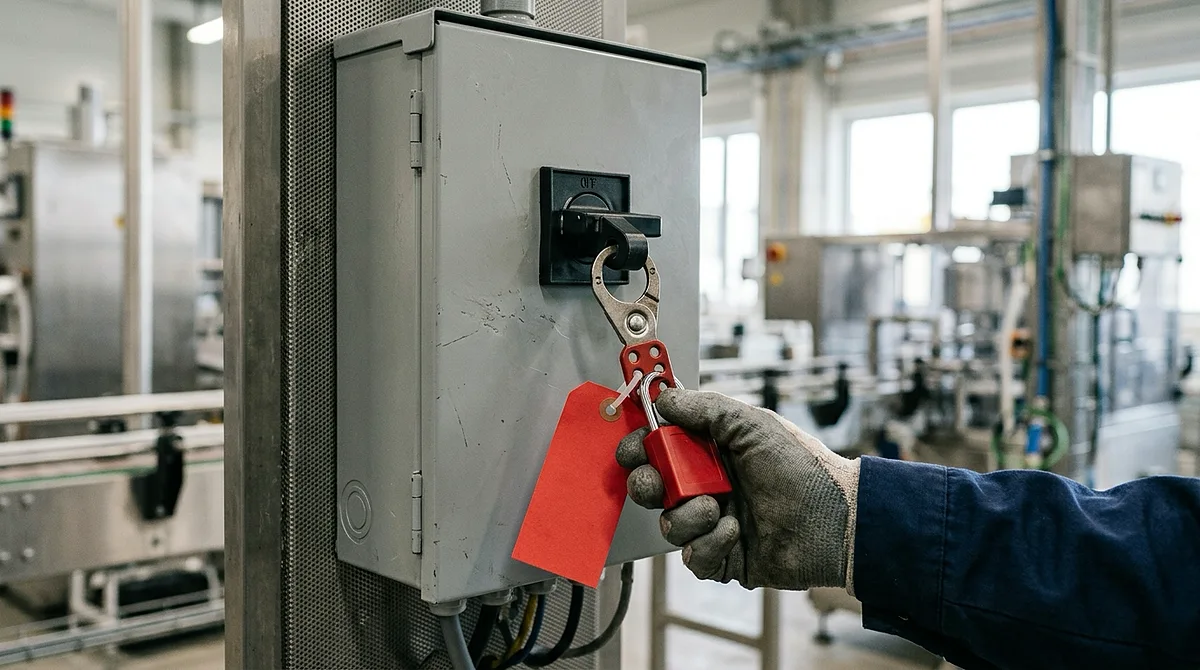
1910.147(c)(5) requires employers to provide lockout and tagout devices that are standardized, durable, substantial, and identifiable. Devices must withstand the environment where they are used (heat, moisture, corrosives) and must not be used for any other purpose; tag attachment means must be non-reusable, self-locking, and attachable by hand.
| Device | Purpose | Key Requirement |
|---|---|---|
| Safety padlocks | Primary lockout device — one per authorized employee | Keyed-different; color-coded by department or craft recommended |
| Lockout hasps | Allow multiple workers to lock out a single isolation point | Must accommodate all authorized employees on the job |
| Circuit breaker lockouts | Clamp over breaker toggle in OFF position | Sized for single-pole, multi-pole, or miniature breakers |
| Valve lockouts | Secure gate, ball, or butterfly valves in closed position | Must prevent valve operation without removing the lock |
| Cable lockouts | Flexible cable for irregular shapes or multiple isolation points | Steel cable, adjustable length, PVC-coated |
| Plug lockouts | Enclose electrical plugs to prevent re-insertion | Available for 110V, 220V, and 480V configurations |
| Lockout tags | Warning labels at each isolation point | Legend warning against operation (e.g., DO NOT OPERATE) and the identity of the employee who applied it |
| Group lockout box | Centralized key box for multi-person jobs | Equipment key locked inside; each worker applies personal lock to box |
Devices and tags support an employer's written energy-control program; no product by itself makes a machine compliant. If you are outfitting or replenishing a program, our collection covers lockout tagout devices (padlocks, hasps, and valve, cable, breaker, and plug lockouts) alongside lockout tagout tags with the DO NOT OPERATE legend, including US-made options.
Tip: Portable LOTO kits — a carry pouch with padlocks, hasps, tags, and common lockout devices — allow maintenance workers to carry everything they need for any machine. Wall-mounted lockout stations provide organized storage at each work area.
Training Requirements
1910.147(c)(7) establishes three tiers of training based on an employee's relationship to the locked-out equipment:
| Employee Type | Role | Training Required |
|---|---|---|
| Authorized | Performs lockout/tagout (maintenance, electricians) | Recognition of hazardous energy sources, type and magnitude of energy, methods for isolation and control, machine-specific procedures |
| Affected | Operates or works near locked-out equipment | Purpose and use of energy control procedures, prohibition against restarting locked-out equipment |
| Other | Works in the area but not directly involved | Prohibition against removing locks/tags or attempting to restart equipment |
Retraining is mandatory when job assignments change, machines or processes change, energy control procedures are updated, or the periodic inspection reveals deviations or knowledge gaps. OSHA does not require annual retraining on a fixed schedule.
Where tagout is used, 1910.147(c)(7)(ii) adds training on tag limitations: tags are warning devices that do not physically restrain, must never be bypassed, ignored, or defeated, must be legible and understandable to all employees in the area, and may be removed only by the person who applied them.
Documentation: Employers must certify that training is accomplished and current. Certification records must include each employee's name and dates of training.
Annual Periodic Inspection
1910.147(c)(6) requires at least one inspection per year of each energy control procedure. This is one of the most commonly cited subsections because employers either skip inspections entirely or fail to document them properly.
The inspection must:
- Be performed by an authorized employee other than the one using the procedure being inspected
- Include a review of responsibilities with each authorized employee for lockout; where tagout is used, the review extends to each affected employee and covers tag limitations
- Correct any deviations or inadequacies observed
Required documentation: Machine/equipment identification, date of inspection, employees included in the inspection, and the name of the person performing the inspection.
Inspection tip: OSHA compliance officers will ask for your inspection records. A common citation scenario: the employer has written LOTO procedures but no documentation showing they were ever inspected. Keep a log with the four required data points for each procedure reviewed.
Group Lockout/Tagout
When multiple employees service the same machine, 1910.147(f)(3) requires group lockout/tagout procedures. The key principle: each employee must have personal control over their own protection.
- A designated primary authorized employee coordinates the group lockout and takes overall responsibility
- Each crew member applies their own personal lock — typically to a group lockout box or multi-hole hasp
- The machine cannot be re-energized until every employee has removed their personal lock
Shift changes (1910.147(f)(4)): When one shift relieves another during ongoing servicing, the employer must have specific procedures that ensure continuity of protection through an orderly transfer. The standard method is for the incoming shift to apply their locks before the outgoing shift removes theirs, so protection never lapses.
For a worked example of group LOTO in a live-infrastructure environment, see our data center lockout tagout procedures guide.
Enforcement and Penalties
LOTO violations are among the most frequently cited and most severely penalized OSHA standards. A single inspection can yield multiple citations — one per machine without a procedure, one for missing training records, and so on.
| Violation Type | Maximum Per Violation | Common Scenario |
|---|---|---|
| Serious | $16,550 | No written procedure, no training, no verification step |
| Other-than-serious | $16,550 | Missing inspection records, non-standardized devices |
| Willful | $165,514 | Known hazard with no corrective action |
| Repeat | $165,514 | Same violation within 5 years of prior citation |
| Failure to abate | $16,550 per day | Violation continues past abatement deadline |
The 2026 federal maximums remain at the 2025 levels shown (OSHA made no 2026 inflation adjustment). Actual penalties depend on employer size, good faith, violation history, and gravity of the hazard. An employer with 10 machines and no written procedures could face over $165,000 in serious violations alone.
Most Cited Subsections
- (c)(4)(i) — Written procedures: No machine-specific energy control procedures, or using a single generic procedure for all equipment
- (c)(7)(i) — Training: Missing training records, no initial training, or no retraining after procedure changes
- (c)(6)(i) — Periodic inspection: Inspections not done, not documented, or performed by the same person who uses the procedure
- (d)(6) — Verification of isolation: Workers skip the "try" step to confirm zero energy state after applying lockout devices
- (c)(1) — Energy control program: No formal program exists or key components are missing
Frequently Asked Questions
What is OSHA 1910.147?
OSHA 29 CFR 1910.147 is the federal standard governing the control of hazardous energy in general industry. It requires employers to establish a documented energy control program, train workers, and use lockout devices (or tagout when lockout is impractical) before performing servicing or maintenance where unexpected energization, startup, or release of stored energy could cause injury. The standard applies to nearly every general industry workplace and is consistently among the most-cited OSHA standards.
Does OSHA require lockout tagout?
Yes. 29 CFR 1910.147(c)(1) requires employers to establish a program for the control of hazardous energy. If an energy-isolating device is capable of being locked out, lockout must be used unless the employer demonstrates that tagout provides full employee protection under 1910.147(c)(3), including an additional safety measure. If the device cannot be locked out, the program uses tagout with those additional protections.
What is the difference between lockout and tagout?
Lockout uses a physical lock to hold an energy-isolating device in the safe position. The machine cannot be re-energized without removing the lock. Tagout uses a warning tag attached to the isolation device but does not physically prevent operation. OSHA requires lockout on lockable devices unless the employer demonstrates tagout provides full employee protection under 1910.147(c)(3) with an additional safety measure; on devices that cannot be locked out, tagout with those additional protections is used.
What are the 6 steps of LOTO?
29 CFR 1910.147(d) lays out a sequence: (1) preparation for shutdown; (2) machine or equipment shutdown; (3) machine or equipment isolation; (4) lockout/tagout device application; (5) stored energy release or restraint; (6) verification of isolation (zero-energy check). Every authorized employee must follow this sequence before beginning service or maintenance.
Does every machine need its own LOTO procedure?
Yes, with one narrow exception. Machine-specific procedures are required under 1910.147(c)(4). A single generic procedure may be used only when machines share the same type and magnitude of energy, the same isolation devices, and a single lockout device will achieve a locked-out condition. In practice, most machines differ enough to require individual procedures.
Who can remove a lockout device?
Only the employee who applied the lock should remove it (1910.147(e)(3)). In rare cases where that employee is unavailable, the employer may remove the lock under a documented procedure: verify the employee is not at the facility, make all reasonable efforts to contact them, and ensure they are informed before their next work shift. The procedure must be documented in the energy control program.
How often is LOTO training required?
OSHA does not mandate a fixed retraining interval. 1910.147(c)(7)(iii) requires retraining whenever job assignments change, machines or procedures change, or the annual inspection reveals deviations or knowledge gaps. Because the annual inspection often uncovers issues, many employers adopt annual refresher training as a best practice.
Do contractors need to follow the host employer's LOTO procedures?
Both the host employer and the contractor have obligations under 1910.147(f)(2). The host must inform the contractor about its energy control procedures and ensure the contractor's workers understand the lockout requirements. The contractor must ensure their employees follow LOTO procedures and inform the host of their own lockout practices. Both parties must coordinate to prevent incidents.
Is OSHA 1910.147 the same as ANSI Z244.1?
No. 1910.147 is a federal regulation. ANSI/ASSP Z244.1 (most recently revised in 2024) is a voluntary consensus standard that is more risk-based and permits alternative methods to lockout when a documented risk assessment shows lower-risk control is adequate. OSHA does not recognize Z244.1 alternative methods as a compliance path. The October 21, 2024 OSHA Letter of Interpretation explicitly answered No to whether Z244.1-2016 (R2020) alternative methods satisfy 1910.147.
When was 1910.147 last updated?
1910.147 was first adopted in 1989 (54 FR 36644, September 1, 1989). The regulatory text has not been substantively amended since. OSHA has issued several Letters of Interpretation that clarify how the standard applies in specific scenarios, including the October 21, 2024 LOI on alternative methods. Always check the current eCFR text for the latest language.
What is the OSHA penalty for lockout tagout violations?
For 2026, the maximum civil penalty is $165,514 per willful or repeat violation, and $16,550 per serious or other-than-serious violation (unchanged from 2025; OSHA made no 2026 inflation adjustment). 1910.147 has been in OSHA's Top 10 most-cited standards for years (ranked #4 in FY2025), and willful or repeat 1910.147 citations frequently trigger the maximum penalty.
Resources
OSHA references
- 29 CFR 1910.147 Full Regulation Text
- OSHA Control of Hazardous Energy Overview
- OSHA Lockout/Tagout eTool (Interactive)
- OSHA Lockout/Tagout Fact Sheet (PDF)
Related standards on this site
OSHA 1910.151 First Aid
Medical services and first aid requirements — energy release incidents are a key reason to have trained responders on-site
OSHA 1910.1030 Bloodborne Pathogens
Exposure control, PPE, and cleanup requirements relevant to maintenance injuries
ANSI/ISEA Z308.1 First Aid Kits
Kit classifications and minimum contents for maintenance work areas
OSHA 1926.1153 Silica in Construction
Respirable silica controls — relevant where LOTO intersects with construction maintenance
Lockout Tagout Devices & Tags

Manufacturer: ZING Green Safety Products
Forklift Propane Tank Lockout
$17.00

Manufacturer: ZING Green Safety Products
Group Lockout Box Stainless Steel Red
$136.00

Manufacturer: ZING Green Safety Products
Group Lockout Box Stainless Steel Yellow
$136.00

Manufacturer: ZING Green Safety Products
ZING Eco Lockout Tagout Poster What You Should Know
$28.00

Manufacturer: ZING Green Safety Products
ZING Eco Safety Tag AED Inspection 10 Pack
$32.00

Manufacturer: ZING Green Safety Products
ZING Eco Safety Tag Blank Yellow 10 Pack
$32.00

Manufacturer: ZING Green Safety Products
ZING Eco Safety Tag Caution 10 Pack
$32.00

Manufacturer: ZING Green Safety Products
ZING Eco Safety Tag Danger 10 Pack
$32.00
Was this page helpful?
Your feedback helps us improve our technical resources.
Recommended in this guide


