
FAA Item P-605
Joint Sealants for Pavements, from AC 150/5370-10H Standard Specifications for Construction of Airports
Last updated: June 10, 2026
Overview
Item P-605, Joint Sealants for Pavements, is the FAA standard specification for providing and installing resilient, adhesive joint sealing material in airport pavement: joints in pavement, joints between different pavement types, and cracks in existing pavement. It is published in Advisory Circular 150/5370-10H and is mandatory on projects funded through the Airport Improvement Program (AIP).
P-605 is a short specification with long reach. It does not define sealant chemistry itself; instead it points to three ASTM material standards and adds the airport-specific rules around them: delivery and certification, backer rod and bond breakers, joint preparation, equipment, installation conditions, and inspection. Preparation of joints and cracks in existing pavement on reseal projects is handled by the companion Item P-101.
Note on placement: P-605 is an FAA specification item, not an ASTM or UL standard. It lives in this section as a pragmatic grouping with the pavement sealant standards specifiers read alongside it: ASTM D5893 and ASTM D6690. For a cost, equipment, and lifecycle comparison across the material families, see the Highway & Pavement Joint Sealant Guide.
When P-605 Applies
AC 150/5370-10H, Standard Specifications for Construction of Airports, is the FAA's master construction spec book, and P-605 is its joint sealant item. The AC states its own applicability plainly: it "is mandatory for all projects funded under Federal grant assistance programs, including the Airport Improvement Program (AIP)" under Grant Assurance No. 34, and it is likewise mandatory for projects funded with Passenger Facility Charge revenue under PFC Assurance 9.
Outside grant-funded work the AC is recommended practice rather than regulation. The FAA recommends it for construction of pavements serving aircraft over 30,000 pounds, and it contains methods acceptable to the Administrator for 14 CFR Part 139 compliance. The current published revision is 10H, dated December 21, 2018; the full text is on the FAA's Airport Construction Standards page.
The AC is a template, not a finished spec. Its standard specifications must be edited into project specifications, and P-605's material paragraph is a bracketed blank the engineer fills in. The controlling document on any project is the project specification, not the AC itself.
Accepted Materials
Paragraph 605-2.1 leaves the sealant material as an engineer's choice. The accompanying note says the engineer may specify one or more of three ASTM standards:
| Specification | Material | Substrate | Where it fits |
|---|---|---|---|
| ASTM D5893 | Cold-applied, single-component silicone (Type NS or Type SL) | PCC | General airfield joints; also permitted on fueling aprons |
| ASTM D6690 | Hot-applied joint and crack sealant (Types I to IV by climate) | PCC and asphalt | General joints and cracks outside fuel-spillage areas |
| ASTM D7116 | Hot-applied, jet-fuel-resistant sealant | PCC only | PCC aprons where fueling occurs, only |
P-605 does not pin a D6690 type. Climate drives that selection, and the logic is the same one used on highway work; see the ASTM D6690 page for the type-by-climate breakdown and the ASTM D5893 page for the NS versus SL placement decision. Whatever the engineer selects, each lot or batch must arrive in the manufacturer's original sealed container with the manufacturer's certification of conformance (more on that under Installation and QC below).
Fuel-Resistant Areas: D7116 and Silicone
Fuel resistance is where P-605 draws its brightest line. ASTM D6690, the general-purpose hot-applied standard, excludes areas subject to fuel spillage from its scope. A D6690 sealant of any type is the wrong material where jet fuel, gasoline, or diesel reaches the pavement.
For those areas P-605 turns to ASTM D7116, Standard Specification for Joint Sealants, Hot Applied, Jet Fuel Resistant Types, for Portland Cement Concrete Pavements. D7116 covers hot-applied sealants for PCC in fuel-spillage areas and adds fuel-immersed bond testing to the qualification battery. P-605's engineer note limits D7116 to PCC aprons where fueling occurs.
The same note gives the engineer a second option in those areas: PCC aprons where fueling occurs may use either ASTM D7116 or ASTM D5893 cold-applied silicone. That makes D5893 the one P-605 material usable on both general airfield joints and fueling aprons.
Legacy spec trap: some older contract documents call for a jet-fuel-resistant "D6690 Type IV." That callout is internally inconsistent; D6690 has no fuel-resistant type, and Type IV is its very-cold-climate class. Raise it with the engineer and confirm whether D7116 or D5893 is intended.
Backer Rod and Bond Breakers
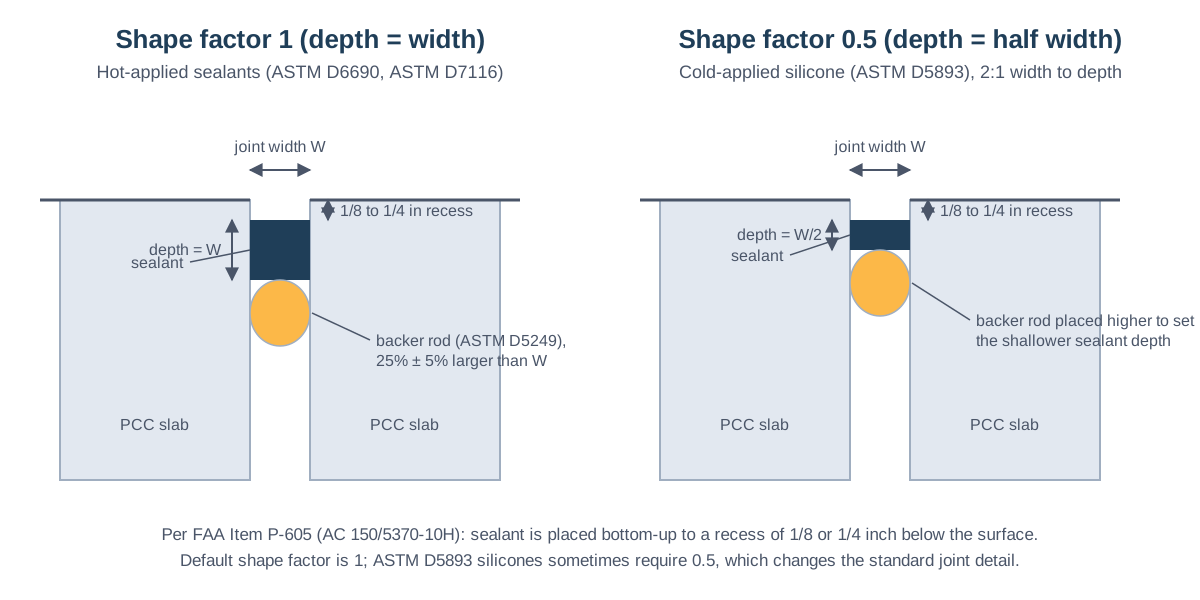
P-605 specifies the support materials as firmly as the sealant. Backer rod must meet ASTM D5249: compressible, non-shrinking, non-staining, non-absorbing, and non-reactive with the sealant, sized 25 percent (plus or minus 5 percent) larger in diameter than the nominal joint width so it seats by friction (paragraph 605-2.2).
Where inserts or filler materials contain bitumen, or the joint opening is too shallow for backer rod, a bond-breaking tape goes in instead: flexible, non-shrinkable, non-absorbing, non-staining, and non-reacting, roughly 1/8 inch wider than the nominal joint width, with a melting point at least 5°F above the sealant pouring temperature (paragraph 605-2.3). The tape must not bond to the sealant; its job is to prevent three-sided adhesion.
The AC's engineer notes set the default shape factor (sealant depth divided by joint width) at 1, with the backup material placed to a depth about equal to the joint width. D5893 silicones sometimes require a shape factor of 0.5 instead, the familiar 2:1 width-to-depth geometry, and the standard joint detail must be modified on the contract drawings when they do.
Joint Preparation and Equipment
Machines, tools, and equipment must be approved before the work starts and kept in satisfactory condition (paragraph 605-3.2). The spec is unusually concrete about what the rigs must be:
- Hot-applied sealant (D6690, D7116): a mobile, double-boiler, agitator-type kettle with an oil heat-transfer medium, a direct-connected pressure-type extruding device with a joint nozzle, positive temperature controls for both the oil and the sealant, and a recording thermometer; the unit must recirculate sealant through the delivery hose when not dispensing
- Cold-applied sealant (D5893): an extrusion pump with air compressor, following plate, hoses, and a nozzle that reaches into the joint so sealing proceeds from the bottom up; hand-held air-powered caulking guns are allowed for small applications
- Old-sealant removal: routing tools shaped and mounted so they cannot damage the joint walls; V-shaped tools and rotary impact routing devices are not permitted
- Sawing: a self-propelled power saw with water-cooled diamond or abrasive blades, cutting joints to the specified depth and width
Joint preparation (paragraph 605-3.3) requires joints that are dry and clean of all scale, dirt, dust, curing compound, and other foreign matter. Saw slurry is flushed out with a water jet immediately after sawing. Final cleaning is sandblasting in a minimum of two passes, one pass per joint face with the nozzle angled toward the face and held within 3 inches of it, plus cleaning of the pavement surface at least 1/2 inch beyond each joint edge, followed by a compressed-air blowout. The contractor demonstrates the cleaning method to the Resident Project Representative (RPR) and must show that it cleans the joint without damaging it.
Sandblasting is not always allowed. The AC notes that local air-quality rules, or sand drifting into areas where it would be objectionable, can prohibit it. Waterblasting is the usual substitute, and wire brushes are acceptable only for small areas because they do not clean as well.
Installation and QC
Joints are sealed as soon after completion of the curing period as feasible, and before the pavement opens to any traffic, including construction equipment (paragraph 605-3.1). Pavement temperature must be 50°F (10°C) and rising at the time of application, and sealant cannot be applied if moisture is observed in the joint.
Final compressed-air cleaning runs no more than 50 feet ahead of the sealing operation. Joints are filled from the bottom up to a recess of 1/8 or 1/4 inch (the project spec picks one), within 1/16 inch, below the pavement surface, or to the bottom of the groove on grooved pavement. Gravity methods and pouring pots are prohibited. When the manufacturer recommends a primer, it is applied evenly to the joint faces per the manufacturer's instructions, and the crew checks that newly placed sealant cures to a tack-free condition within the specified time (paragraph 605-3.4).
The submittal and QC chain is simple and strict. Every lot or batch of sealant arrives in the manufacturer's original sealed container, marked with the manufacturer's name, the batch or lot number, and the safe heating temperature, and accompanied by the manufacturer's certification that the sealant meets the specification (paragraph 605-2.1). After placement, the contractor inspects the sealant for rate of cure and set, bonding to the joint walls, cohesive separation, reversion to liquid, entrapped air, and voids. Sealant showing any of those deficiencies at any time before final acceptance is removed from the joint and replaced at no additional cost to the airport (paragraph 605-3.5).
Measurement and payment run by the gallon, the pound, or the linear foot of sealant in place, completed, and accepted, as the project specification selects.
Common Spec Language
Two sample paragraphs in the P-605 pattern. The brackets in the real AC are engineer choices; treat these as templates and let the project specification govern.
General airfield joints:
"Joint sealant shall conform to [ASTM D6690, Type __] [ASTM D5893, Type NS or Type SL] in accordance with FAA Item P-605, paragraph 605-2.1. Each lot or batch shall be delivered in the manufacturer's original sealed container, marked with the manufacturer's name, batch or lot number, and safe heating temperature, and accompanied by the manufacturer's certification of conformance."
Fueling aprons:
"Joint sealant for PCC apron pavement where fueling occurs shall conform to ASTM D7116 or ASTM D5893 per FAA Item P-605. Backer rod shall conform to ASTM D5249, sized 25 percent (plus or minus 5 percent) larger than the nominal joint width."
P-605 and Buy American
The funding instrument that makes P-605 mandatory also brings procurement rules with it. Under 49 USC 50101, steel and manufactured goods used on AIP-funded projects must be produced in the United States. The FAA can waive the preference in narrow cases: when applying it would be inconsistent with the public interest, when US goods are not available in sufficient quantity or satisfactory quality, when the cost of US components exceeds 60 percent of all components and final assembly happens in the United States, or when domestic content would raise the total project cost by more than 25 percent. The FAA publishes its Buy American Preference Requirements and waiver listings.
For a sealant supplier, that means an AIP submittal package usually pairs the P-605 material certification with Buy American documentation; absent a waiver, plan on domestic manufacture. Our Buy America Compliance Guide walks the documentation, and the comparison page on which domestic-preference law applies sorts out the regimes when a project mixes funding sources.
Sourcing P-605 joint sealant for an airfield or DOT project?
Tell us the spec (D6690 type, D5893 NS or SL, or D7116), the linear footage, and the project funding source. We will come back with US-manufactured options, current lead times, and Buy American documentation. Typical turnaround: one business day.
or call 714-248-6555 · email partners@usmadesupply.com
Frequently Asked Questions
What is FAA Item P-605?
Item P-605, Joint Sealants for Pavements, is the FAA's standard specification for furnishing and installing joint sealing material in airport pavement: joints in pavement, joints between different pavement types, and cracks in existing pavement. It is published in Advisory Circular 150/5370-10H, Standard Specifications for Construction of Airports, and it covers materials, backer rod and bond breakers, equipment, joint preparation, installation conditions, and inspection.
Which sealant materials does Item P-605 accept?
Three, at the engineer's choice: ASTM D5893 cold-applied single-component silicone for PCC, ASTM D6690 hot-applied sealant for concrete and asphalt, and ASTM D7116 hot-applied jet-fuel-resistant sealant for PCC. The material paragraph in the AC is a bracketed blank, so the project specification names which of the three applies (one or more), along with the D6690 type or the D5893 NS or SL designation.
When is jet-fuel-resistant sealant required on an airport?
P-605's engineer note limits ASTM D7116 to PCC aprons where fueling occurs, and the same note allows ASTM D5893 silicone as the alternative in those areas. Outside fueling areas, joints use D6690 or D5893. D6690 itself has no fuel-resistant type; its scope excludes areas subject to fuel spillage entirely.
Does P-605 apply to projects without AIP funding?
Use of AC 150/5370-10H is mandatory for projects funded under federal grant assistance programs, including AIP, and for projects funded with Passenger Facility Charge revenue. Outside those funding sources the AC is recommended practice rather than regulation, recommended in particular for pavements serving aircraft over 30,000 pounds. Many airports apply it to all airfield work anyway so a single spec governs.
What is the current version of AC 150/5370-10?
AC 150/5370-10H, dated December 21, 2018, is the current published revision; it cancelled AC 150/5370-10G. A draft 10J revision was released for industry comment in April 2025 and has not been finalized. Check the FAA's Airport Construction Standards page for the current document before quoting section numbers in a project specification.
Was this page helpful?
Your feedback helps us improve our technical resources.