
DOT Fire Extinguisher Requirements for Commercial Vehicles
A roadside equipment inspection can include the fire extinguisher, and 49 CFR §393.95 writes the requirement as a UL rating rather than a pound weight. Here is what we would put in each vehicle type, what it costs, and how it mounts.
Last updated: October 7, 2026
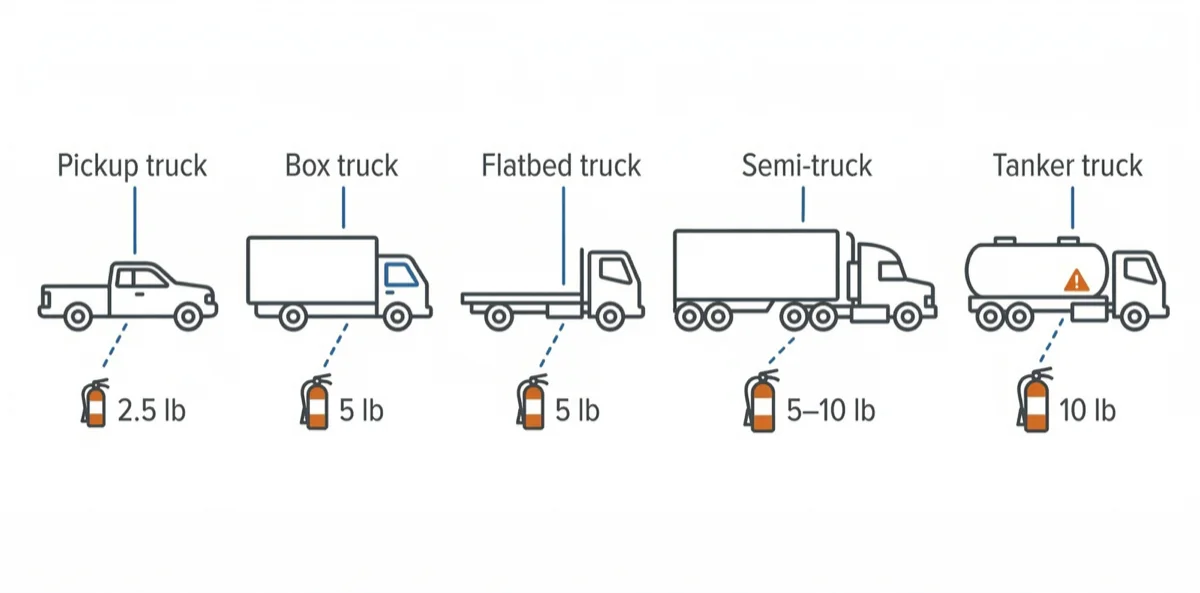
Recommended extinguisher size by vehicle type. Every unit shown carries a B:C rating above the 5 B:C single-extinguisher minimum in §393.95.
DOT-Compliant Bestsellers
UL-listed ABC extinguishers that meet 49 CFR §393.95. In stock, typically ships in 3–5 business days.
Overview
The requirement itself comes from 49 CFR §393.95, and that reference page carries the regulation text, the rating minimums, labeling and charge-indicator conditions, mounting, and the driveaway-towaway exception. This page is about which unit to put in the truck.
It matches a specific extinguisher to each commercial vehicle type, from semi-trucks and box trucks through tankers, buses, and pickups, so you can order the right size with the right bracket in one step. ABC-rated dry chemical is a common choice because one unit covers Class A (ordinary combustibles), B (flammable liquids), and C (electrical) fires; browse the full fire extinguisher collection if you need a size or agent this page does not cover, or the fire extinguisher cabinets for depot and yard mounting. For the wider compliance picture, covering USDOT registration, vehicle marking, inspections, and documentation, see our DOT fleet compliance guide.
All extinguishers on this page are UL-listed, ABC-rated dry chemical units that meet or exceed DOT 49 CFR §393.95 requirements. They are made in the USA.
Who this page is for
Fleet managers
Truck upfitters
Box truck / delivery operators
Tow and recovery companies
Bus operators
Service vehicle fleets
Common reasons to order
Adding new vehicles
Replacing missing or damaged extinguishers
Standardizing one size across fleet
Preparing vehicles for DOT inspection
Outfitting new service trucks
Quick Reference
Minimum ratings under 49 CFR §393.95. The rule covers trucks, truck tractors and buses that are commercial motor vehicles in interstate commerce. A vehicle counts if it is rated at or weighs 10,001 lb or more, alone or with its trailer. It also counts if it hauls hazmat in a quantity that requires placards, or if it is designed or used to carry more than 8 passengers for pay or more than 15 without pay (counting the driver). The extinguisher rule does not apply to the vehicles in a driveaway-towaway operation, towed or driving, and pipeline welding trucks are excluded.
| Vehicle Type | Federal Minimum | Recommended Unit |
|---|---|---|
| Semi-truck / Tractor-trailer | 5 B:C, or two 4 B:C | 5 lb ABC w/ vehicle bracket |
| Box truck / Delivery truck | 5 B:C, or two 4 B:C | 5 lb ABC w/ vehicle bracket |
| Flatbed / Stake truck | 5 B:C, or two 4 B:C | 5 lb ABC w/ vehicle bracket |
| Hazmat in a quantity that requires placards | 10 B:C, one unit (no two-unit option) | 10 lb ABC w/ heavy-duty vehicle bracket. A 5 lb 3-A:40-B:C also meets 10 B:C. |
| Bus (charter, private motorcoach) | 5 B:C, or two 4 B:C | 5 lb ABC w/ vehicle bracket |
| Pickup / Service vehicle (when it is a CMV, e.g. 10,001 lb+ with a trailer) | 5 B:C, or two 4 B:C | 2.5 lb ABC w/ vehicle bracket * |
* The 2.5 lb ABC is UL-rated 1-A:10-B:C. Its B:C component (10-B:C) exceeds the 5 B:C federal minimum.
Compliance Comparison
Side-by-side comparison of representative models — one per size, preferring vehicle-bracket variants. Every model meets or exceeds the 5 B:C federal minimum.
| Size | UL Rating | Meets 5 B:C min? | Best For | Price | |
|---|---|---|---|---|---|
 | 2.5 lb | 1-A:10-B:C | Yes | Pickup trucks, Service vehicles | $44.00 4+ for $39 each |
 | 5 lb | 3-A:40-B:C | Yes | Semi-trucks, Box trucks, Flatbed, Buses | $54.00 4+ for $49 each |
 | 10 lb | 4-A:80-B:C | Yes | Tankers, Buses, Large fleets | $90.00 |
 | 20 lb | 10-A:120-B:C | Yes | Fuel haulers | $155.00 |
Every model on this page meets or exceeds the 5 B:C federal minimum for standard commercial vehicles. For hazmat hauled in placarded quantities (10 B:C minimum), see the Tanker Trucks & Hazmat section above.
Semi-Trucks & Tractor-Trailers
Semi-trucks and tractor-trailers need a minimum 5 B:C-rated extinguisher, securely mounted and readily accessible; most carriers put it in the cab within the driver's reach. A 5 lb ABC unit (3-A:40-B:C) is the standard choice — it exceeds the minimum by 8x and handles tire, brake, and electrical fires. For carriers with higher internal safety standards or long-haul routes through remote areas, a 10 lb unit provides more agent for larger fires.
Buckeye ABC Dry Chemical Fire Extinguisher w/ Vehicle Bracket – 5 lb.
5 lb · 3-A:40-B:C
Vehicle Bracket · 10 lbs
$54.00
4+ for $49 each
Buckeye ABC Dry Chemical Fire Extinguisher w/ Wall Hook – 10 lb.
10 lb · 4-A:80-B:C
Wall Hook · 18.25 lbs
$90.00
The 10 lb unit ships with a wall hook. §393.95 requires the extinguisher to be securely mounted to prevent sliding, rolling or vertical movement, so for vehicle use we recommend Buckeye's heavy-duty vehicle bracket for the 10 lb.
Fleet best practice: mount with a vehicle bracket (not a wall hook) to withstand road vibration. Check the pressure gauge during every pre-trip inspection.
Box Trucks & Delivery Vehicles
Box trucks and delivery vans follow the same 5 B:C minimum as other standard CMVs. The 5 lb ABC with vehicle bracket is the most common choice — compact enough for cab-side mounting, powerful enough for engine compartment and cargo fires. Common in HVAC, plumbing, flooring, and fire protection trades. Last-mile delivery fleets often standardize on this size for simplicity.
Buckeye ABC Dry Chemical Fire Extinguisher w/ Vehicle Bracket – 5 lb.
5 lb · 3-A:40-B:C
Vehicle Bracket · 10 lbs
$54.00
4+ for $49 each
§393.95 asks for a readily accessible, securely mounted extinguisher and doesn't name a spot. We recommend one the driver can reach from the seat; if the cab layout doesn't allow it, a bracket behind the driver's seat or on the bulkhead wall works.
Flatbed & Stake Trucks
Flatbed and stake trucks need the same 5 B:C minimum as enclosed vehicles. The open cargo area means any fire is exposed to wind, which can spread flames quickly — having the right extinguisher matters. A 5 lb ABC unit in the cab covers the regulation and provides enough agent for most roadside fires. Roofing, fencing, steel fabrication, and hotshot trucking operations commonly run flatbeds.
Buckeye ABC Dry Chemical Fire Extinguisher w/ Vehicle Bracket – 5 lb.
5 lb · 3-A:40-B:C
Vehicle Bracket · 10 lbs
$54.00
4+ for $49 each
For flatbeds carrying lumber, steel, fence panels, or roofing materials, the Class A rating on an ABC extinguisher is especially valuable — B:C-only units won't suppress wood or paper fires in your cargo.
Tanker Trucks & Hazmat Transport
The highest §393.95 requirement applies to hazmat hauled in a quantity that requires placarding: an extinguisher rated 10 B:C or more. A tanker that isn't in placarded hazmat service follows the standard 5 B:C minimum. A 10 lb ABC extinguisher (4-A:80-B:C) is the standard choice — it exceeds the minimum by 8x and handles the Class A fires (tires, cab materials) that a B:C-only unit would miss. For bulk fuel haulers or high-risk cargo, a 20 lb unit provides maximum suppression capacity.
Buckeye ABC Dry Chemical Fire Extinguisher w/ Wall Hook – 10 lb.
10 lb · 4-A:80-B:C
Wall Hook · 18.25 lbs
$90.00
Buckeye ABC Dry Chemical Fire Extinguisher w/ Wall Hook – 20 lb.
20 lb · 10-A:120-B:C
Wall Hook · 33.5 lbs
$155.00
The 10 lb and 20 lb units ship with wall hooks. §393.95 requires the extinguisher to be securely mounted to prevent sliding, rolling or vertical movement, so for vehicle use we recommend Buckeye's heavy-duty vehicle brackets for the 10 lb and the 20 lb.
The 10 B:C extinguisher is one piece of the hazmat equipment list. Driving and parking restrictions, the §397.5 attended-vehicle rule, written route plans for explosives, and a spill kit sized to the cargo class all come from 49 CFR Part 397. See the Hazmat Spill Kit Selection Guide for sorbent chemistry by hazard class.
Buses
Charter coaches and privately operated buses in interstate commerce need a minimum 5 B:C-rated extinguisher. Most operators use a 5 lb ABC unit mounted near the driver. School bus operations and government-run transit are outside these federal rules (49 CFR §390.3(f)), so their extinguisher requirements come from state law. Larger coaches carrying 30+ passengers may benefit from a 10 lb unit for the additional suppression capacity.
Buckeye ABC Dry Chemical Fire Extinguisher w/ Vehicle Bracket – 5 lb.
5 lb · 3-A:40-B:C
Vehicle Bracket · 10 lbs
$54.00
4+ for $49 each
Buckeye ABC Dry Chemical Fire Extinguisher w/ Wall Hook – 10 lb.
10 lb · 4-A:80-B:C
Wall Hook · 18.25 lbs
$90.00
The 10 lb unit ships with a wall hook. §393.95 requires the extinguisher to be securely mounted to prevent sliding, rolling or vertical movement, so for vehicle use we recommend Buckeye's heavy-duty vehicle bracket for the 10 lb.
School bus operators: check your state's specific requirements. Some states mandate a larger extinguisher or an additional unit near the rear emergency exit.
Pickup Trucks & Service Vehicles
Pickup trucks and service vehicles used in interstate commerce are CMVs under DOT if they have a GVWR or GCWR of 10,001 lbs or more (or haul hazmat in a quantity that requires placarding). This is the most common vehicle class for trade contractors — fencing crews, landscapers, electricians, painters, and general contractors often run 3/4-ton or 1-ton pickups with material trailers that push well past the threshold. The 2.5 lb ABC vehicle-bracket extinguisher (UL 1-A:10-B:C) clears the federal 5 B:C minimum and fits behind the seat without sacrificing cab space. But for any pickup that carries fueled equipment, fuel containers, two-stroke mix, propane, or ordinary combustibles like lumber, mulch, or tarps, the 5 lb 3-A:40-B:C is the more defensible fleet default — see Fleet Outfitting below for the full reasoning.
Buckeye ABC Dry Chemical Fire Extinguisher w/ Vehicle Bracket – 2.5 lb.
2.5 lb · 1-A:10-B:C
Vehicle Bracket · 5.5 lbs
$44.00
4+ for $39 each
Buckeye ABC Dry Chemical Fire Extinguisher w/ Vehicle Bracket – 5 lb.
5 lb · 3-A:40-B:C
Vehicle Bracket · 10 lbs
$54.00
4+ for $49 each
Not sure if your pickup qualifies as a CMV? If the GVWR on the door sticker is 10,001 lbs or more, you need the extinguisher. Many 1-ton pickups are rated at or above that. Add a trailer and the combined rating or weight often crosses the line.
California fleet considerations
If your California fleet is mostly half-ton or three-quarter-ton pickups, federal DOT rules (49 CFR §393.95) only apply when a truck's weight rating — GVWR or GCWR, whichever is higher — is 10,001 lbs or more, or when the truck is hauling hazmat in placardable quantities, or carrying certain passenger counts. Most light-duty service pickups fall under that. California's own motor-carrier rule (13 CCR §1242) covers the vehicle classes listed in Vehicle Code §34500 — mainly commercial trucks of three or more axles over 10,000 lbs, buses, hazmat carriers, and any motortruck separately regulated by USDOT. Typical work pickups aren't in that list. The Cal/OSHA rule that's most likely to apply is 8 CCR §3702, which covers trucks and buses primarily used to take crews to and from jobsites on a regular schedule. For those vehicles, the rule asks for a UL-listed dry-chemical extinguisher of at least 4 lbs, or another type of extinguisher with at least a 4-B:C rating. A 2.5 lb dry-chem doesn't meet the 4-lb part; a 5 lb does.
A separate Cal/OSHA rule (8 CCR §6151) governs portable extinguishers in California workplaces — selection, mounting, maintenance, inspection, and crew training. It doesn't specify what size extinguisher to put in a truck, but once you provide one to your crew, the unit is treated as workplace equipment and has to be inspected and maintained accordingly. For trucks carrying fuel cans, two-stroke mix, or fueled equipment, NFPA 10 (the national portable-extinguisher standard) treats that as ordinary hazard — at least a 2-A rating for Class A combustibles, and at least 10-B at 30 ft (or 20-B at 50 ft) for Class B.
A 2.5 lb ABC 1-A:10-B:C clears the federal DOT minimum. For a California landscape, electrical, or service crew, a 5 lb 3-A:40-B:C is the more practical fleet standard — it satisfies §3702 if that rule applies to your trucks, it exceeds the NFPA 10 ordinary-hazard minimums for both Class A and Class B, and it gives crews more discharge time on the real fires you're likely to face on a work truck: dry grass under a hot mower deck, a fuel-can spill, a mower fuel-tank fire. At fleet quantity, the cost difference per truck is small.
Operating intrastate-only in California? Inspection cadence depends on the truck's weight. See our California BIT Inspection guide for the 26,001-lb threshold and how AB 3278 changed it.
Outfitting 10+ vehicles?
Volume pricing on UL-listed ABC extinguishers, vehicle brackets, and DOT-compliant fleet kits. Ships to one yard or multiple. Quote back within one business day.
or call 714-248-6555 · email partners@usmadesupply.com
Other DOT Emergency Equipment
Fire extinguishers are just one part of 49 CFR §393.95. The regulation also requires three reflective warning triangles (or at least six fusees) on every CMV. Fusees cannot be carried on vehicles covered by §393.95(g) — explosives loads, cargo tank vehicles hauling Class 3 or Division 2.1 whether loaded or empty, and compressed-gas-fueled vehicles. Our DOT fleet fire safety kits bundle the UL-listed extinguisher, FMVSS 125 warning triangles, and an ANSI Z308.1 first aid kit for each vehicle class.
A first aid kit is not a §393.95 item at all. Many carriers mandate them, and OSHA 1910.151(b) requires adequate first aid supplies where no infirmary, clinic, or hospital is in near proximity to the workplace — a condition most fleet operations meet. Consider adding an ANSI Z308.1 Class A kit to your order.
Full DOT Compliance Checklist
Beyond fire extinguishers, DOT compliance includes vehicle markings, DOT number display, annual inspections, driver documentation, and more. Our Fleet & DOT Compliance Guide covers every requirement by vehicle type — pickups with trailers, box trucks, flatbeds, dump trucks, and service vans — with trade-specific examples for fencing, landscaping, roofing, HVAC, and other contractors.
Outfitting 10+ vehicles?
Volume pricing on UL-listed ABC extinguishers, vehicle brackets, and DOT-compliant fleet kits. Ships to one yard or multiple. Quote back within one business day.
or call 714-248-6555 · email partners@usmadesupply.com
Fleet Outfitting
Most service fleets should standardize on the 5 lb ABC vehicle-bracket extinguisher (3-A:40-B:C) across mixed-weight vehicles. The DOT 5 B:C floor under 49 CFR §393.95 only governs commercial motor vehicles, which generally means a GVWR or GCWR of 10,001 lbs or more, or hazmat hauled in placarded quantities. A half-ton or three-quarter-ton service pickup typically isn't a CMV on its own, though a trailer can change that. That doesn't mean any extinguisher will do.
Once an employer provides an extinguisher for crew use, OSHA 29 CFR 1910.157 generally covers its inspection, maintenance, and crew training. The standard's selection paragraph, (d)(1), asks that extinguishers match the classes of anticipated fire and the size of the hazard. It formally excludes units kept outside workplace buildings, but it is still the right test. A truck carrying gas cans, two-stroke mix, propane, fueled equipment, and ordinary combustibles like lumber, mulch, or tarps has real Class A + Class B exposure. The 2.5 lb 1-A:10-B:C technically clears the DOT floor; it's a thin choice for that hazard mix.
Two practical wrinkles make the 5 lb the simpler standardization:
- Combined GVWR. A pickup plus a loaded trailer is often rated or loaded at 10,001 lbs or more combined — making the vehicle a CMV during that trip and triggering DOT §393.95 directly. One SKU across the fleet avoids the "this truck today is a CMV, that one isn't" mess.
- State-plan OSHAs. 22 states run their own OSHA-approved plans with rules sometimes stricter than federal. California, for example, has a crew-transport rule (8 CCR §3702) that asks for a UL-listed dry-chemical extinguisher of at least 4 lbs when it applies — the 2.5 lb doesn't meet the 4-lb weight floor. See California fleet considerations above for the full state-rule overlay.
- Hazard match. NFPA 10 classifies workspaces with fueled equipment and ordinary combustibles as ordinary hazard, with a 2-A minimum for Class A protection. A 5 lb 3-A:40-B:C meets that minimum; a 2.5 lb 1-A doesn't. NFPA 10's fixed-facility tables don't bind a vehicle directly, but the underlying hazard classification is the same logic OSHA applies under the selection rule.
Cost delta per truck is small. Across a 25-vehicle fleet the 5 lb upgrade runs a couple hundred dollars more than the 2.5 lb — trivial against the defensibility gap. Reserve the 2.5 lb only for vehicles that genuinely never carry combustibles and where cabin space is the binding constraint.
Buckeye ABC Dry Chemical Fire Extinguisher w/ Vehicle Bracket – 2.5 lb.
2.5 lb · 1-A:10-B:C
Vehicle Bracket · 5.5 lbs
$44.00
4+ for $39 each
Buckeye ABC Dry Chemical Fire Extinguisher w/ Vehicle Bracket – 5 lb.
5 lb · 3-A:40-B:C
Vehicle Bracket · 10 lbs
$54.00
4+ for $49 each
See NFPA 10 for annual service requirements and OSHA 1910.157 for inspection, maintenance, and crew-training obligations once you provide extinguishers.
All DOT-Compliant Fire Extinguishers
Every extinguisher below is UL-listed, ABC-rated, and meets or exceeds 49 CFR §393.95 requirements. Sorted by size from smallest to largest.
| Product | Size | UL Rating | Weight | Discharge | Range | Mount | Price | |
|---|---|---|---|---|---|---|---|---|
| Buckeye ABC Dry Chemical Fire Extinguisher w/ Vehicle Bracket – 2.5 lb. | 2.5 lb | 1-A:10-B:C | 5.5 lbs | 9 sec | 9–15 ft | Vehicle Bracket | $44.00 4+ for $39 each | |
| Buckeye ABC Dry Chemical Fire Extinguisher w/ Vehicle Bracket – 5 lb. | 5 lb | 3-A:40-B:C | 10 lbs | 14 sec | 12–18 ft | Vehicle Bracket | $54.00 4+ for $49 each | |
| Buckeye ABC Dry Chemical Fire Extinguisher w/ Wall Hook – 5 lb. | 5 lb | 3-A:40-B:C | 10 lbs | 14 sec | 12–18 ft | Wall Hook | $56.00 4+ for $51 each | |
| Buckeye ABC Dry Chemical Fire Extinguisher w/ Wall Hook – 10 lb. | 10 lb | 4-A:80-B:C | 18.25 lbs | 22 sec | 15–21 ft | Wall Hook | $90.00 | |
| Buckeye ABC Dry Chemical Fire Extinguisher w/ Wall Hook – 20 lb. | 20 lb | 10-A:120-B:C | 33.5 lbs | 27 sec | 15–21 ft | Wall Hook | $155.00 |
Mounting & Inspection
DOT requires the extinguisher to be securely mounted to prevent sliding, rolling, or vertical movement during transport. Whether you call it a vehicle mount, truck mount, fire extinguisher bracket, or holder, the requirement is the same: the unit must stay put. The pressure gauge must be visible for pre-trip inspection. (For the building-side rules at your terminal or shop, heights, visibility, and cabinets, see the fire extinguisher mounting requirements page.)
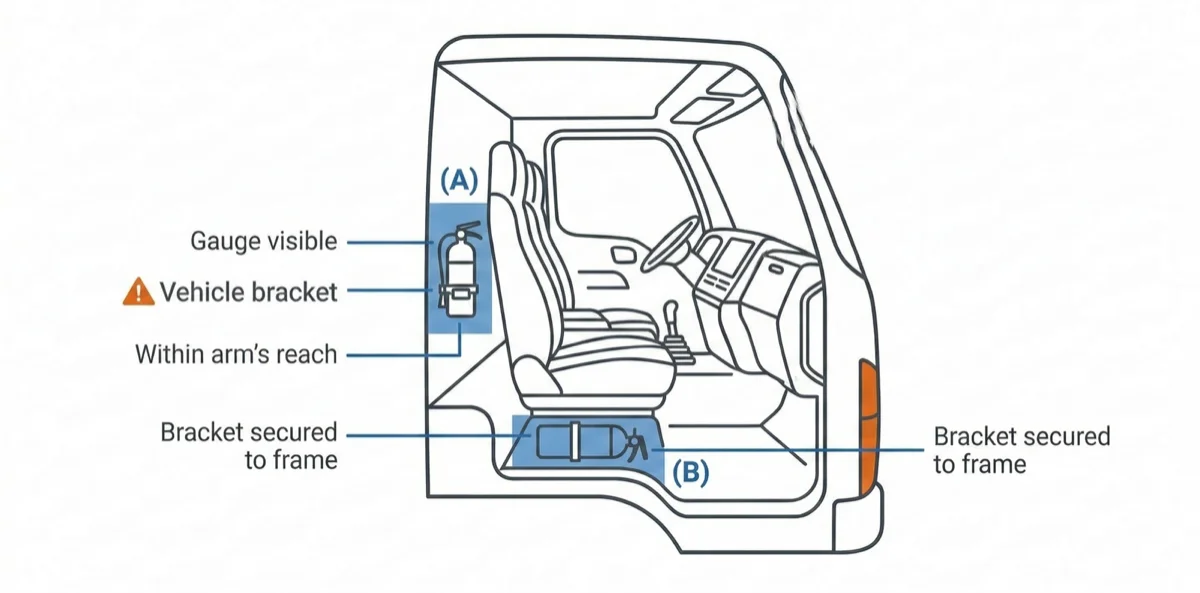
Recommended cab mounting positions — gauge must be visible, bracket secured to frame
- Use a vehicle-rated bracket with strap or clamp — standard wall hooks are not sufficient for road vibration
- Mount in the cab where the driver can reach it without leaving the seat
- Keep the pressure gauge visible for quick daily checks
- Protect from weather if mounted outside the cab
- Annual professional inspection required under NFPA 10
- 6-year internal exam and 12-year hydrostatic test for dry chemical units
Vehicle-Bracket Units That Meet the Mounting Rule
For complete inspection and maintenance schedules, see the 49 CFR §393.95 inspection requirements and NFPA 10 maintenance standards.
Frequently Asked Questions
What size fire extinguisher do I need for a semi-truck?
A 5 lb ABC extinguisher (rated 3-A:40-B:C) is the common pick for semi-trucks. §393.95 asks a covered power unit for one extinguisher rated 5 B:C or more, or two rated 4 B:C or more, so a 40 B:C component clears it with room to spare. Use a UL-listed vehicle-bracket model for secure cab mounting.
What is the DOT fire extinguisher requirement for hazmat vehicles?
Hauling hazardous materials in a quantity that requires placarding raises the minimum to a 10 B:C rating under 49 CFR §393.95. A 10 lb ABC extinguisher (rated 4-A:80-B:C) is the standard choice. For bulk fuel haulers, consider a 20 lb unit for maximum suppression capacity. The extinguisher is one piece of the hazmat equipment list: 49 CFR Part 397 covers driving and parking, attended-vehicle rules, written route plans for explosives, and the spill-response gear placarded loads carry alongside the cab extinguisher.
Can I use a B:C-only extinguisher instead of ABC?
Yes, DOT only requires a B:C rating. However, ABC extinguishers are strongly recommended because they also cover Class A fires (tires, cab materials, wood cargo). The price difference is minimal and the added protection is significant.
How often do DOT fire extinguishers need to be inspected?
Check the pressure gauge during every pre-trip inspection (daily). Get a professional inspection annually per NFPA 10. Internal exam every 6 years and hydrostatic test every 12 years for dry chemical units.
What happens if my fire extinguisher fails a DOT inspection?
A missing, discharged, or unsecured fire extinguisher is a §393.95(a) violation. It goes on the roadside inspection report and counts against your carrier's Vehicle Maintenance record in FMCSA's Safety Measurement System (CSA).
Does my pickup truck need a DOT fire extinguisher?
If your pickup's GVWR is 10,001 lbs or more, or the truck and trailer together are rated or loaded at 10,001 lbs or more, and it operates in interstate commerce, yes. Many 1-ton pickups qualify on their own. Check the door sticker for GVWR.
Does a 2.5 lb fire extinguisher meet DOT requirements?
It depends on the UL rating, not the weight. A 2.5 lb ABC dry-chemical extinguisher rated 1-A:10-B:C exceeds the 5 B:C federal minimum for standard commercial motor vehicles by its 10-B:C component. Weight refers to the amount of dry chemical agent inside; the UL rating measures actual fire suppression capability. Note that the 2.5 lb 1-A clears DOT but doesn't satisfy Cal/OSHA 8 CCR §3702 (where it applies) or NFPA 10's ordinary-hazard 2-A guidance — see Fleet Outfitting for the size-selection logic.
Does my non-CMV work truck need a fire extinguisher under OSHA?
There's no federal OSHA rule that mandates an extinguisher in every employer-owned vehicle. OSHA 29 CFR 1910.157 applies if you provide one for crew use (inspection, maintenance, and annual training duties) or if a specific standard requires it (DOT §393.95 for CMVs, logging operations, etc.). For a pickup that isn't a CMV (rated and loaded under 10,001 lbs, including any trailer, and no placarded hazmat), no extinguisher is technically mandated at the federal level. OSHA's selection paragraph (§1910.157(d)(1)) formally excludes extinguishers kept outside workplace buildings, but matching the unit to the hazard on the truck, like fueled equipment, is still the sound choice. State-plan OSHAs (Cal/OSHA and 21 others) add their own overlays. See Fleet Outfitting for the practical fleet-standardization logic.
What is the difference between extinguisher weight and UL rating?
Weight (e.g., 2.5 lb, 5 lb) is the amount of extinguishing agent inside the cylinder. The UL rating (e.g., 1-A:10-B:C) is the fire suppression capability tested and certified by Underwriters Laboratories. A smaller extinguisher can have a rating that exceeds the DOT minimum — compliance is determined by the UL rating, not the weight.
Does California have stricter fire extinguisher rules than federal DOT for work trucks?
California's motor-carrier rule (13 CCR §1242) sets a 4-B:C floor for the vehicle classes listed in Vehicle Code §34500 — commercial trucks of three or more axles over 10,000 lbs, buses, hazmat carriers, and any motortruck separately regulated by USDOT. Most half-ton and three-quarter-ton service pickups aren't in that group. The Cal/OSHA rule that usually does apply is 8 CCR §3702, which covers trucks and buses primarily used to take crews to and from jobsites on a regular schedule. That rule asks for a UL-listed dry-chemical extinguisher of at least 4 lbs, or a non-dry-chemical alternative rated 4-B:C. A 5 lb 3-A:40-B:C is the simplest fleet fit.
Is a 2.5 lb fire extinguisher enough for a California work truck?
A 2.5 lb ABC extinguisher rated 1-A:10-B:C meets the federal DOT 5-B:C minimum (49 CFR §393.95). California's 8 CCR §3702 — when it applies to your truck (crew transport on a regular schedule) — asks for a UL-listed dry-chemical of at least 4 lbs, or a non-dry-chemical extinguisher rated 4-B:C. A 2.5 lb dry-chem doesn't meet the 4-lb part. For California fleets carrying fuel or fueled equipment, a 5 lb 3-A:40-B:C is the more conservative choice — it satisfies both rules and is sized for the fires you're more likely to face on a work truck.
Can I get a custom fire extinguisher mount for my truck or fleet vehicle?
Yes. Standard vehicle brackets work for most cabs, but if you have a non-standard mounting location (tool box, flatbed rail, custom compartment), a CNC-machined aluminum bracket can be made to fit your exact setup. Aluminum won't rust, handles vibration well, and can be anodized to match your fleet color. Contact us if you need a custom mount for 10+ vehicles - we can spec and quote brackets built to your measurements.
Was this page helpful?
Your feedback helps us improve our technical resources.

Outfitting your fleet?
Buckeye ABC Dry Chemical Fire Extinguisher w/ Vehicle Bracket – 5 lb.
DOT-compliant volume discounts