
DOT Warning Triangles: 49 CFR §393.95(f) Requirements
What §393.95(f) requires you to carry, what §392.22 requires you to deploy, and what FMVSS 125 actually certifies
Last updated: September 23, 2026
Contents
Overview
Most fleet managers reading the regulation get tripped up by the same thing: §393.95(f) is the rule that says you have to carry warning devices, but it does not tell you where to put them on the road. The deployment rule lives one section over at 49 CFR §392.22. Roadside inspectors check both. This page covers carriage (what has to be in the truck) and points at deployment (where to set them out) so a driver can be compliant on both ends of an inspection.
Except where §393.95(g) prohibits flame-producing devices, §393.95(f) requires every commercial motor vehicle to carry one of two things: three bidirectional reflective triangles that meet FMVSS 125, or at least six fusees, plus as many additional fusees as §392.22 requires. Triangles are the only option that works on every cargo type in every weather, which is why almost every modern fleet standardizes on them.
2026 rule change: liquid-burning flares are no longer an option
FMCSA removed liquid-burning flares from §393.95(f)(2), (g), and (j) and from the §392.22 placement rules, effective March 23, 2026 (final rule 2026-03261, 91 FR 7867). Paragraph (f) now lists two options: FMVSS 125 triangles or at least six fusees. A separate rule effective April 20, 2026 removed the spare-fuse requirement at §393.95(b), which is now reserved. Guidance published before those dates, including the 2024 annual print edition of the CFR, still shows the old text.
The full carriage rule is published in 49 CFR §393.95 paragraph (f). The parent §393.95 page on this site covers the fire-extinguisher side of the same regulation; this sub-page covers warning devices only.
Two rules, one inspection
§393.95(f) is the carriage rule. §392.22 is the placement rule. A roadside officer can write a violation under either one. The fix on the carriage side is a spec-grade set of FMVSS 125 triangles. The fix on the placement side is driver training and a habit of stopping with the kit accessible.
Quick Reference
What §393.95(f) requires you to carry, by device choice and cargo type.
| Device | Quantity Required | Conforms To | Allowed on Class 3 / Div 1.1 to 1.3 |
|---|---|---|---|
| Bidirectional reflective triangles | 3 | FMVSS 125 (49 CFR §571.125) | Yes |
| Fusees | At least 6 | UL 912 (§393.95(j)), 30-minute burn | No (open flame restricted under (g)) |
Bidirectional reflective triangles
Qty: 3 · Conforms to: FMVSS 125
Hazmat: Yes, allowed on all cargo types
Fusees
Qty: At least 6 · Conforms to: UL 912, 30-minute burn
Hazmat: No, open flame restricted under (g)
Other warning devices may be carried in addition to, but never in lieu of, the required ones, and they must not reduce the effectiveness of the required devices (§393.95(f)(3)). At minimum the truck has to carry the full quantity of one of the two options. In practice, almost every modern fleet runs three FMVSS 125 triangles because they cover every cargo class with no fire risk.
Triangles vs Fusees
The two options are not equivalent in real-world use. Triangles are reusable, weather-tolerant, and legal on every cargo type. Fusees burn with an open flame, which puts them off-limits on the cargo classes that move the most ton-miles in the United States, and §392.22(b)(2)(vi) additionally bars lighting or placing any flame-producing signal near leaking fuel except at a distance that prevents fire or explosion.
| Attribute | Reflective Triangles | Fusees |
|---|---|---|
| Reusable | Yes (5+ years typical) | No (single use) |
| Wind / weather | Stable in 40 mph wind (FMVSS 125 S5.6) | Burns in rain and wind |
| Hazmat compatibility | Allowed on all classes | Restricted (open flame, §393.95(g)) |
| Visibility distance | 500+ ft in headlights | Direct flame (high) |
| Burn / lifespan | Indefinite | 30 minutes minimum (§393.95(j), UL 912) |
| Quantity required | 3 | At least 6, plus more if §392.22 requires |
Reusable
Triangles: Yes (5+ yrs)
Fusees: No
Hazmat compatibility
Triangles: Allowed on all classes
Fusees: Restricted (open flame, §393.95(g))
Burn / lifespan
Triangles: Indefinite
Fusees: 30 min minimum (UL 912)
Quantity required
Triangles: 3
Fusees: At least 6
The practical answer for most fleets: standardize on three FMVSS 125 reflective triangles per vehicle, store them in the cab, and replace the kit if the reflective surface delaminates or a triangle gets cracked. Fusees and liquid fusees are kept by some carriers as supplementary devices for low-visibility conditions, but they cannot legally substitute for the carriage requirement on hazmat loads.
Placement Rule: 49 CFR §392.22 (10 / 100 / 200 ft)
Once a CMV is stopped on the traveled portion of a highway or shoulder for any reason other than a normal traffic stop, the driver has 10 minutes to deploy warning devices. §392.22 specifies the spacing.
- General rule (§392.22(b)(1)): One device on the traffic side of the vehicle, about 10 ft (4 paces) toward approaching traffic; one about 100 ft (40 paces) toward approaching traffic in the center of the lane or shoulder the vehicle occupies; and one about 100 ft in the direction away from approaching traffic, also centered. Only the first is placed on the traffic side, not in the lane center.
- Divided / one-way highway (§392.22(b)(2)(v)): One device at 200 ft and one at 100 ft toward approaching traffic in the center of the lane or shoulder, plus a third on the traffic side of the vehicle within 10 ft of the rear. Three devices, not two.
- Hill, curve, or obstructed view (§392.22(b)(2)(iv)): If the vehicle is stopped within 500 ft of a curve, crest, or other obstruction, place the device toward the obstruction at a distance of 100 to 500 ft from the vehicle. It is a range, not a 500-ft minimum.
- Business or residential district (§392.22(b)(2)(iii)): Placement is not required in these districts, except during the time lighted lamps are required and street or highway lighting is insufficient to make the vehicle clearly discernable at 500 ft. The test is lighting, not whether the vehicle obstructs traffic.
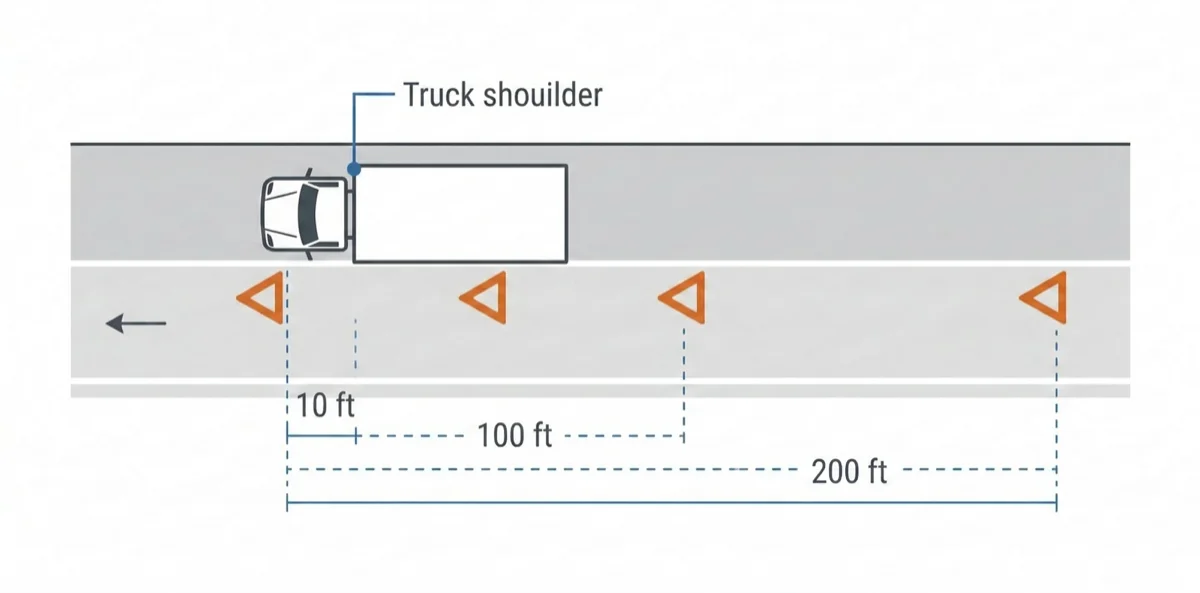
§392.22 spacing on a divided / one-way highway: 10 ft, 100 ft, 200 ft behind the vehicle.
The 10-minute window
During the first 10 minutes after a CMV stops, the driver may use vehicular hazard warning signal flashers in place of triangles. After 10 minutes, the triangles (or fusees) must be deployed at the §392.22 spacing for as long as the vehicle remains stopped.
What FMVSS 125 Actually Tests
Federal Motor Vehicle Safety Standard 125 (49 CFR §571.125) is the construction and performance standard for warning triangles. It applies to devices carried in buses and trucks with a GVWR over 10,000 lb. A triangle that is not marked as required by the standard is not legal for §393.95(f) carriage, even if it looks the part.
- Reflectivity: The triangle must reflect light back to a driver approaching at night with low-beam headlights. Both faces carry the material (bidirectional) so the same kit works for traffic in either direction.
- Size (S5.2.2 - S5.2.3): Each side 17 to 22 inches long and 2 to 3 inches wide. Each face carries an outer border of red reflex reflective material 0.75 to 1.75 inches wide and an inner border of orange fluorescent material 1.25 to 1.30 inches wide. A single dual-purpose orange-fluorescent/red-reflective material may be used instead of the two separate borders.
- Stability (S5.6): Tested on brushed concrete under a horizontal wind of 40 mph in any direction for 3 minutes, without sliding more than 3 inches.
- Construction: Must be erectable and returnable to its container without tools, and supplied in an opaque reusable container.
- Marking (S5.1.4): Permanently and legibly marked with the manufacturer's name, the month and year of manufacture, and either the symbol "DOT" or a statement that the device complies with all applicable Federal motor vehicle safety standards. The standard does not require the literal string "FMVSS 125".
Cheap import triangles sold for personal-vehicle roadside kits sometimes carry none of the required marking. Those are not legal for CMV carriage. When buying for a fleet, check for the manufacturer name, the date of manufacture, and the DOT symbol or compliance statement — a triangle marked "DOT" without the words "FMVSS 125" is fully compliant.
Hazmat Restrictions on Open-Flame Devices
§393.95(g) bars fusees and any other signal produced by a flame from being carried on three categories of vehicle. Note the scope carefully: for flammable liquid and flammable gas the restriction attaches to cargo tank motor vehicles, not to every placarded load. For these vehicles, FMVSS 125 reflective triangles are the only legal carriage option.
- Division 1.1, 1.2, 1.3 Explosives: any commercial motor vehicle transporting them.
- Class 3 Flammable Liquids: any cargo tank motor vehicle used to transport them, whether loaded or empty. A placarded Class 3 load on a non-cargo-tank vehicle is not covered by this restriction.
- Division 2.1 Flammable Gases: any cargo tank motor vehicle used to transport them, whether loaded or empty.
- Compressed-gas-fueled vehicles: any CMV using compressed gas as a motor fuel. The restriction is on carrying the device at all, not on proximity to the fuel system.
A second, situational restriction applies to every vehicle regardless of cargo: under §392.22(b)(2)(vi), if gasoline or any other flammable liquid, combustible liquid, or gas is seeping or leaking from a fuel container or from the stopped vehicle, no flame-producing warning signal may be lit or placed except at a distance that assures prevention of fire or explosion.
Practical hazmat rule
If the truck has a placard, run reflective triangles. The hazmat driving and parking rules in 49 CFR Part 397 add further restrictions on open-flame devices and parking near them, so the safe default for any placarded operation is triangles only.
Common Violations & FMCSA Penalties
Warning-device violations show up in roadside inspections under the Vehicle Maintenance BASIC. They are usually fixable on the spot if the driver has a kit somewhere; the citation sticks if no compliant device is on the truck.
- Missing or incomplete kit: Fewer than three triangles, fewer than six fusees. The most common violation. Citable; no out-of-service for missing devices alone, but it goes on the inspection report.
- Missing required marking: The triangles are present but the certification mark is missing or unreadable. Treated as a missing device.
- Damaged or non-functional devices: Cracked frames, delaminated reflective material, or fusees that have been water-damaged. Counts as missing.
- Open-flame device on hazmat load: Fusees carried as the primary warning device on a placarded vehicle. Citable under §393.95(f) and potentially under §397.13 (smoking and open-flame restrictions).
- Failure to deploy under §392.22: Driver stopped on the shoulder for more than 10 minutes without deploying triangles. Citable even if the kit is on the truck. This is a deployment-rule violation, not a carriage-rule violation.
FMCSA penalties for warning-device violations are typically modest as standalone citations (a few hundred dollars), but they accumulate on the carrier's CSA Vehicle Maintenance BASIC score and can trigger compliance reviews when paired with other findings. The cost of compliance is a $15 to $40 triangle kit per truck.
Warning Triangles Related to FMVSS 125

Need full kits? Our Fleet Fire Safety Kits bundle FMVSS 125 triangles with a §393.95 fire extinguisher and first-aid kit sized to your vehicle class. For Cortina-direct triangle questions, see the Cortina brand page.
Frequently Asked Questions
What does 49 CFR §393.95(f) require commercial vehicles to carry?
Except where §393.95(g) prohibits flame-producing devices, §393.95(f) requires every CMV to carry one of two options: three bidirectional reflective triangles that conform to FMVSS 125, or at least six fusees plus as many additional fusees as §392.22 requires. The driver picks one option, but the full quantity has to be on the truck. Liquid-burning flares were removed from §393.95(f) effective March 23, 2026. Most fleets standardize on three FMVSS 125 triangles because they are the only choice that works on every cargo class.
What is the difference between §393.95(f) and §392.22?
§393.95(f) is the carriage rule: it tells you what warning devices have to be in the truck. §392.22 is the placement rule: it tells you where to put them on the road after a stop and the 10-minute window for deploying them. Roadside inspectors check both. A truck can pass the carriage check (kit is on board) and still get cited for not deploying the kit at the §392.22 spacing.
What is FMVSS 125 and why does it matter for fleet purchasing?
FMVSS 125 (49 CFR §571.125) is the federal construction standard that defines what counts as a compliant reflective triangle: bidirectional reflectivity, 17 to 22 inch sides, a red reflex reflective outer border, an orange fluorescent inner border, and stability in a 40 mph wind. Under S5.1.4 the device must be marked with the manufacturer's name, the month and year of manufacture, and either the symbol "DOT" or a statement that it complies with all applicable Federal motor vehicle safety standards. The standard does not require the literal string "FMVSS 125", so a triangle marked "DOT" is compliant. When buying for a fleet, verify those three markings rather than looking for a specific standard number.
Where do I place the three warning triangles after stopping?
On a divided or one-way highway: 10 feet, 100 feet, and 200 feet behind the vehicle, plus a third on the traffic side within 10 ft of the rear. On a two-lane or undivided road: 10 feet behind, 100 feet behind, and 100 feet in front. On a hill or curve where the sightline is shorter than 500 feet, move the rear-most triangle further back so approaching traffic sees it 500 feet before reaching the truck. The driver has 10 minutes from the stop to deploy them.
Can I use fusees instead of triangles on a hazmat truck?
Not on the vehicles §393.95(g) covers. Fusees and any other flame-producing signal cannot be carried on a CMV transporting Division 1.1, 1.2, or 1.3 explosives; on any cargo tank motor vehicle hauling Division 2.1 flammable gas or Class 3 flammable liquid, whether loaded or empty; or on any CMV using compressed gas as a motor fuel. The hazmat driving rules in 49 CFR Part 397 add further open-flame restrictions. The safe default for any placarded operation is FMVSS 125 reflective triangles.
How long do reflective warning triangles last before they need replacement?
Most FMVSS 125 triangles last 5 or more years in normal cab storage. Replace a kit when the reflective material delaminates, the orange fluorescent border fades to pink, the frame cracks, or the case is damaged. UV exposure is the main wear factor for triangles stored where sunlight reaches them; cab-stored kits typically outlast outside-mounted kits by several years.
Are warning triangles required on pickup trucks and light commercial vehicles?
Only if the pickup is operating as a CMV in interstate commerce, generally vehicles rated or loaded at 10,001 lbs or more, including any trailer, or those carrying hazardous materials in placardable quantities. Personal pickups and light commercial vehicles below the CMV threshold are not subject to §393.95(f). State laws may still recommend or require warning devices for any vehicle on the road, so check state statutes for non-CMV operations.
Can my four-way hazard flashers replace the triangles?
Only for the first 10 minutes after a stop. §392.22 allows the vehicular hazard signal flashers as the warning device for the first 10 minutes; after that, the triangles (or fusees) must be deployed at the §392.22 spacing. The flashers are a bridge, not a substitute. The carriage requirement under §393.95(f) is independent of the flashers: the triangles have to be on the truck whether or not they are deployed.
Outfitting a fleet?
Volume pricing on 10+ FMVSS 125 reflective triangle kits, marked per S5.1.4 for CMV carriage. Quotes typically returned within one business day.
or call 714-248-6555 · email partners@usmadesupply.com
Was this page helpful?
Your feedback helps us improve our technical resources.