
49 CFR §393.95: Emergency Equipment Regulation
Federal regulation text for fire extinguisher and emergency equipment on CMVs
Last updated: October 22, 2026
Contents
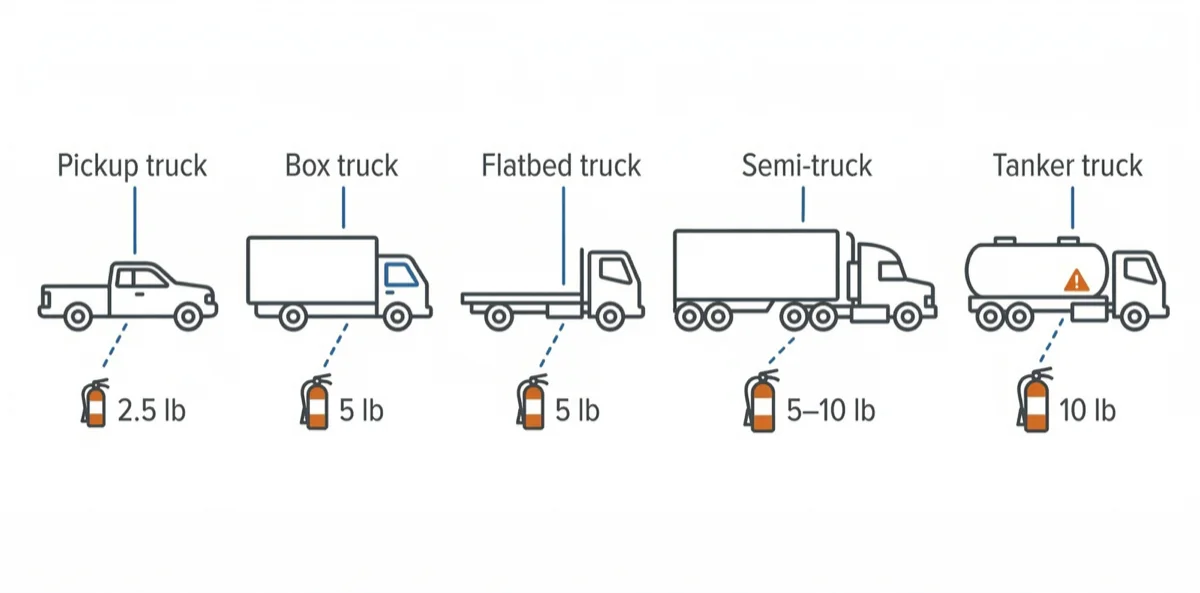
49 CFR §393.95 applied to common vehicle classes — all options shown meet or exceed the 5 B:C minimum for standard CMVs and the 10 B:C minimum for hazmat in placardable quantities.
DOT-Compliant Bestsellers
UL-listed ABC extinguishers that meet 49 CFR §393.95. In stock, typically ships in 3–5 business days.


Also needed for compliance
DOT 393.95 is the federal vehicle rule. The extinguisher itself has to meet UL 299 and UL 711. Facilities that garage those vehicles also need NFPA 10 on the building side.
Overview
49 CFR §393.95 establishes federal requirements for emergency equipment on all power units operating in interstate commerce. These regulations ensure commercial motor vehicles carry appropriate fire suppression equipment for emergency situations.
The regulation applies to all commercial motor vehicles including trucks, truck tractors, and buses, with specific requirements based on the type of cargo being transported. FMCSA (Federal Motor Carrier Safety Administration) is the DOT sub-agency that writes and enforces this rule — when fleet operators reference "FMCSA fire extinguisher requirements" or "U.S. DOT fire extinguisher requirements," they mean 49 CFR §393.95. The extinguisher rule is one piece of broader DOT fleet compliance; for the full picture covering vehicle marking, inspection cadence, and documentation, see that guide. Fire extinguishers themselves must meet UL 299 and UL 711 standards for certification.
The full regulation text is published in Title 49, Part 393, Subpart H of the Electronic Code of Federal Regulations.
Looking for product recommendations? Our DOT fire extinguisher buying guide matches specific extinguisher models to each vehicle type — semi-trucks, box trucks, tankers, buses, and pickups — with specs, pricing, and add-to-cart.
Need the full compliance picture? Fire extinguishers are just one part of DOT compliance. Our Fleet & DOT Compliance Guide covers everything inspectors check — DOT number display, warning devices, documentation, annual inspections, and requirements by vehicle type for pickup trucks, box trucks, flatbeds, and service vans.
Quick Reference
Minimum fire extinguisher requirements by vehicle and cargo type under 49 CFR §393.95.
| Vehicle / Cargo Type | Min. UL Rating | Qty | Common Compliant Agents |
|---|---|---|---|
| Truck, tractor or bus, no hazmat | 5 B:C | 1 | Dry chemical, CO₂, halogenated (e.g., Halotron I) |
| Truck, tractor or bus, no hazmat (alternate) | 4 B:C | 2 | Dry chemical, CO₂, halogenated (e.g., Halotron I) |
| Hazmat (placardable quantities) | 10 B:C | 1 | Dry chemical, CO₂, halogenated (e.g., Halotron I) |
Truck, tractor or bus, no hazmat
Rating: 5 B:C · Qty: 1
Agents: Dry chemical, CO₂, halogenated (e.g., Halotron I)
Truck, tractor or bus, no hazmat (alternate)
Rating: 4 B:C · Qty: 2
Agents: Dry chemical, CO₂, halogenated (e.g., Halotron I)
Hazmat (placardable)
Rating: 10 B:C · Qty: 1
Agents: Dry chemical, CO₂, halogenated (e.g., Halotron I)
§393.95(a)(5) does not list permitted agent types. It sets two tests: the agent must not need protection from freezing, and it must comply with the toxicity provisions of EPA's Significant New Alternatives Policy (SNAP) regulations under 40 CFR Part 82, Subpart G. A plain water extinguisher fails the freezing test; a loaded-stream or antifreeze-charged unit is evaluated on the same two tests rather than excluded by type. ABC-rated dry chemical extinguishers satisfy both B:C requirements and provide additional Class A coverage for ordinary combustibles.
What changed in §393.95 in 2026
FMCSA issued two deregulatory rules affecting this section, both published February 19, 2026 with different effective dates. Effective March 23, 2026, liquid-burning flares were removed as a warning device from §393.95(f)(2), (g), and (j) and from the §392.22 placement rules — paragraph (f) now lists two options, FMVSS 125 triangles or at least six fusees. Effective April 20, 2026, the spare-fuse requirement at §393.95(b) was removed and reserved; it accounted for roughly 9,000 roadside violations a year and is no longer citable. The fire-extinguisher requirements in paragraph (a) were not changed by either rule. Guidance published before those dates, including the 2024 annual print edition of the CFR, still shows the old text.
Vehicle Requirements
Standard commercial vehicles not transporting hazardous materials must carry either one extinguisher rated UL 5 B:C or more, or two extinguishers each rated UL 4 B:C or more (§393.95(a)(1)(ii)). Paragraph (a) does not apply to the driven unit in a driveaway-towaway operation (§393.95(a)(6)).
- Option A: One fire extinguisher with an Underwriters' Laboratories rating of 5 B:C or more
- Option B: Two fire extinguishers, each with an Underwriters' Laboratories rating of 4 B:C or more
- Class A rating is not required but may be beneficial for cargo fires
- Dry chemical, carbon dioxide, or halogenated agent types are acceptable
- Agent must not need protection from freezing and must meet EPA SNAP toxicity provisions (§393.95(a)(5))
Most carriers choose ABC-rated dry chemical extinguishers because they cover Class A (ordinary combustibles like wood, paper, rubber), Class B (flammable liquids), and Class C (electrical fires) in a single unit. A 5 lb ABC extinguisher typically carries a 3-A:40-B:C rating, which exceeds the minimum 5 B:C requirement.
Note: Many carriers require higher ratings or additional extinguishers based on their safety policies.
Hazmat Transport Requirements
Vehicles transporting hazardous materials in placardable quantities must carry a higher-rated extinguisher. Placarding is generally required when shipping 1,001 lbs or more of a hazmat class, or any quantity of certain high-hazard materials (49 CFR §172.504).
- Minimum Rating: One extinguisher with UL rating of 10 B:C or more
- Warning devices are governed by §393.95(g), not (a): fusees and any other flame-producing signal cannot be carried on a CMV transporting Division 1.1, 1.2, or 1.3 explosives; on any cargo tank motor vehicle hauling Division 2.1 flammable gas or Class 3 flammable liquid, whether loaded or empty; or on any CMV using compressed gas as a motor fuel. A placarded load on a non-cargo-tank vehicle is not covered by that restriction.
- Mounting: §393.95(a)(4) requires the extinguisher be filled, readily accessible, and securely mounted to prevent sliding, rolling, or vertical movement relative to the vehicle. The rule sets no cargo-specific mounting distances.
A 10 lb ABC dry chemical extinguisher (typically rated 4-A:80-B:C) is a common choice for hazmat in placardable quantities because it exceeds the 10 B:C minimum and provides Class A coverage.
§393.95 is a floor — not the ceiling for tank vehicles. Two consensus standards stack on top of the 10-B:C placarded minimum and require materially larger units on specific hazmat fleets:
• NFPA 385 requires one 4-A:40-B:C OR two 2-A:20-B:C extinguishers on flammable/combustible liquid tank vehicles (gasoline, diesel, ethanol, heating oil, jet fuel).
• NFPA 58 Chapter 9 requires 18 lb dry chemical (A:B:C in 2020+ editions) on propane bobtails — the trucks that deliver LP-Gas to homes and businesses — and on cylinder delivery vehicles.
Related sub-rules: §393.95(f) warning devices covers triangles and fusees under §393.95(f), and the flame-device restrictions under §393.95(g). 49 CFR §397 covers hazmat driving, parking, smoking, and routing rules for placarded vehicles.
Specifications & Mounting
DOT requirements for extinguisher installation:
- UL Rating Label: Must be clearly marked by manufacturer with UL rating
- Visual Indicator: Must permit visual determination of charge status
- Accessibility: Must be readily accessible for immediate use
- Secure Mounting: Must be mounted to prevent sliding, rolling, or vertical movement
- Weather Protection: Extinguishing agent must not require freeze protection
- Location: Typically mounted in cab, but may be outside if weather-protected
- EPA Compliance: Agents must meet SNAP regulations for environmental safety
Selecting a Compliant Extinguisher
The regulation specifies minimum UL ratings and agent performance tests (dry chemical, CO₂, halogenated) but does not mandate a specific product. ABC-rated dry chemical extinguishers are the most common choice because they satisfy both the B:C requirement and provide additional Class A coverage.
Need help choosing? Our vehicle-by-vehicle product guide matches specific extinguisher sizes and models to each commercial vehicle type — semi-trucks, box trucks, tankers, buses, and pickups — with specs and pricing.
Inspection & Maintenance
Required inspection and maintenance procedures follow NFPA 10 standards for portable fire extinguishers:
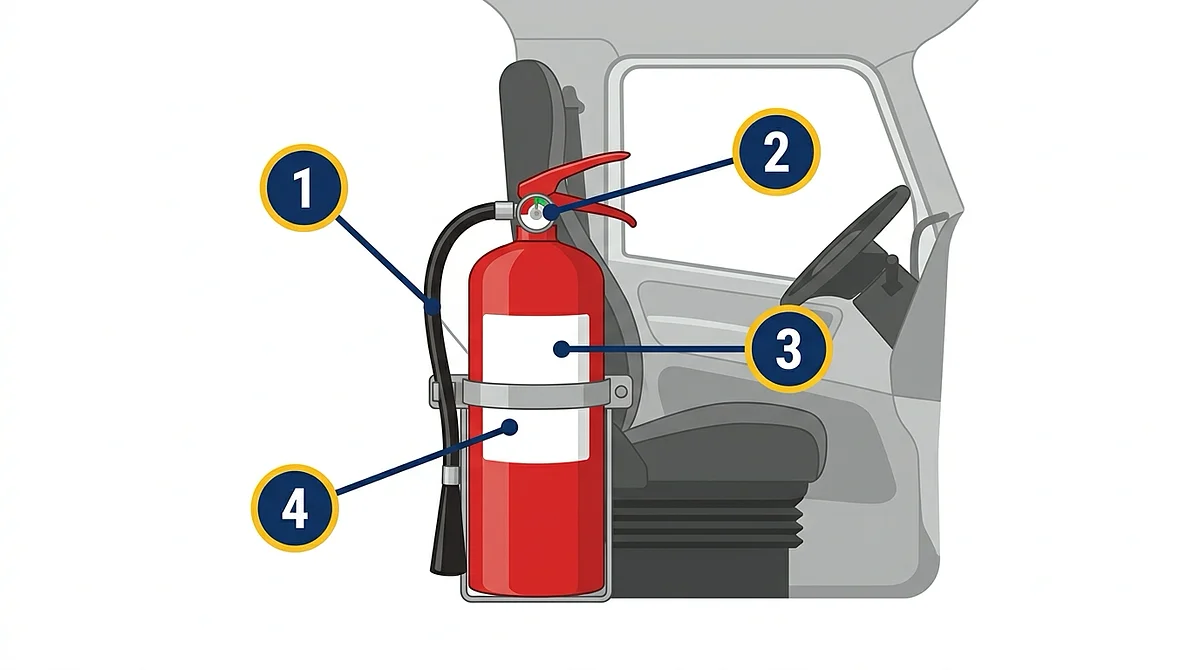
The four-point monthly driver check: ① mounting bracket secure, ② pressure gauge showing full charge, ③ cylinder free of damage or corrosion, ④ label legible.
- Monthly visual inspection: verify the extinguisher is in its designated location with the mounting bracket secure, check for physical damage or corrosion, and confirm the pressure gauge shows full charge
- Annual service: professional inspection by a certified technician — weight check for agent loss, verification of discharge components, and an updated inspection tag
- Documentation: maintain records of inspections and service
- Replacement: immediate replacement if discharged or damaged
- Hydrostatic testing: required at intervals per manufacturer specifications
Common DOT Violations & Penalties
Fire extinguisher violations are among the most common findings during FMCSA roadside inspections. They go on the inspection report and count against the carrier's Vehicle Maintenance BASIC in the Compliance, Safety, Accountability (CSA) program.
- Missing or discharged extinguisher: The most common violation. No extinguisher on board, or the gauge shows the unit is not fully charged.
- Incorrect UL rating for cargo type: Carrying a 5 B:C unit while transporting placardable hazmat (which requires 10 B:C).
- Improper mounting: Extinguisher not secured, sliding or rolling loose in the cab or on the frame. This violates the secure mounting requirement and is citable even if the extinguisher itself is compliant.
- Blocked access: Extinguisher buried under cargo, tools, or personal items and not readily accessible for immediate use.
- No pressure gauge or unreadable label: The charge indicator must be visible, and the UL rating label must be legible. Faded, painted-over, or missing labels are violations.
- Agent fails §393.95(a)(5): the agent needs freeze protection or does not meet EPA SNAP toxicity provisions. Dry chemical, CO₂, and clean agents are the common compliant choices, but the rule is a performance test, not a list.
FMCSA penalties for fire extinguisher violations include CSA points against the carrier's Vehicle Maintenance BASIC score. Civil penalties may also apply under 49 CFR part 386; the maximum depends on who is cited and whether hazardous materials rules are involved. Repeated violations can trigger a compliance investigation of the carrier.
Fire Extinguishers Related to 49 CFR 393.95
Need help choosing the right size? See our vehicle-by-vehicle sizing guide for extinguisher recommendations by vehicle type — pickups, box trucks, semi-trucks, tankers, and buses — with specs and pricing.
Frequently Asked Questions
What size fire extinguisher is required for a commercial truck?
A standard commercial truck (not hauling hazmat) needs at least one fire extinguisher rated 5 B:C or higher, or two extinguishers each rated 4 B:C or higher. A 5 lb ABC dry chemical extinguisher (typically rated 3-A:40-B:C) is the most common choice and exceeds the minimum requirement.
Do I need a fire extinguisher in my pickup truck?
Only if the pickup is operating as a commercial motor vehicle (CMV) in interstate commerce — generally vehicles with a GVWR or GCWR of 10,001 lbs or more, or those transporting hazardous materials in placardable quantities. Personal pickup trucks not used for commercial purposes are not subject to 49 CFR §393.95.
How often do DOT fire extinguishers need to be inspected?
Monthly visual inspections (check gauge, location, damage) and annual professional servicing by a certified fire extinguisher technician. Drivers should verify the extinguisher during pre-trip inspections. Hydrostatic testing is required per the manufacturer's schedule, typically every 6 or 12 years depending on the cylinder type.
What type of fire extinguisher is required for hazmat transport?
Vehicles hauling hazardous materials in placardable quantities must carry at least one extinguisher rated 10 B:C or higher. A 10 lb ABC dry chemical extinguisher is recommended because it exceeds the 10 B:C minimum and provides Class A coverage. CO₂ and halogenated agents are also permitted.
Can I use a water fire extinguisher in a commercial vehicle?
Not a plain water unit. §393.95(a)(5) does not name permitted agents; it requires an agent that does not need protection from freezing and that meets the toxicity provisions of EPA's SNAP regulations (40 CFR Part 82, Subpart G). Plain water fails the freezing test. Dry chemical, carbon dioxide (CO₂), and clean agents are the common compliant choices.
Where should a fire extinguisher be mounted in a truck?
The cab is the preferred location for easy access. Outside mounting is acceptable if the extinguisher is weather-protected and the agent does not require freeze protection. The extinguisher must be securely mounted with a bracket — sometimes called a vehicle mount, truck mount, or extinguisher holder — to prevent movement, and it must be readily accessible, not buried behind cargo, tools, or equipment.
What does "5 B:C rated" mean on a fire extinguisher?
The rating tells you what the extinguisher can handle. The number before the letter is the relative firefighting capacity, and the letter is the fire class. B covers flammable liquids (fuel, oil, grease) and C covers energized electrical equipment. A 5 B:C extinguisher can fight a flammable liquid fire roughly five times the size of a 1 B:C unit. Most ABC dry chemical extinguishers also carry an A rating for ordinary combustibles (wood, paper, rubber), which is why a 5 lb ABC rated 3-A:40-B:C far exceeds the DOT 5 B:C minimum.
Is a 2.5 lb fire extinguisher DOT compliant for commercial vehicles?
Yes. A 2.5 lb ABC extinguisher (typically rated 1-A:10-B:C) exceeds the 5-B:C federal minimum — its 10-B:C component is double the 5-B:C floor that §393.95(a)(1)(ii) requires. Check the UL label to confirm the rating before relying on any 2.5 lb unit. Note that trucks below the federal CMV threshold (10,001 lbs or more by GVWR/GCWR, placardable hazmat, or certain passenger counts) generally aren't required to carry a DOT extinguisher at all — many fleet operators still equip them with a 2.5 lb or 5 lb unit voluntarily.
Does DOT approve or certify specific fire extinguisher brands?
No. DOT does not maintain an approved-brands list or certify individual fire extinguishers. The regulation (49 CFR §393.95) sets minimum performance requirements: the extinguisher must be UL listed, carry the required B:C rating, use an approved agent (dry chemical, CO₂, or halogenated), and be properly maintained. Any extinguisher from any manufacturer that meets those specs is compliant. The UL listing is what inspectors look for during roadside checks.
What fire extinguisher do I need for my CDL pre-trip inspection?
During a CDL pre-trip, you need to verify the extinguisher is properly mounted, the gauge shows a full charge (green zone), the safety pin and tamper seal are intact, and there is no visible damage or corrosion. The extinguisher must be at least 5 B:C rated for standard CMVs or 10 B:C for placarded hazmat loads. If the gauge reads empty or the unit is damaged, the vehicle fails the pre-trip and cannot operate until the extinguisher is replaced or serviced.
When do I need a 20 lb fire extinguisher instead of a 5 lb or 10 lb?
DOT §393.95 does not require a 20 lb extinguisher for any standard CMV, but two consensus standards do require materially larger units on specific hazmat fleets. NFPA 385 requires one 4-A:40-B:C or two 2-A:20-B:C extinguishers on flammable-liquid tank vehicles (gasoline, diesel, ethanol, heating oil, jet fuel). NFPA 58 Chapter 9 requires 18 lb dry chemical (A:B:C in 2020+ editions) on propane bobtails — the trucks that deliver LP-Gas to homes and businesses. Outside those mandates, fleet operators also choose 20 lb units for high-value cargo, remote-route operations where fire department response is slow, or extended bunker-fueling at a construction site. A 20 lb ABC unit typically rated 10-A:120-B:C provides roughly four times the agent of a 5 lb unit. The tradeoff is weight and mounting: at 25+ lbs loaded, vehicle bracket options are limited. Most fleets standardize on 5 lb for standard trucks, 10 lb for hazmat under §393.95 alone, and 20 lb where NFPA 385 or NFPA 58 binds the operation.
Outfitting a fleet?
Volume pricing on 10+ DOT-compliant vehicle-bracket extinguishers. We send a fleet-ready spec sheet with UL ratings, mounting options, and annual inspection tag templates.
or call 714-248-6555 · email partners@usmadesupply.com
Was this page helpful?
Your feedback helps us improve our technical resources.

Outfitting your fleet?
Buckeye ABC Dry Chemical Fire Extinguisher w/ Vehicle Bracket – 5 lb.
DOT-compliant volume discounts