
Acoustic Sealant for Soundproofing
How acoustic caulk works, when to use it, and which sealant to spec for STC-rated walls
Last updated: June 11, 2026
Overview
If you can hear a conversation through your wall, sound is not passing through the drywall. It is leaking around it. Sound transmission follows the same path as air, and the largest sound paths in a finished wall are the gaps at the perimeter: where drywall meets the floor, the ceiling, electrical boxes, and pipe penetrations. Acoustic sealant (also called acoustical sealant or acoustic caulk) is the product that seals those gaps without going rigid.
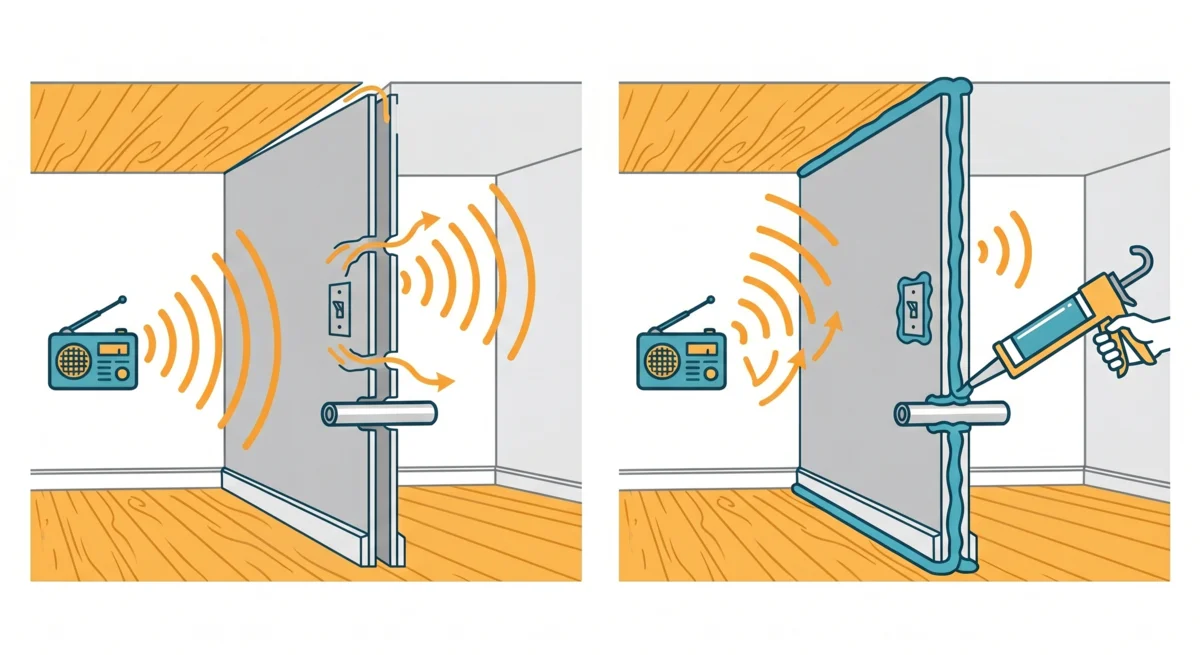
The defining property of acoustic sealant is that it never fully cures. It stays permanently flexible and slightly tacky, so the gap stays sealed even when the framing moves seasonally or the building shifts. A regular silicone or polyurethane caulk hardens, eventually pulls away from one substrate, and opens a sound path the assembly was designed to close.
This guide covers what acoustic sealant is, where it goes in a wall assembly, the STC rating math behind it, the code references that drive its use, and the pro-grade product we stock in the U.S. (Everkem Sound Seal 90).
Quick read: If you are sealing a sound-rated wall, an electrical box on a sound-rated wall, or any drywall perimeter where you want to limit sound transmission, use a non-hardening acoustical sealant. If the wall also needs a fire rating, that is a different product (firestop sealant, not acoustic).
How Sound Travels Through Walls
Sound is a pressure wave. It moves through air, and it follows any path that air can follow. In a finished wall, three things determine how much sound gets through:
- Mass: heavier walls block more sound (two layers of drywall beat one)
- Decoupling: separating the two faces of the wall (resilient channels, staggered or double studs) prevents direct vibration
- Air sealing: closing every gap, no matter how small, at the wall perimeter and at every penetration
Acoustic sealant addresses the third factor. It is not a substitute for mass or decoupling, but a wall with great mass and decoupling can still leak sound through a 1/8 inch gap at the bottom plate. Lab and field testing on partition assemblies (ASTM E90 in the lab, ASTM E336 in the field) consistently shows that unsealed perimeters and penetrations cost a finished assembly several STC points compared to a properly sealed reference build.
The places sound leaks through a typical residential or light-commercial partition:
- Top and bottom of drywall (where the sheet meets the plate)
- Wall-to-wall corners
- Around electrical boxes, especially back-to-back boxes in the same stud bay
- Around plumbing and HVAC penetrations
- At the underside of the deck above (head-of-wall) where partitions stop short of structure
- Through can lights, ceiling registers, and HVAC ducts that pass through the wall
Acoustic Sealant vs Regular Caulk
The vocabulary is loose. Acoustic caulk, acoustical caulk, acoustical sealant, acoustic sealant, and sound sealant all describe the same product family: non-hardening latex sealants formulated for use in sound-rated wall assemblies. They are not interchangeable with general-purpose silicone, polyurethane, or acrylic latex caulk.
| Property | Acoustic Sealant | Silicone | Polyurethane | Acrylic Latex |
|---|---|---|---|---|
| Hardens? | No (stays tacky) | Yes (flexible cure) | Yes (flexible cure) | Yes (rigid cure) |
| Paintable | Yes (latex 2 hr) | No | Yes | Yes |
| Joint movement | Sealed-seam (small) | ±25 to ±50% | ±25 to ±50% | ±12% |
| STC contribution | High (closes flanking) | Low (cures rigid) | Low (cures rigid) | Low (cracks open) |
| Primary use | STC-rated walls, smoke partitions | Wet areas, glazing | Exterior, expansion joints | Interior trim |
| Typical cost / 10 oz tube | $10 to $14 | $6 to $12 | $8 to $14 | $3 to $6 |
Common mistake: Using a 100% silicone at the drywall perimeter because it is what was on the truck. Silicone cures into a hard, springy gasket that bridges the joint cleanly the day it goes in, then transmits vibration because it has no give. Acoustic sealant stays soft and damps vibration instead of carrying it.
For a broader comparison of every sealant chemistry (silicone, polyurethane, MS polymer, acrylic, firestop), see our Commercial Sealant and Caulk Selection Guide.
When to Use Acoustic Sealant
Acoustic sealant belongs anywhere two surfaces meet inside a sound-rated assembly. The best time to apply it is before the drywall goes up (running a bead on the framing where the sheet will land) and after (sealing the seam between drywall and adjacent surface).
Wall Perimeter
The single most important application. Run a continuous bead on the bottom plate and top plate before drywall installation. After the drywall is up and tooled, run a second bead at the seam where the drywall meets the floor or ceiling. Both beads together seal the gap from both sides.
- Run a 3/8 inch bead on top of the bottom plate before drywall
- Set the drywall into the bead so it squeezes out evenly
- After mudding, caulk the floor-to-drywall seam from the room side
- Repeat at the head (drywall to top plate or to underside of structure)
Electrical Box Gaskets
Electrical boxes are one of the worst sound paths because they cut through the drywall and often sit back-to-back across a wall. There are two ways to handle them. Use a putty pad behind the box (this is what we recommend, and what we stock for fire-rated assemblies) or run a heavy bead of acoustic sealant around the box opening and where the box meets the stud.
- Never install boxes back-to-back in the same stud bay on a sound wall
- Stagger boxes by at least one stud bay across a sound-rated partition
- Seal the perimeter of the cut-out in the drywall to the box
Pipe and Conduit Penetrations
Any pipe, conduit, or cable that crosses a sound-rated wall is a sound path. Pack mineral wool around the penetration first, then seal both faces of the wall with acoustic sealant. If the wall is also fire-rated, this becomes a firestop detail, and you need a UL-listed firestop assembly, not acoustic sealant.
Ceiling and Floor Junctions
Where a sound-rated wall meets a ceiling drywall sheet or a floor finish, run a continuous bead. Pay particular attention to the head-of-wall condition in multifamily projects where partitions extend to the underside of the structural deck. The deck flexes and an acoustic sealant accommodates that movement without pulling away.
Resilient Channel Installations
Resilient channel decouples the drywall from the studs. The benefit goes away if the drywall is rigidly bonded to anything else (corner bead, adjacent walls, perimeter framing). Use acoustic sealant at the perimeter so the drywall is sealed without being mechanically tied to the surrounding structure.
Double-Stud and Staggered-Stud Walls
The whole point of a double-stud wall is the air gap between the two stud lines. Sealing the perimeter with acoustic sealant is what locks in that performance. Without it, the high-STC wall you paid for is doing the work of a much cheaper assembly.
STC Ratings Explained
Sound Transmission Class (STC) is a single-number rating of how much sound a partition blocks across the speech frequency range. It is measured in a lab using ASTM E90 (transmission loss measurement) and calculated using ASTM E413 (the STC classification method). Higher numbers mean more attenuation.
The numbers are not linear. A 10-point increase in STC is roughly half the perceived loudness on the other side. A 5-point increase is clearly audible. Below are the ranges most projects target.
| Wall Assembly | Approx. STC | What You Hear |
|---|---|---|
| Single 2x4 stud, 1/2" drywall both sides, no insulation | 33 to 35 | Loud speech understandable |
| Single 2x4 stud, insulation, sealed perimeter | 36 to 40 | Loud speech audible, not understandable |
| Single 2x4 with resilient channel, insulation, sealed | 45 to 52 | Speech faint |
| Staggered stud or single stud with double drywall, insulation, sealed | 45 to 55 | Loud speech inaudible |
| Double stud, insulation, double drywall, sealed | 55 to 63 | Music at normal volume inaudible |
| Double stud, double drywall, mass-loaded vinyl, sealed | 63 to 70+ | Drum kit and bass inaudible |
These are typical lab ranges drawn from NRC, the Gypsum Association GA-600 Fire and Sound Design Manual, and manufacturer test reports for assemblies built with the perimeter sealed. Values vary by drywall thickness (1/2 inch vs 5/8 inch Type X), insulation type, stud spacing, and number of layers. Field STC commonly runs 3 to 8 points below the lab number, primarily because of unsealed perimeters, electrical box flanking paths, and other leaks. Confirm your numbers against the manufacturer's tested assembly when STC is a permit requirement.
The word “sealed” in that table is carrying more weight than it looks. USG's Acoustical Assemblies brochure (SA-200) documents the same wall testing at STC 53 with the perimeter sealed and STC 29 with the perimeter left unsealed: the bead is worth more than 20 points. The placement practice behind those numbers is ASTM C919.
STC vs IIC: STC measures airborne sound (voices, TV, music). IIC (Impact Insulation Class) measures footfall and structure-borne sound. Walls are rated STC. Floor-ceiling assemblies are rated both STC and IIC.
Code Requirements
Sound transmission requirements live in the building code, not the energy code, and apply mostly to multifamily and mixed-use buildings. Single-family residential is not regulated for sound except in a few jurisdictions.
IBC Section 1206 (Sound Transmission)
Section 1206 (still numbered 1206 in the 2021 and 2024 IBC) sets minimums for airborne and impact sound between dwelling units, sleeping units, and adjacent public or service areas. Walls, partitions, and floor-ceiling assemblies must achieve a laboratory STC of at least 50 (ASTM E90) or, if field-tested, a Normalized Noise Isolation Class (NNIC) of at least 45 (ASTM E336). Floor-ceiling assemblies must also achieve an Impact Insulation Class of at least 50 (ASTM E492) or an Apparent Impact Insulation Class (AIIC) of at least 45 if field-tested (ASTM E1007).
The 2021 IBC uses the older terms NIC and NISR for the field-tested versions of these metrics; the 2024 IBC updated them to NNIC and AIIC. The numerical requirements did not change. STC and IIC are separate tests with separate ratings, so a floor-ceiling assembly has to meet both independently. For the edition-by-edition section numbering (1206 vs 1207), the penetration sealing rule quoted verbatim, and field test enforcement, see our IBC sound transmission page.
The lab numbers assume the assembly is built per the tested detail, including the perimeter air seal. If the on-site partition skips the acoustic sealant at the perimeter, field results drop below the lab number and the building can fail its acoustic test.
IRC (Single Family)
The International Residential Code does not include a general sound transmission requirement. Sound performance in detached single-family construction is driven by buyer expectation, not code. Home theaters, recording studios, and quiet offices in single-family homes follow the same physics as multifamily, just without the inspection.
Smoke Partitions
Acoustic sealant is also commonly specified at smoke partitions in non-fire-rated assemblies (corridor walls, some occupancy separations) because it stays tacky and seals against passage of smoke and toxic gases. For fire-rated assemblies, a UL-listed firestop sealant is required in place of (or in addition to) the acoustic sealant. See our sealant selection guide for the firestop product line.
How to Apply
Acoustic sealant goes down with a standard caulking gun (cartridge tubes) or a sausage gun (28 oz fiber tubes). For larger jobs, the 5 gallon pail can be loaded into a bulk sausage gun or, in the spray-grade form, an airless sprayer.
Bead Size and Coverage
Most sound-rated assemblies are detailed for a 1/4 to 3/8 inch continuous bead. A 20 oz tube of Sound Seal 90 covers roughly 60 linear feet at a 1/4 inch bead and 27 linear feet at a 3/8 inch bead.
- 1/4 inch bead: 3.07 ft per fl oz, about 60 ft per 20 oz tube
- 3/8 inch bead: 1.36 ft per fl oz, about 27 ft per 20 oz tube
- Application temperature: 60 to 90 F surface and ambient
- Tooling time: 10 to 15 minutes after application
- Tack-free in about 2 hours, dry through in 24 to 48 hours
Step-by-Step
- Surface clean and dry, no dust or release oils
- Cut the tube nozzle to your bead size, slit it at a 30 degree angle
- Run a continuous bead on the framing before drywall (top plate, bottom plate, perimeter studs at corners)
- Set the drywall sheet into the wet bead and screw off
- After taping and mudding, run a second bead at the room-side seam (drywall to floor, drywall to adjacent wall)
- Tool the bead within 10 to 15 minutes of application
- Wipe the gun and tools with water before the sealant skins
Cleanup
Latex chemistry, so wet sealant cleans up with water and rags. Cured sealant removes mechanically (knife or scraper). Skin within an hour of application.
Brands and Products
Acoustic sealant is a small, specialty corner of the sealant aisle. The category is dominated by a handful of brands that all formulate to the same general chemistry (acrylic latex, non-hardening) and the same standards (ASTM E90, ASTM C919, ASTM C834). Pro-grade options in the U.S. market include Tremco Acoustical Sealant, USG Acoustical Sealant, OSI SC-175, Pecora AC-20 FTR, and Everkem Sound Seal 90. They perform similarly in tested assemblies. The decision is usually availability, packaging, and price.
What we stock and recommend is Everkem Sound Seal 90, made in the U.S. and tested to the same ASTM E90, C919, C834, and E84 specs the major brand-name products list. It ships in 20 oz cartridges, 28 oz fiber tubes for sausage guns, and 5 gallon pails (gun-grade or spray-grade for airless application).
Acoustic Sealant in Stock

Bidding a multifamily or hotel project?
We pull volume pricing on Sound Seal 90 cartridges, fiber tubes, and 5 gallon pails for projects that need more than a couple cases. Tell us the scope and we will be in touch.
or call 714-248-6555 · email partners@usmadesupply.com
Cost and Coverage
Pro-grade acoustic sealant runs $10 to $14 per 20 oz cartridge at small quantities. The 28 oz sausage tubes and 5 gallon pails drop the per-ounce price meaningfully and are the right pick for any project north of a few cases.
| Package | Volume | Coverage at 1/4" bead | Best for |
|---|---|---|---|
| 20 oz cartridge | 591 mL | ~60 lf | Single rooms, punch list |
| 28 oz fiber tube | 828 mL | ~86 lf | Whole-floor sealing, sausage gun |
| 5 gallon pail (gun grade) | 19 L | ~1,950 lf | Multifamily floor plates, bulk sausage gun |
| 5 gallon pail (spray grade) | 19 L | ~1,950 lf | Airless spray, large repeat condos |
A typical 12 by 14 foot home theater (one room with all four walls sealed) needs about 100 to 150 linear feet at the wall perimeter (top plate, bottom plate, and inside corners), so two 20 oz tubes are enough with margin for the punch list.
Frequently Asked Questions
Is acoustic sealant the same as caulk?
Acoustic caulk and acoustic sealant are two names for the same product category: a non-hardening latex sealant for sound-rated wall assemblies. It is different from a regular silicone or polyurethane caulk because it never fully cures. It stays permanently flexible so the seal does not crack open as the framing moves.
Will acoustic sealant block all sound?
No. Acoustic sealant closes the gaps that would otherwise leak sound around a wall. The wall itself still has to do the work of attenuating sound through mass and decoupling. Acoustic sealant on a thin, single-stud wall might add 5 STC points. Acoustic sealant is what makes a high-performance assembly actually hit its rated number.
Can I paint acoustic sealant?
Yes. Most acoustic sealants, including Sound Seal 90, accept latex paint after about 2 hours and oil-based paint after 24 or more hours. The product stays tacky underneath, so the painted surface acts as a skin. Do not use acoustic sealant in spots that need to look like a clean caulk line (it tools differently from a finish caulk).
What is the difference between draft sealant and acoustic sealant?
Most products are both. Sound Seal 90 is labeled as a draft, smoke, and acoustical sealant because the same non-hardening chemistry that closes sound paths also closes air-leakage paths and resists smoke passage in non-fire-rated smoke partitions. A pure draft sealant is rare in the pro market. If a product is marketed for one of the three uses, it is almost always rated for the other two as well.
Do I need acoustic sealant in a single-stud wall?
For an interior partition between rooms in the same home where you do not care about sound transmission, no. For any partition where you want noticeably better sound performance (between a home office and a kid's room, between a bedroom and a living room, around a home theater), yes. The cost is two tubes per room and the performance gain is real. For a code-driven multifamily wall, the tested assembly almost always includes the perimeter seal. Skipping it puts the field STC test at risk.
How much acoustic caulk do I need for a 12x14 home theater?
Plan on 100 to 150 linear feet of bead per room, which is two 20 oz cartridges with margin. That covers the bottom plate, top plate, and inside corners on all four walls plus the wall-to-ceiling seam. If you are also sealing electrical boxes and pipe penetrations, plan a third tube.
Can acoustic sealant replace firestop in a fire-rated wall?
No. Sound Seal 90 and other acoustic sealants are not fire-rated and not for use in fire-rated assemblies. For a wall that has both an STC requirement and a fire rating, the firestop sealant carries the fire rating, and the acoustic seal is achieved by the firestop assembly itself plus any air-seal at non-rated joints. The right product for fire-rated penetrations is a UL-listed firestop like Everkem Firestop-814+, not an acoustic sealant.
Was this page helpful?
Your feedback helps us improve our technical resources.
