
Heat-Resistant Sealant Selection Guide
Pick the right heat-resistant 100% silicone for HVAC flues, exhaust, and food-service work — Everkem TruSil 100 (400°F continuous) or Hi-Temp / TruSil HTS (500°F continuous), both NSF-51 certified.
Last updated: June 10, 2026
Overview
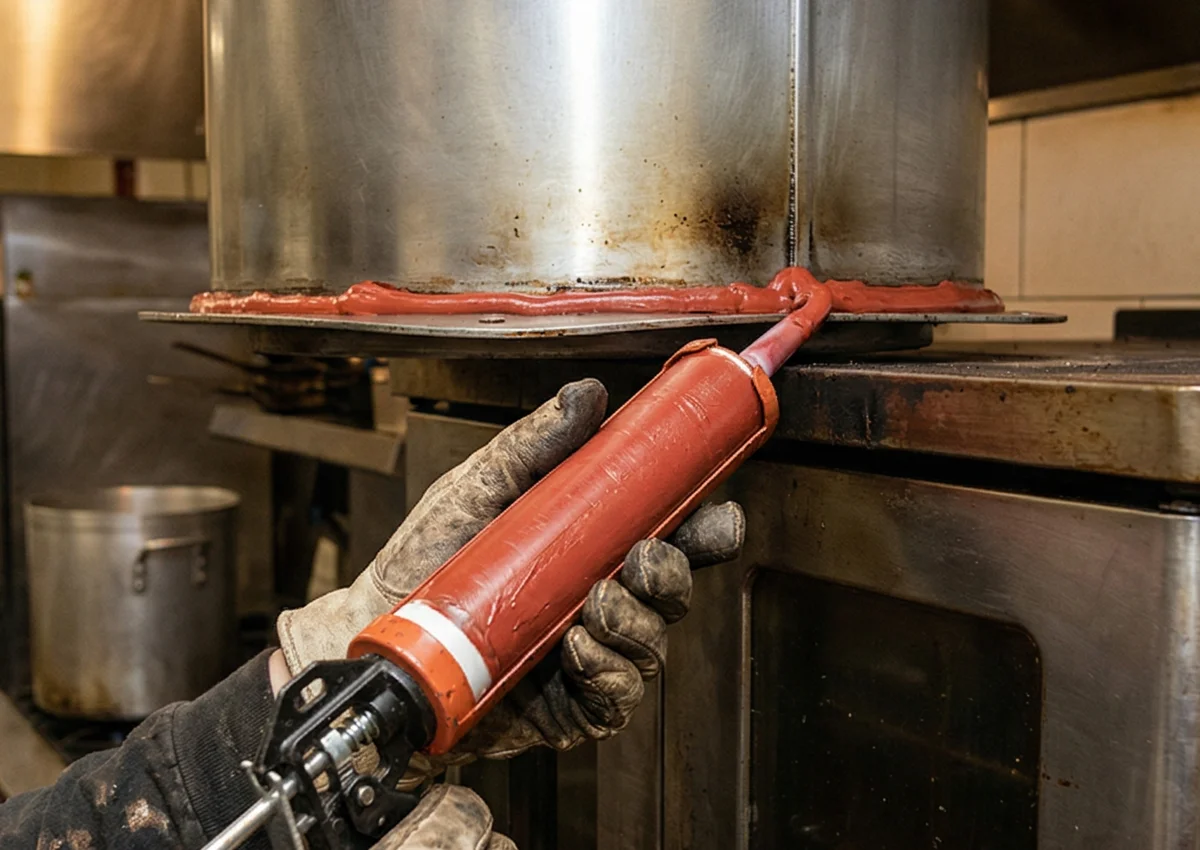
Standard silicone and polyurethane sealants top out around 250-300F. Push them beyond that and they harden, crack, or turn to powder. If you're sealing around exhaust flues, furnace equipment, chimney flashing, or industrial ovens, you need a sealant rated for the actual operating temperature of the surface.
This guide covers the two silicone tiers we carry (400F and 500F continuous), the applications each one fits, and the mistakes that cause early failures. For a broader overview of sealant types and chemistry, see the high-temp section of the Sealant Selection Guide.
Key distinction: Continuous temperature rating is what the surface stays at during normal operation. Intermittent rating is what it can handle for short spikes. A furnace flue might spike to 600F but run at 300F continuously. Always select based on the continuous rating.
Quick Picks by Temperature
Know your operating temperature? Here's what to grab.
Up to 400F continuous
Everkem TruSil 100
100% acetoxy-cure silicone, NSF-51 food-contact. HVAC ductwork, water heater flues, chimney flashing, general high-temp sealing.
View Product500F continuous / 600F intermittent
Everkem Hi-Temp Heat Resistant Silicone
High-temperature acetoxy silicone (Everkem TruSil HTS), NSF-51. Furnace exhaust flues, industrial ovens, engine exhaust, smoker joints.
View ProductAbove 600F? You're outside the silicone-sealant range. Wood stoves, kilns, fireplaces, and foundry joints need refractory cement (sodium silicate or calcium aluminate ceramic), which we don't currently carry. For those, look to Rutland or Imperial furnace cement at a hearth-products supplier.
Temperature Tiers: What Works Where
Silicone sealants fall into two clear tiers within their elastomeric range. Picking a product from the wrong tier is the most common failure mode.
| Temp Range | Product Type | Chemistry | Stays Flexible? | Paintable? |
|---|---|---|---|---|
| Up to 400F continuous | Standard 100% silicone | Acetoxy-cure RTV silicone | Yes (± 25% joint movement) | No |
| 500F continuous / 600F intermittent | High-temperature 100% silicone | Acetoxy-cure RTV silicone, high-temp formula | Yes (± 25% joint movement) | No |
Above 600F, silicone is the wrong chemistry — for fireboxes, wood stoves, kilns, and foundry work you need refractory cement (sodium silicate or calcium aluminate ceramic), which we don't currently carry. Refractory cement is rigid when cured and handles no joint movement, so even within its temperature range it isn't a substitute for silicone where parts expand and contract.
How to Choose a Heat-Resistant Sealant
Start with two questions: what is the continuous operating temperature of the surface, and does the joint move?
| Surface Temp | Joint Moves? | Use This | Example |
|---|---|---|---|
| Under 300F | Yes | Standard 100% silicone (TruSil 100) | HVAC duct seams, water heater B-vent |
| 300-400F | Yes | Standard 100% silicone (TruSil 100) | Chimney flashing, water heater flue, light duct |
| 400-500F continuous | Yes | High-temp silicone (Hi-Temp Heat Resistant Silicone) | Furnace flue connector, exhaust manifold |
| 500-600F intermittent | Yes | High-temp silicone (Hi-Temp Heat Resistant Silicone) | Engine exhaust headers, industrial oven trim |
| Any temp | Near food | NSF-51 rated silicone (both Everkem products qualify) | Commercial oven seals, smoker joints, kitchen exhaust |
If you're not sure about the temperature: measure with an infrared thermometer during normal operation. A $20 IR gun pays for itself by preventing a sealant failure that costs ten times that to redo.
Sealant Selection by Application
| Application | Typical Temp | Product Type | Notes |
|---|---|---|---|
| HVAC ductwork seams | 150-250F | Standard 100% silicone (TruSil 100) | Acetoxy is fine on galvanized; ventilate during cure |
| Water heater flue | 200-350F | Standard 100% silicone (TruSil 100) | Check local code for B-vent clearance requirements |
| Furnace exhaust flue | 300-500F | High-temp 100% silicone (Hi-Temp / TruSil HTS) | Use 500F continuous; standard 400F won't last on the hot side |
| Chimney flashing | 200-400F | Standard 100% silicone (TruSil 100) or flashing tape | Exterior UV exposure matters; pick UV-stable |
| Industrial oven trim / appliance | 400-500F | High-temp 100% silicone (Hi-Temp / TruSil HTS) | Apply to clean, dry, room-temperature substrate |
| Commercial kitchen exhaust hood | 200-400F | NSF-51 rated silicone (both Everkem products qualify) | Either product if near food-contact surfaces |
| Automotive / engine exhaust | 400-600F | High-temp 100% silicone (Hi-Temp / TruSil HTS) | Vibration resistance matters; verify sensor compatibility |
| Smoker / BBQ pit | 250-500F | NSF-51 rated silicone (Hi-Temp at 500F) | Allow full cure (24-72 hr) before first heat exposure |
Safety note: Both Everkem high-temp silicones are acetoxy-cure — they release acetic acid (vinegar smell) for 24-48 hours during cure. Ventilate enclosed spaces during application. Once fully cured, the acetic acid has fully dissipated and the cured silicone is NSF-51 certified for food contact.
Heat-Resistant Sealants: Head-to-Head Comparison
These are the products we carry for high-temperature work. Each one covers a different tier. Browse and buy in the products section below.
| Product | Max Temp | Type | Cure | Flexible? | Best For |
|---|---|---|---|---|---|
| Everkem TruSil 100 | 400F continuous | 100% silicone | Acetoxy cure | Yes (± 25%) | HVAC, water heaters, chimney flashing, food-contact |
| Everkem Hi-Temp Heat Resistant Silicone (TruSil HTS) | 500F continuous / 600F intermittent | High-temp 100% silicone | Acetoxy cure | Yes (± 25%) | Furnace flues, exhaust, industrial ovens, smokers |
Cross-Reference: If You've Used These Before
Already familiar with another brand? Here's where each Everkem product fits in.
TruSil 100 (400F continuous, 100% silicone, NSF-51)
Acetoxy-cure 100% silicone. Use anywhere you'd use a general-purpose 100% silicone — HVAC, water heaters, chimney flashing, food-contact joints.
Similar to: Boss 315, DAP 100% Silicone Kitchen & Bath, Red Devil 100% Silicone, Oatey/Hercules Silicone, Rectorseal 100% GP, 3M Super Silicone, SikaSil GP, TiteBond 100% Silicone
Hi-Temp Heat Resistant Silicone (Everkem TruSil HTS, 500F continuous, 600F intermittent, NSF-51)
High-temperature acetoxy 100% silicone for furnace flues, exhaust systems, industrial oven trim, and heat-exposed joints. Listed in our catalog under both names — same product (HTS-100), red color.
Similar to: Boss 326 Hi-Temp Red, DAP High Temp 100% Silicone, Red Devil 100% Heat Resistant, Oatey Hercules High Temp Red, Rectorseal Hi-Temp 100% Silicone, Permatex Ultra Copper / Ultra Red
Both Everkem high-temp products are acetoxy-cure. That's the standard chemistry for high-temperature 100% silicone sealants — it gives the strongest adhesion to glass, ceramic, painted and coated metals, and most building substrates. The acetic acid released during cure (the "vinegar smell") dissipates within 24-48 hours and the cured product is NSF-51 certified for food contact. For prolonged direct contact with bare copper or aluminum (e.g. certain medical or electronics enclosures), an oxime/alkoxy neutral-cure formula may be preferred — we don't currently carry one. For HVAC flues, furnace exhaust, and exterior chimney flashing, acetoxy cure is the standard and works fine.
Food Service and NSF-51 Requirements
Commercial kitchens, food processing plants, and restaurant equipment have an extra requirement: the sealant must be food-safe. NSF-51 certification means the material has been tested for use in food contact zones. NSF-Listed (not the same as NSF-51) covers splash zones and non-contact areas.
Most high-temp silicone is NOT food-safe. The fillers and curing agents used to boost temperature resistance are often not NSF-51 certified. You need a product specifically labeled for both high-temp AND food contact.
- Commercial oven door seals: NSF-51 rated, 400F+ continuous
- Exhaust hood transitions: NSF-Listed is usually sufficient (no direct food contact)
- Walk-in cooler/freezer seams near cooking areas: NSF-51 if within splash zone
- Smoker and BBQ joints: FDA food-safe silicone, rated for the operating temperature
For detailed guidance on food processing sealant requirements, see the Food Processing Sealants Guide.
For the cold end of the same NSF 51 family, walk-in panel joints, penetrations, and application temperature floors, see the walk-in cooler and freezer sealant guide.
Common Mistakes
Using the intermittent rating instead of continuous
A label that says "withstands temperatures up to 600F" often means intermittent peaks, not continuous operation. The continuous rating might be 400F. If your furnace flue runs at 450F all winter, the sealant will fail within one season. Always check the datasheet for the continuous temperature rating.
Applying to hot surfaces
High-temp sealants need to be applied to cool surfaces (under 100F) and allowed to fully cure before heat exposure. Applying to a hot surface prevents proper adhesion and curing. The sealant skins over on contact but never bonds to the substrate underneath.
Sealing bare copper or aluminum without checking the chemistry
Acetoxy-cure silicone (which is what both our Everkem high-temp products are) releases acetic acid during the 24-48 hour cure window. On most building substrates — galvanized or painted steel, stainless, glass, ceramic — that brief exposure is fine and doesn't affect long-term adhesion. On bare copper or bare aluminum in long-life or critical applications, the residual acid can attack the substrate and weaken the bond line. For those substrates, specify a neutral-cure (oxime or alkoxy) silicone. For HVAC flues, exhaust manifolds, and standard metal flashing, acetoxy is the industry standard.
Treating high-temp silicone as a substitute for refractory cement
Even our 500F-continuous high-temp silicone is the wrong product for a firebox, kiln, or wood stove (1000F+). For those, you need refractory cement (sodium silicate or calcium aluminate ceramic), which cures rigid and can't handle joint movement but tolerates extreme heat. We don't currently carry refractory cement — for that look to Rutland or Imperial at a hearth supplier.
Standards Reference
| Standard | Covers | When You Need It |
|---|---|---|
| ASTM C920 | Elastomeric joint sealants (all types) | Spec-grade projects requiring classified sealant. Full reference |
| UL 723 / ASTM E84 | Surface burning characteristics (flame spread) | Building code compliance for sealants in plenums and air ducts |
| UL 181A / UL 181B | Duct closure tapes and mastics | Sealing duct joints and seams, not flues. UL 181 markings |
| NSF/ANSI 51 | Food equipment materials (food contact) | Commercial kitchens, food processing, any food contact application |
Frequently Asked Questions
What is the most heat-resistant silicone sealant?
Acetoxy-cure 100% silicone tops out around 500F continuous and 600F intermittent. Beyond that, silicone is the wrong chemistry — you need refractory cement (ceramic-based, rigid). The highest-temperature silicone we carry is the Everkem Hi-Temp Heat Resistant Silicone (also called TruSil HTS), rated 500F continuous and 600F intermittent.
Can I use regular silicone on a furnace flue?
No. Standard silicone is rated to about 250-300F. Most furnace flues run 300-500F. The silicone will harden, crack, and eventually crumble. Use a high-temp RTV silicone rated for at least 500F continuous.
What sealant is safe for a smoker or BBQ?
You need both food-safe (FDA or NSF-51) and high-temp rated. Most high-temp silicones are NOT food-safe. Look for products specifically labeled as food-grade high-temperature silicone. Standard RTV releases toxic fumes during curing and is not safe near food.
Do I need a primer for high-temp silicone?
Usually no. Most high-temp RTV silicones bond directly to clean, dry metal, glass, and ceramic without primer. Some products need primer on plastics or painted surfaces. Check the product datasheet. Surface must be clean, dry, and below 100F at application.
How long does high-temp silicone take to cure?
For both Everkem high-temp products, tooling time is 5-7 minutes and full cure is 24-48 hours at 75F / 50% relative humidity (longer at lower temp or humidity, up to 7 days for maximum strength). Do not expose to operating temperature until fully cured — heating uncured silicone causes bubbling, poor adhesion, and skinning over before the bulk material gels.
What is the best high-temperature sealant for exhaust pipes?
For automotive exhaust manifolds and downpipes (400-600F), use the Everkem Hi-Temp Heat Resistant Silicone (TruSil HTS), rated 500F continuous and 600F intermittent. For residential furnace exhaust flues (300-500F), the same product works. Verify oxygen-sensor compatibility for vehicles with sensors downstream of the seal — sensor-safe means the cured silicone doesn't release enough silicon-bearing volatiles to coat the sensor element.
Is high-temperature sealant waterproof?
Yes. Cured 100% silicone sealant is fully waterproof and resists water, steam, and most household chemicals. That makes both Everkem high-temp products suitable for exterior applications like chimney flashing where heat and rain exposure both occur. (Refractory cements, by contrast, are not waterproof — another reason silicone is the right choice for any outdoor or wet-area high-temp joint.)
What color does high-temp sealant come in?
The standard high-temperature silicone color is red — that's the industry convention for identifying high-temp rated product on the shelf and in the field. Everkem Hi-Temp Heat Resistant Silicone (TruSil HTS) is red. TruSil 100, the standard 400F version, ships in white, clear, black, aluminum, and mildew-resistant translucent white so the joint blends with the substrate. Color is a labeling and aesthetic choice, not a performance differentiator.


Was this page helpful?
Your feedback helps us improve our technical resources.

Recommended in this guide
Everkem Hi-Temp Heat Resistant Silicone
Case of 12 (10.1 oz)
500°F continuous / 600°F intermittent — NSF-51 food-safe