
Firestop Inspection Requirements
What Building Owners and Contractors Need to Know
Overview
Firestop means sealing the gaps around pipes, cables, ducts, and conduits where they pass through fire-rated walls and floors. A 2-hour fire-rated wall with an unsealed pipe penetration is effectively a 0-hour wall at that point. The fire follows the path of least resistance, and an open penetration is an open path.
This page covers when third-party firestop inspection is required under IBC 2021, what inspectors actually look for, the most common reasons firestop installations fail inspection, and how to read a UL system listing to verify your installation matches the tested configuration.
For firestop sealant types, material selection, and specification guidance, see the firestop section of our Commercial Sealant & Caulk Selection Guide.
When Is Firestop Special Inspection Required?
IBC 2021 Section 1705.18 requires third-party special inspection for firestop systems in certain building types. The special inspector is hired by the building owner (per IBC Section 1704.2.5), not the installing contractor. The inspector verifies that installed firestop systems match their UL system listings.
Section 1705.18.1 requires that through-penetration firestop systems be inspected in accordance with ASTM E2174. This covers pipes, conduits, cables, and ducts that pass through fire-rated walls and floor/ceiling assemblies.
Section 1705.18.2 requires that fire-resistant joint systems, including expansion joints, seismic joints, and perimeter fire barrier systems, be inspected in accordance with ASTM E2393.
Which buildings trigger the requirement:
| Building Type | Special Inspection Required? |
|---|---|
| High-rise (occupied floors above 75 ft) | Yes |
| Risk Category III (assembly, schools with 250+ occupants) | Yes |
| Risk Category IV (essential facilities, hospitals) | Yes |
| Group R residential over 250 occupants (new in IBC 2021) | Yes |
| All other buildings with fire-rated assemblies | No special inspection required, but firestop must still comply with IBC Sections 714 and 715 |
What changed from IBC 2018 to 2021: The 2021 edition expanded the scope to include Group R residential occupancies over 250 occupants. Previously, firestop special inspection was limited to high-rise and Risk Category III/IV buildings. If you manage a large residential property, this may be a new requirement for your next renovation or new construction project.
What Inspectors Check
A firestop special inspector walks each penetration and joint and compares the installed condition against the UL system listing. Here is what they verify:
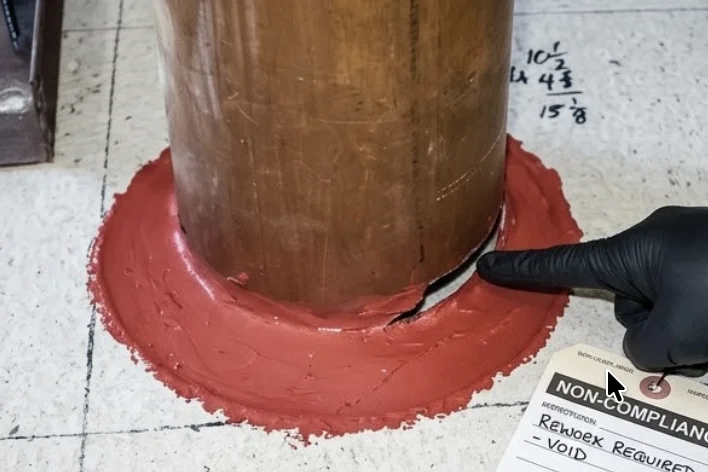
A firestop inspection failure: the inspector identified a void in the sealant around this pipe penetration, requiring rework before approval.
UL system listing match
The installed firestop system must be a tested and listed UL system, not just "fire-rated caulk from the hardware store." The inspector checks that the specific product, depth, backing material, and configuration match the UL listing.
Correct hourly rating
The firestop system must match or exceed the hourly rating of the wall or floor assembly it penetrates. A 2-hour wall needs a firestop system tested to at least 2 hours.
Penetrating item match
The pipe, cable, or duct passing through the wall must be the same type and size (or within the range) that the UL listing covers. A listing tested with steel pipe does not cover plastic pipe.
Annular space
The gap between the penetrating item and the edge of the opening must be within the range specified in the UL listing. Too large or too small, and the listing does not apply.
Backing material
Many UL systems require mineral wool, backer rod, or other fill material behind the sealant. Sealant alone is often not the complete system.
Sealant depth
UL listings specify minimum sealant depth (often 5/8 inch or 1 inch). A thin bead of caulk does not meet the tested configuration.
Red UL system label and documentation
Each penetration should have the manufacturer's red system identification label installed. The inspector also checks for installation photos and a log of UL system numbers used at each location.
Common Firestop Violations
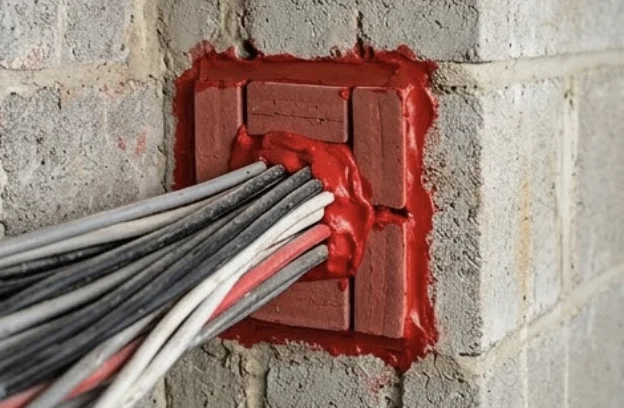
A compliant firestop installation: intumescent sealant with mineral wool backing around cable penetrations through a CMU wall.
These are the reasons firestop caulk and firestop systems fail inspection most often. Each one means the installed firestop does not match its tested, listed configuration and cannot be relied on to perform in a fire.
| Violation | Why It Fails | How to Fix |
|---|---|---|
| Wrong sealant product | Each UL listing names specific products. A different brand or type voids the listing even if it is also fire-rated. | Look up the UL system number and verify the exact product specified. |
| Insufficient sealant depth | UL listings specify minimum depth. A shallow bead does not replicate the tested configuration. | Reapply to the listed depth. Measure with a depth gauge before the inspector arrives. |
| Missing backing material | Many UL systems require mineral wool or backer rod behind the sealant. Sealant alone is not the complete system. | Install backing material to the type and depth shown in the UL listing detail drawing. |
| Annular space out of range | UL listings specify the maximum gap between the penetrating item and the opening. Gaps outside this range are not covered. | Resize the opening or select a different UL system that covers the actual gap dimension. |
| Plastic pipe without intumescent | Plastic pipe melts in a fire. Without an intumescent collar, wrap, or sealant that expands to fill the void, the opening is unprotected after the pipe is gone. | Install the intumescent component specified in the UL system listing. |
| No red UL system label | The label identifies which UL system was installed. Without it, the inspector cannot verify compliance and the installation is undocumented. | Install the manufacturer's red system identification label at each penetration. |
| No installation documentation | IBC requires the special inspector to document each penetration. Missing records mean the work cannot be verified after the walls are closed up. | Photograph each penetration before it is concealed. Log the UL system number, date, and installer for each location. |
| Cable fill percentage exceeded | Too many cables crammed into one opening push the aggregate cable cross-section past the maximum the UL system was tested to, so the sealant can no longer surround each cable and the assembly is outside its listing. | Split the cables across multiple firestopped openings, or select a UL system rated for the actual fill and reseal to that listing. |
| Wrong or uncompressed mineral wool | Low-density mineral wool, or the correct wool left uncompressed, does not match the packing the system was tested with and can let the assembly fail well short of its rating. | Use the mineral wool density and compression the UL listing specifies, packed to the depth shown in the system detail drawing. |
| Incompatible materials (CPVC) | Some sealants react chemically with the penetrating item, most commonly CPVC pipe, degrading the seal over time even when it looked correct at installation. | Confirm the sealant is listed as compatible with the penetrant, and use a CPVC-compatible system wherever CPVC is present. |
| Poorly tooled sealant | Sealant that was not tooled to adhere fully to both the penetrating item and the substrate leaves voids and gaps the tested system does not have. | Tool the sealant so it fully wets and bonds to the penetrant and the wall or floor, with no voids at the interface. |
| New penetrations from later cable work | The most common real-world failure: a later move, add, or change runs new cable through a rated wall and never re-firestops the breach, so a previously passing barrier is now open. | Re-firestop every penetration created or disturbed by cabling work back to a valid listed system. See our mission-critical firestop compliance hub. |
The fix is always the same: firestop is a tested, listed system, not a product you can improvise. Match your wall, penetrating item, and annular space to a UL system, then install the exact sealant, collar, or wrap it names. See the firestop products below, or the firestop product selection guide to pick by penetration type.
How to Read a UL Firestop System Listing
A UL firestop system listing describes a specific tested configuration: the wall or floor type, the penetrating item, the firestop product, and the installation method. If your field condition does not match the listing, the listing does not apply to your installation.
Every listing includes an F-rating and usually a T-rating. The F-rating is the time in hours that the system prevents flame passage through the penetration. The T-rating is the time in hours before the temperature on the unexposed side rises more than 325 degrees F above ambient. Some listings also include an L-rating, which measures air leakage in cubic feet per minute and is required for penetrations through smoke barriers.
Where to find UL listings:
UL Product iQ (productiq.ulprospector.com) is the official database. Manufacturers also provide searchable system tools: Hilti (firestop.hilti.com), STI/Specified Technologies (systems.stifirestop.com), and 3M each have system lookup tools where you enter your wall type and penetrating item to find the matching listing.
How to match a listing to your field condition:
Start with the wall or floor assembly (the UL design number or generic description). Then identify the penetrating item type and size. Then check that the annular space falls within the listed range. The listing will specify the exact firestop product, application depth, and any required backing material. If any variable does not match, you need a different listing.
Firestop Standards Reference
| Standard | What It Covers |
|---|---|
| UL 1479 (ASTM E814) | Fire test for through-penetration firestop systems (the test that produces F, T, and L ratings) |
| UL 2079 | Fire test for building joint systems (expansion joints, seismic joints, perimeter fire barrier systems) |
| ASTM E2174 | On-site inspection procedure for installed firestop systems (the standard the special inspector follows) |
| ASTM E2393 | On-site inspection procedure for installed fire-resistant joint systems |
| IBC 2021 Section 714 | Code requirements for through-penetration firestop systems |
| IBC 2021 Section 715 | Code requirements for fire-resistant joint systems |
| IBC 2021 Section 1705.18 | When third-party special inspection is required for firestop |
| NEC Article 300.21 | Sealing of openings around electrical penetrations in fire-rated assemblies to prevent the spread of fire and products of combustion |
| NEC Articles 770.26 / 800.26 / 820.26 | Same firestop mandate as 300.21 applied to optical fiber, communications, and CATV cable penetrations through fire-rated walls and floors |
Firestop Products

Manufacturer: Everkem
Everkem Fire Rated Intumescent Putty Pad
$144.00
$180.00

Manufacturer: Everkem
Everkem Firestop-814+ Intumescent Firestopping Sealant
$137.00
$144.00

Manufacturer: Everkem
Everkem Intumescent Firestop Collars
$216.00

Manufacturer: Everkem
Everkem Intumescent Firestop Pillow
$270.00
$310.00

Manufacturer: Everkem
Fire Seal 136 Residential Firestop Caulk
$107.00
Frequently Asked Questions
Does every building need firestop special inspection?
No. IBC 2021 Section 1705.18 requires third-party special inspection only for high-rise buildings, Risk Category III and IV buildings, and Group R residential occupancies over 250 occupants. However, all buildings with fire-rated walls and floors must have compliant firestop at every penetration, regardless of whether special inspection is triggered. The difference is who checks the work: in buildings that require special inspection, a third-party inspector hired by the owner verifies compliance. In other buildings, the general contractor or fire protection contractor is responsible.
Can I use any fire-rated caulk for firestop?
No. The words "fire-rated" on a tube of caulk do not mean it is listed for your specific wall assembly and penetration type. Firestop compliance requires using the exact product named in the UL system listing that matches your field condition, including the correct wall type, penetrating item, annular space, sealant depth, and backing material. Using a different product, even one that is also fire-rated, means the installation is not a listed system.
Who pays for firestop special inspection?
The building owner, per IBC Section 1704.2.5. The special inspector is hired by and reports to the owner, not the installing contractor. This separation is intentional: the inspector must be independent of the party doing the work. Typical cost ranges from $500 to $2,000 depending on building size and the number of penetrations to be inspected.
Was this page helpful?
Your feedback helps us improve our technical resources.
