
Fire Extinguishers for Server Rooms, Data Centers, and Sensitive Electronics
Choose a clean-agent or CO2 extinguisher that does not damage equipment, leaves no residue, and gets the room back online without an outage extension.
Last updated: July 21, 2026
Halotron Clean-Agent Extinguishers: Zero Residue
The spec pick for server rooms and data centers. The UL 2129 halocarbon agent discharges as a fast-evaporating liquid that leaves no residue and does not conduct electricity, so an energized rack stays online.

2.5 lb
UL 2-B:C
Manufacturer: Buckeye
Buckeye 2.5 lb Halotron Clean Agent Fire Extinguisher
$275.00

5 lb
UL 5-B:C
Manufacturer: Buckeye
Buckeye 5 lb Halotron Clean Agent Fire Extinguisher
$515.00

11 lb
UL 1-A:10-B:C
Manufacturer: Buckeye
Buckeye 11 lb Halotron Clean Agent Fire Extinguisher
$1,109.00
CO2 Extinguishers: Economical Class C
Non-conductive and residue-free at a lower cost than clean agent. Note CO2's thermal-shock and confined-space cautions versus Halotron for the most sensitive rooms.
Not sure which agent or size? This guide compares clean agent vs CO2, how to size by room, and why ABC and water damage electronics.
Where each extinguisher goes — jump to the section:
Quick Room Finder
Pick the room you are protecting. We will point you at the right agent and the right buying motion.
Overview
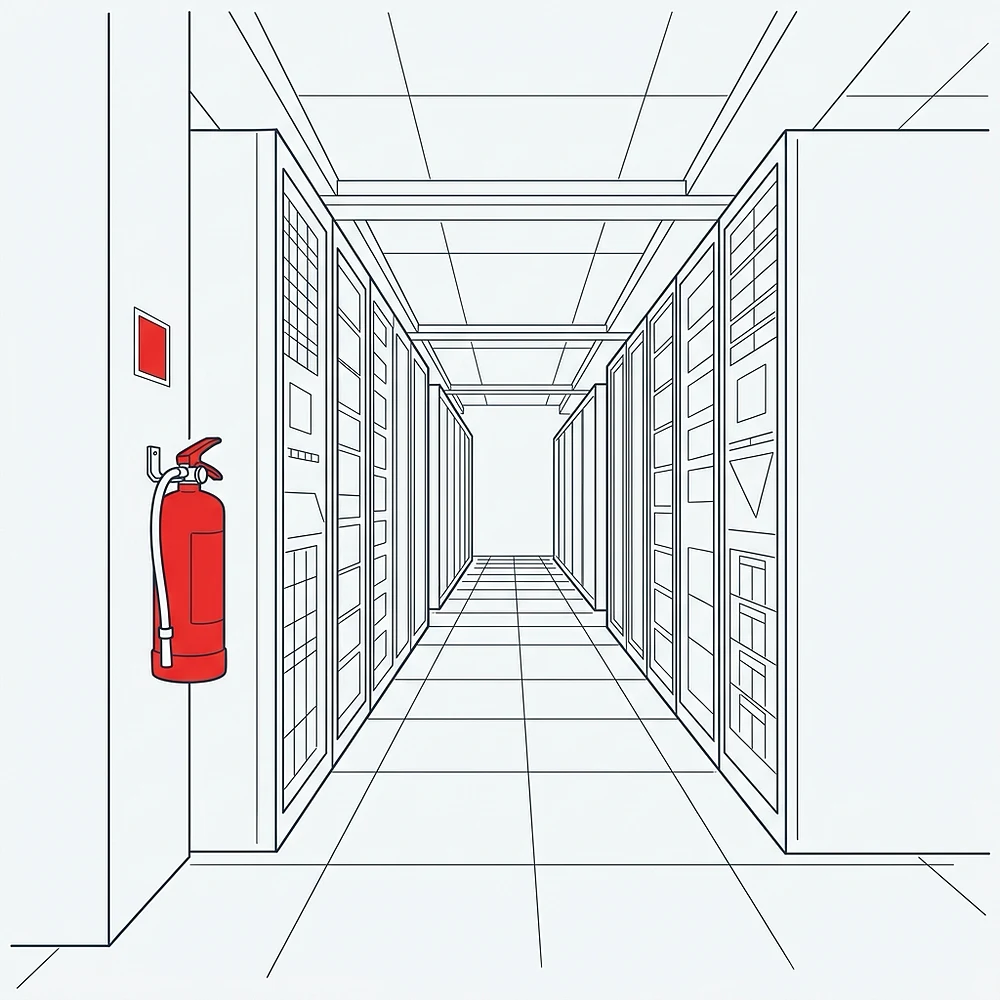
The buyer for a server room or data center extinguisher is not shopping for a fire extinguisher. They are shopping for a way to put out a small fire near expensive equipment without making the situation worse. The wrong extinguisher on a live cabinet can cost more in cleanup and downtime than the fire would have. The right one is non-conductive, leaves no residue, and lets you put the room back into service that day.
This guide covers the two products we recommend for IT, telecom, and electrical spaces (Halotron clean-agent and CO2), how they compare to legacy options (HFC-236fa / FE-36, Halon 1211), and how to size them under OSHA 1910.157 and NFPA 75, and how to think about cabinets, signs, and mounting brackets so the extinguisher is actually usable when someone needs it.
If you only remember one thing: never put an ABC dry chemical extinguisher in a room with energized servers, switchgear, or sensitive electronics. The residue is corrosive to circuit boards, and cleanup costs more than upgrading every extinguisher in the building.
Why ABC and Water Are Wrong Here
Generic ABC dry chemical extinguishers are the cheapest, most common extinguisher in a commercial building. They are also the wrong choice for a server room. The agent inside an ABC unit is monoammonium phosphate, a fine yellow powder. When discharged onto a circuit board, the powder coats every component and is hygroscopic, meaning it pulls moisture out of the air. With humidity, the powder becomes phosphoric acid and corrodes copper traces, pads, and pin headers. Boards that survived the fire can fail weeks later from the cleanup.
Water is conductive and damages paper, magnetic media, and most electronics immediately. AFFF foam is conductive and adds a film that has to be cleaned off. Both are appropriate for Class A combustibles in office spaces and storage rooms but not on or near live equipment.
Real cost of an ABC discharge in a data hall: the extinguisher itself runs around $80. The cleanup of a single rack and the surrounding cold-aisle floor tiles, plus the engineering downtime for affected services, runs into five and six figures. The discharge takes seconds. The cleanup takes weeks.
The right answer is a clean-agent extinguisher (Halotron, or a legacy HFC-236fa or Halon 1211 unit if you already have one in service) or carbon dioxide. All are non-conductive and leave no residue. All are safe on energized equipment. The next section breaks down which to pick.
One code-driven exception — elevator machine rooms. An elevator machine room or MRL control space is governed by ASME A17.1, which calls for an extinguisher rated for Class A, B, and C — so a CO2 unit (rated B:C, no Class A) does not satisfy it on its own. For that specific room the residue-free option is a larger A:B:C-rated Halotron, or a multipurpose ABC dry chemical; confirm your local elevator-code amendments. See our NFPA 10 fire extinguisher guide for the requirement.
Clean Agent vs CO2 vs ABC for Sensitive Electronics
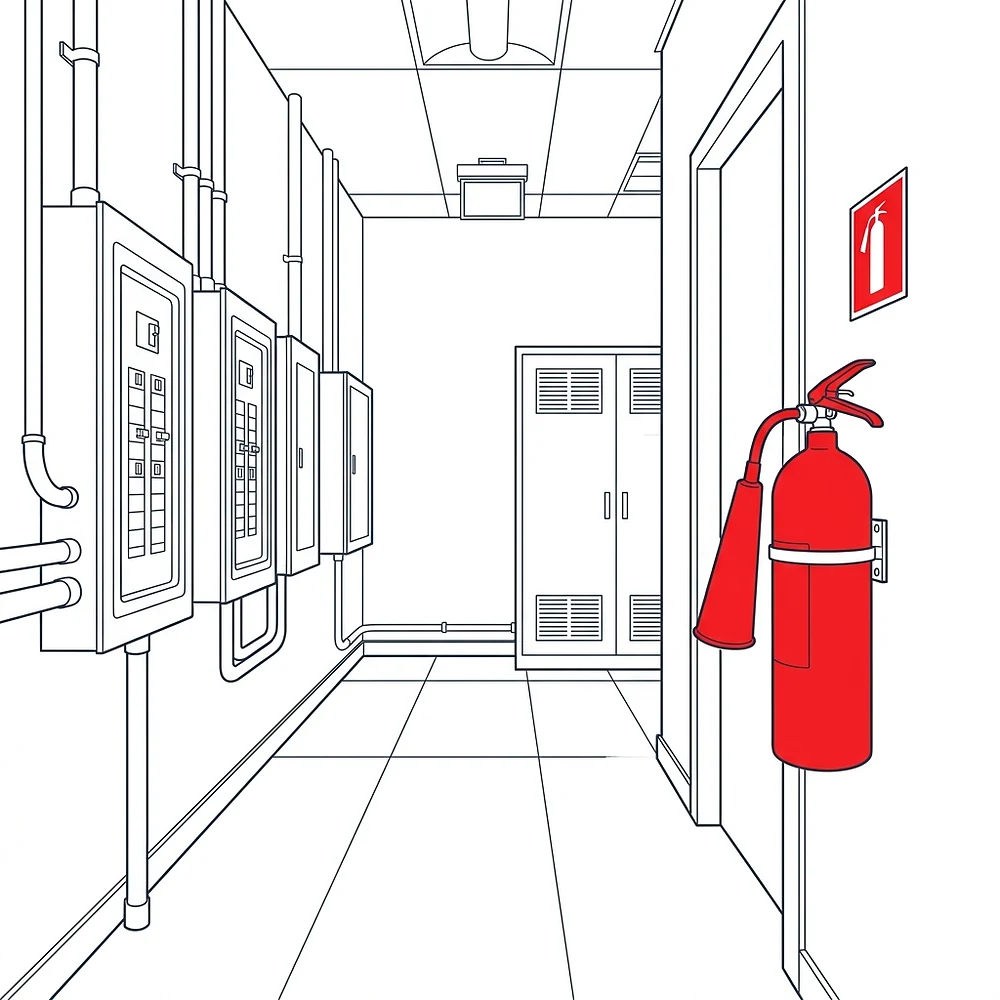
Six agents end up in this conversation. Two are right for almost any electronics space and are what we stock today. One is acceptable on energized equipment but has no Class A rating. The other three are either legacy or should not be there at all.
| Agent | Typical UL Rating | Residue | Conductive | Best For | Avoid In |
|---|---|---|---|---|---|
| Halotron I (we stock) | 2-A:10-B:C | None | No | Computer rooms, telecom closets, electrical cabinets, document storage | Outdoor / wind |
| CO2 (we stock) | 10-B:C (no Class A) | None | No | Electrical rooms, switchgear, machine shops | Small confined rooms (oxygen displacement), document storage (no Class A), outdoor wind |
| HFC-236fa (FE-36) / Halotron BrX | 1-A:10-B:C and up | None | No | Equivalent to Halotron I; specified by some hyperscalers and OEMs | Outdoor / wind |
| Halon 1211 (legacy) | varies | None | No | Service existing units; do not specify new | New installations |
| ABC dry chemical | A:B:C (broad) | Yes, corrosive | Not recommended on live equipment | General-purpose office and warehouse | Computer rooms, switchgear, document storage |
| Water / AFFF | A or A:B | Yes | Yes | Class A combustibles, no live equipment | Anywhere with energized electronics |
Halotron I (Recommended for IT, Telecom, and Mixed Hazards)
Halotron I is an HCFC-123-based clean agent that has been in service for decades, is rated A:B:C, and remains in active production for fire extinguishers despite the broader phaseout of HCFCs in refrigeration. Recharge supply will continue to be available for the foreseeable future. The 15.5 lb Halotron handheld carries a 2-A:10-B:C rating under ANSI/UL 711, which covers combustibles, flammable liquids, and energized electrical equipment from a single cylinder. That makes it the right fit for any space that mixes paper, electronics, and live gear: server rooms, telecom closets, control rooms, document archives.
- Residue-free and non-conductive, safe on energized equipment
- 2-A:10-B:C rating covers paper, flammable liquids, and Class C electrical
- Made in the USA
CO2 (Recommended for Electrical Rooms and Switchgear)
Carbon dioxide extinguishers are the legacy standard for electrical hazards and are listed under ANSI/UL 154. The agent is non-conductive, leaves no residue, and is cheap on a per-pound basis. CO2 is rated B:C (not A), so it is not the right pick if the protected space contains a meaningful amount of paper, fabric, or other Class A combustibles.
The trade-off with CO2 in a small enclosed room is oxygen displacement. NIOSH lists CO2 IDLH at 40,000 ppm (4%). A 20 lb CO2 extinguisher discharged in a 200-cubic-foot closet pushes ambient CO2 well past that level. Halotron does not have this problem at handheld sizes. Pick CO2 when the room is large enough that oxygen displacement is not a concern, the load is purely electrical, and cost per pound matters.
- Residue-free, non-conductive, no thermal damage to most components
- 10-B:C rating, no Class A; not for paper or document storage
- Made in the USA
HFC-236fa (FE-36), Halotron BrX, and Halon 1211 (Legacy and Specialty)
HFC-236fa (commonly labeled FE-36) and Halotron BrX (chemical name 2-BTP) are both residue-free clean agents in the same use cases as Halotron I. FE-36 is specified by some hyperscalers and OEMs because of its wider NOAEL margin for occupied spaces. BrX is the EPA SNAP-listed next-generation streaming agent and is what some new specifications point toward.
Halon 1211 new production was banned in the US in 1994 under the Clean Air Act and the Montreal Protocol. Existing Halon 1211 portables can still be legally recharged from reclaimed supply, but no facility should specify new Halon 1211 today. If your spec calls for FE-36, BrX, or Halon 1211, contact us for a sourcing quote. Halotron I and CO2 cover the same use cases and are what we stock for fast shipment.
Sizing and UL Ratings
Sizing a portable for a sensitive-electronics space comes down to two things: the UL fire-test rating stamped on the cylinder, and how far someone has to carry the unit to reach the fire.
Reading the UL Rating
A handheld rating like 1A:10B:C means the cylinder is tested to extinguish a 1A wood-crib fire, a 10B flammable-liquid pan fire, and is listed as safe on Class C energized electrical equipment. The Class A and B numbers are linear ratings: a 2A unit covers twice the Class A area of a 1A unit. The C is binary, either it is rated C or it is not. Clean agents and CO2 are both rated C; CO2 has no Class A rating because it tends to allow Class A re-flash. The rating you need depends on the hazard, not on the agent. Cylinder weight is set by the rating: smaller hazards get a smaller cylinder.
Travel Distance
For Class C hazards, NFPA 10 sizes the extinguisher distribution based on the underlying Class A or Class B exposure. In practice, that means cylinder spacing in a data hall is set by the Class A loading (pallets, paper, packaging) or by the Class B exposure if you have flammable liquids in the room. A practical rule for IT spaces: a portable extinguisher within 50 feet of any point in the protected room, mounted on the egress path so someone leaving the room walks past it.
Mounting height per OSHA 29 CFR 1910.157(c)(1)(iv): the top of the extinguisher must be no more than 5 feet above the floor for units weighing 40 pounds or less, and no more than 3.5 feet above the floor for units over 40 pounds. The clearance from the bottom of the extinguisher to the floor must be at least 4 inches.
Code Expectations
Three documents drive what most facilities are inspected against. Read these in order before specifying.
NFPA 75: Information Technology Equipment
NFPA 75 is the standard for fire protection of IT equipment. It addresses construction, detection, suppression, firestop, and the role of portable extinguishers. Portable Class C extinguishers are called for as a complement to room-level suppression in IT spaces, on the principle that someone on the floor should be able to handle a small incipient fire without activating the room-level system.
Read the NFPA 75 standard page →NFPA 2001: Clean Agent Fire Extinguishing Systems
NFPA 2001 governs total-flooding clean-agent systems (FM-200, FK-5-1-12 / Novec 1230, IG-541 / Inergen, IG-55 / Argonite). The standard is fixed systems, not handhelds, but the logic of agent selection is the same: avoid residue, avoid conductivity, design for occupied or unoccupied concentrations, and address acoustic damage to spinning hard drives from inert-gas discharge.
Read the NFPA 2001 standard page →OSHA 29 CFR 1910.157: Portable Fire Extinguishers
OSHA 1910.157 sets placement, accessibility, mounting height, monthly inspection, and annual maintenance requirements for portables. The mounting and monthly-inspection clauses are where most facilities fail an audit.
Read the OSHA 1910.157 standard page →Acoustic damage from total-flooding inert systems: a conventional inert-gas discharge can exceed 130 dB(A) at the nozzle. Hard drives start to degrade around 110 dB(A), and some report errors as low as 85 dB(A). If a data hall has spinning HDDs and an inert-gas system, it should be specified with low-noise or silent nozzles. This does not affect handheld extinguishers, but it is the most common source of post-discharge damage in NFPA 2001 systems.
Mounting, Cabinet, and Signage
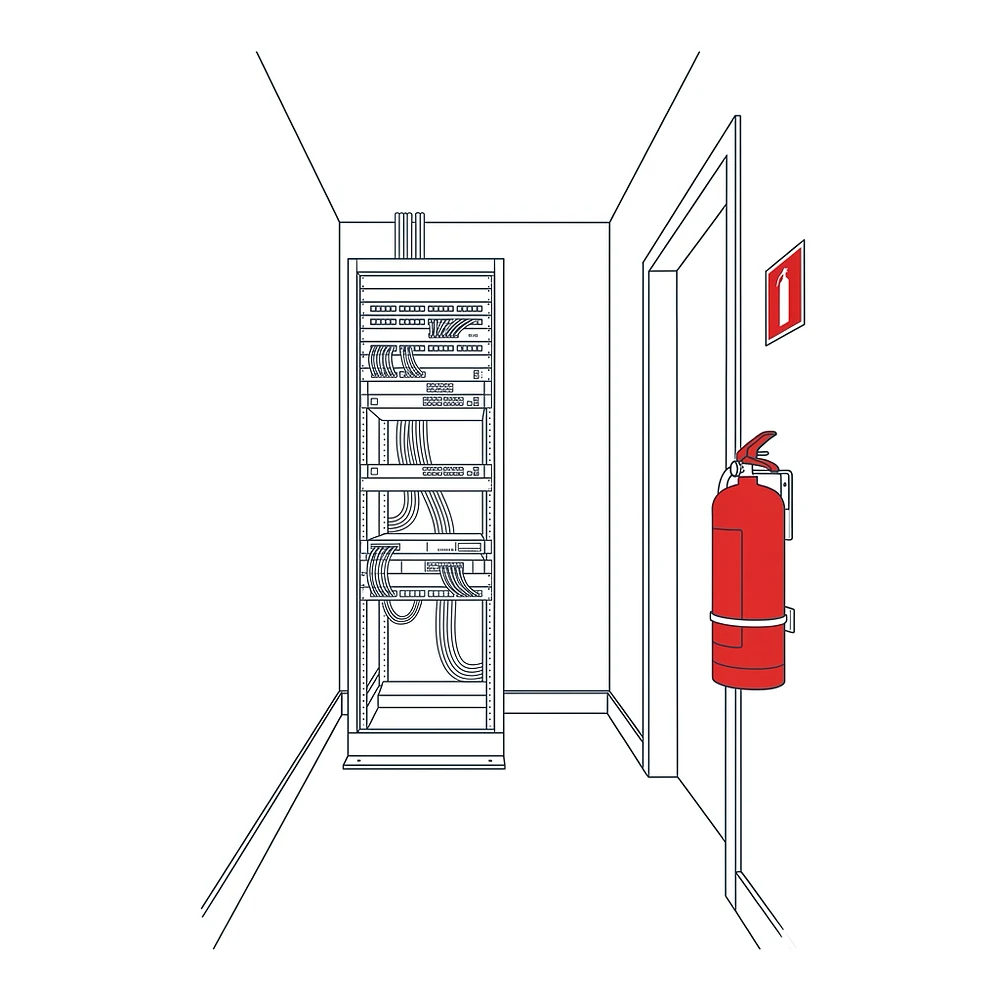
The extinguisher is one of four parts of the install. The other three are the bracket or cabinet, the wall sign, and the OSHA-required monthly inspection tag. Buying just the cylinder pushes the rest of the work onto the customer.
Wall Bracket vs Cabinet
- Wall bracket: cheapest option, exposed cylinder. Fine in a back-of-house electrical room or a clean equipment area.
- Surface-mount cabinet: the cylinder is enclosed in a wall-mounted box with glass or polycarbonate. Required where dust, public traffic, or aesthetics matter.
- Recessed or semi-recessed cabinet: the cabinet sits flush in the wall. Architectural choice for finished spaces, lobbies, and hospital corridors.
Signage
A wall sign visible from across the room is required so the unit is findable in low light or smoke. For NFPA 2001 protected spaces, a separate placard at the door indicates total-flooding system status and abort-switch location. Plain English is fine; international ISO 7010 fire-equipment pictograms are also acceptable.
Monthly Inspection
OSHA 1910.157(e)(2) requires a monthly visual inspection. The inspection is a check of pressure gauge, hose, pin, tamper seal, and accessibility. The inspector signs the back tag. This is the single most common compliance gap in IT facilities, where the extinguisher is installed correctly and then forgotten until the AHJ walks through.
When Handhelds Are Not Enough
Handheld extinguishers depend on a person being there to discharge them. For an enclosed cabinet or an unattended closet, that is the wrong assumption. Automatic spot-protection units are small clean-agent flood devices mounted inside the enclosure that activate on a fixed-temperature heat link or detection signal. No one needs to be present.
Common applications: server and network cabinets, telecom and IDF closets too small to occupy, machine-tool and SCADA control enclosures, and cell-tower equipment shelters. Coverage volumes are small (typically tens to low hundreds of cubic feet per unit), and most are heat-actuated without a control panel or detection wiring.
Sizing an automatic spot unit depends on enclosure volume, agent concentration, and whether the cabinet is sealed or louvered. We handle this as a quote rather than a direct purchase. If you are evaluating one for a server cabinet, telecom closet, or control enclosure, contact us and we will scope the right unit.
Large Open Spaces: Halotron Wheeled Units
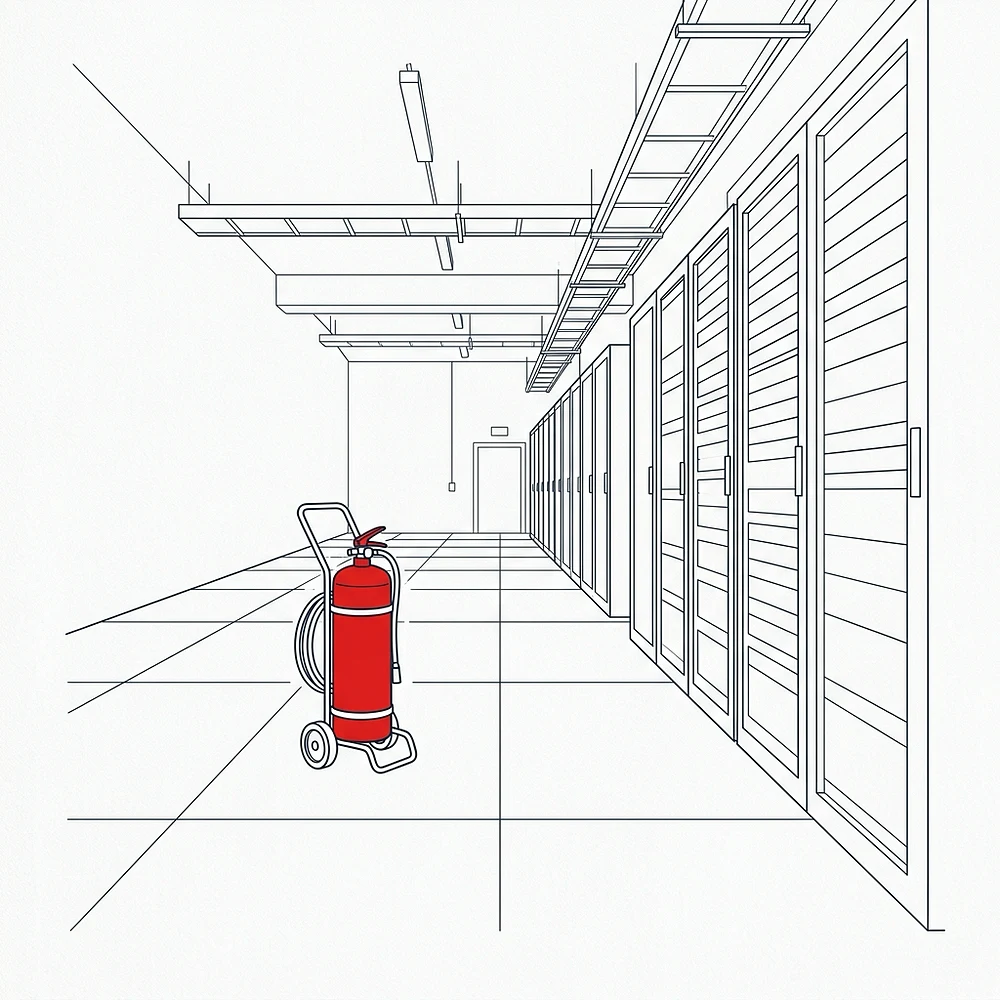
A 15.5 lb Halotron handheld covers a server room, an electrical room, or a single data-hall aisle. A large data hall, an aircraft hangar with avionics and ground-support electronics, or a wide switchgear and control room is a different problem: too much floor area and fire load for the reach and discharge time of a handheld. A Halotron wheeled unit gives one operator a large charge of the same Halotron I clean agent on a cart, with the range and duration a handheld cannot match. The agent is non-conductive and residue-free, so it is safe around energized equipment and adds no residue cleanup to the recovery.
We stock two sizes. The 65 lb Halotron wheeled is rated 4-A:60-B:C, and the 150 lb Halotron wheeled is rated 10-A:120-B:C. Both use the same Halotron I agent as the handhelds, so the difference is capacity, discharge time, and reach, not how the agent behaves around energized equipment.
Large clean-agent coverage suits aircraft hangars and avionics areas, large data halls, and wide electrical or control rooms, where a residue-free agent protects electronics that dry chemical would foul. NFPA 409 governs aircraft hangar fire protection. Fuel-servicing ramps are a separate requirement: NFPA 407 calls for dry-chemical units such as Purple K, not clean agent. For the full lineup of high-capacity units, see the wheeled extinguisher collection.
Halotron Wheeled Units for Large Clean-Agent Coverage
When a handheld is too small for the space, a wheeled Halotron unit puts 65 to 150 lb of non-conductive, residue-free agent on a cart. UL 2129 listed and made in the USA. These ship by LTL freight; request volume pricing for multi-unit or multi-site orders.

Frequently Asked Questions
Will a clean-agent extinguisher damage my servers?
No. Halotron is non-conductive, leaves no residue, and is designed for use on energized electrical equipment. After a discharge the agent vaporizes and ventilates out of the room. There is no cleanup of the equipment itself. The same is true for CO2, with the caveat that CO2 thermally shocks components and can crack a hot semiconductor or display. The same is also true for the legacy clean agents (HFC-236fa / FE-36, Halotron BrX, Halon 1211).
Can I just put a regular ABC extinguisher in my server room?
It is technically allowed by code in many jurisdictions, but it is not what manufacturers, NFPA 75, or any data center operator recommends. ABC dry chemical residue is corrosive to circuit boards. The cost of cleaning up after an ABC discharge in a live rack is far greater than the cost of upgrading to a clean-agent unit before the fire.
Halotron or CO2 for an electrical room?
Either works. CO2 is cheaper and the long-time standard for electrical hazards. Pick Halotron if the room is small enough that CO2 oxygen displacement becomes a personnel concern, if the gear includes sensitive electronics like SCADA terminals, or if the room contains paper or other Class A combustibles that CO2 will not extinguish.
What size clean-agent extinguisher do I need?
Most IT and electrical rooms are covered by a 15.5 lb Halotron handheld rated 2-A:10-B:C, or a 10 lb CO2 handheld rated 10-B:C. The size is set by the underlying Class A or Class B exposure in the room and by travel distance, not by the C rating. For travel distance, mount one within 50 feet of any point in the protected area, on the egress path.
Our insurance carrier recommended clean agent extinguishers for the server room. What do we buy?
Insurance risk walkthroughs commonly recommend locating clean-agent extinguishers in server and equipment rooms because the agent is non-conductive and leaves no residue on the equipment it protects. A 2.5 or 5 lb Halotron handheld per room is the typical starting point for small server rooms and network closets; larger rooms or mixed hazards step up to the 11 or 15.5 lb units with Class A coverage. Match the UL rating to the room, place units per NFPA 10, and keep the recommendation letter with your inspection records. If the walkthrough covered multiple sites, request a quote and we will spec the count per room.
Can I still buy or recharge a Halon 1211 extinguisher?
US new production of Halon 1211 was banned in 1994. Existing Halon 1211 portables can still be legally serviced and recharged from reclaimed supply. If you have Halon 1211 units, keep using them; for new specifications, the direct replacement is a Halotron handheld.
Do I need an automatic spot-protection unit for my server cabinet?
If the cabinet is enclosed, unattended, and contains equipment expensive or critical enough that a small fire would not be discovered for hours, yes. A small clean-agent flood unit mounted inside the cabinet is the common answer. Mounting and sizing are specific to the cabinet volume and ventilation, so we handle these as quotes rather than direct purchases.
When do I need a wheeled Halotron unit instead of a handheld?
When the space is too large or the fire load too high for a handheld to reach and hold. A 15.5 lb handheld is right for a server room, an electrical room, or a single aisle. A large open data hall, an aircraft hangar with avionics and ground-support electronics, or a wide switchgear room is better served by a 65 lb (4-A:60-B:C) or 150 lb (10-A:120-B:C) Halotron wheeled unit, which puts far more of the same non-conductive, residue-free agent on a mobile cart. For aircraft hangars and avionics areas, NFPA 409 governs placement; fuel-servicing ramps are a separate NFPA 407 case that uses dry chemical, not clean agent.
Are these extinguishers Made in the USA?
Yes. The Halotron and CO2 hand-helds we stock are made in Kings Mountain, North Carolina. The clean agents themselves (Halotron I, plus the legacy HFC-236fa and Halotron BrX) are produced domestically as well.
Clean Agent and CO2 Extinguishers
Portable extinguishers we currently stock for sensitive-electronics applications. For the full extinguisher catalog, see the fire extinguisher collection. For automatic spot-protection units, contact us for a quote.
Products

Manufacturer: Buckeye
Buckeye 10 lb CO2 Fire Extinguisher
$264.00
Manufacturer: Buckeye
Buckeye 11 lb Halotron Clean Agent Fire Extinguisher
$1,109.00
$1,205.00

Manufacturer: Buckeye
Buckeye 15 lb CO2 Fire Extinguisher
$307.00

Manufacturer: Buckeye
Buckeye 15.5 lb Halotron Clean Agent Fire Extinguisher
$1,513.00
$1,625.00

Manufacturer: Buckeye
Buckeye 150 lb Halotron Wheeled Fire Extinguisher
$16,469.00
Manufacturer: Buckeye
Buckeye 2.5 lb Halotron Clean Agent Fire Extinguisher
$275.00

Manufacturer: Buckeye
Buckeye 20 lb CO2 Fire Extinguisher
$367.00

Manufacturer: Buckeye
Buckeye 5 lb CO2 Fire Extinguisher
$185.00
Was this page helpful?
Your feedback helps us improve our technical resources.

Protecting multiple rooms?
Buckeye Halotron & CO2 Clean Agents
Zero-residue clean agent — volume pricing across sizes