
ISO 7010 Safe Condition Signs: E-Series Guide
Green rectangle signs for emergency exits, first aid, AEDs, and assembly points
Overview
ISO 7010 safe condition signs belong to the E-series and show people where to go in an emergency. Each sign uses a green rectangle or square with a white pictogram. The green background is the international color for "safe condition," telling occupants that the direction, equipment, or location indicated is safe to use. For the full ISO 7010 standard covering all sign categories, see our complete ISO 7010 safety signs guide.
Safe condition signs are critical during evacuations and medical emergencies. They mark escape routes, locate first aid equipment, identify AED stations, and designate assembly points. Unlike prohibition or warning signs that prevent harm, E-series signs guide people toward safety after an incident has already started. For where an AED is required in the first place, and how to place and mount the wall cabinet an AED sign points to, see the AED requirements and cabinet placement guide.
This guide covers seven of the most relevant E-series signs for US workplaces, explains placement and sizing requirements, and covers how these signs integrate with emergency lighting systems required by NFPA 101 and the International Building Code.
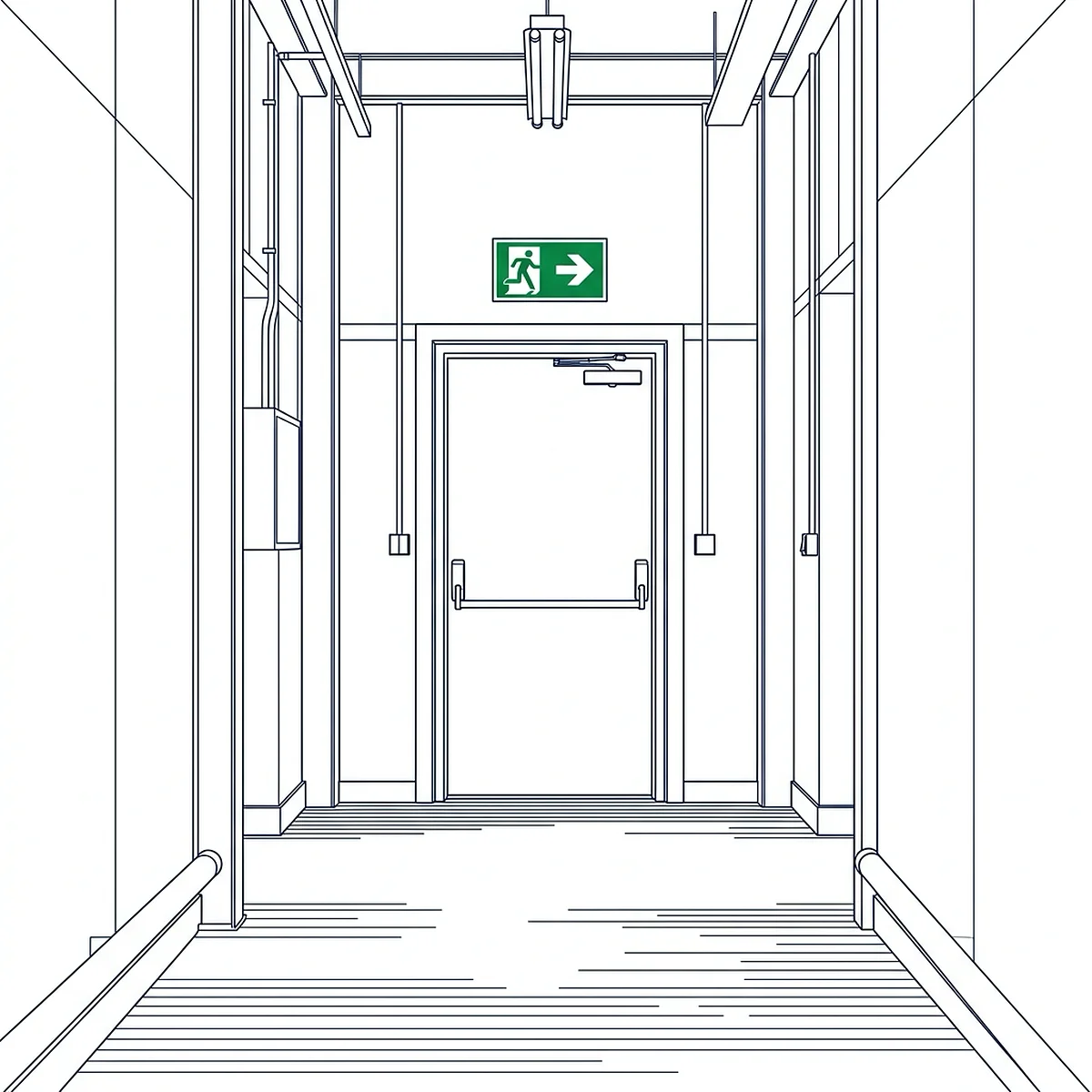
Common Safe Condition Signs
The E-series signs most commonly required in US commercial and industrial facilities. Every sign uses a rectangular or square shape with a green background and white pictogram.
| Code | Meaning | Description | Where Used |
|---|---|---|---|
| E001 | Emergency exit (left) | Exit route is to the left | Corridors, stairways, above doors leading to exit routes |
| E002 | Emergency exit (right) | Exit route is to the right | Corridors, stairways, above doors leading to exit routes |
| E003 | First aid | First aid station or kit location | Near first aid kits, medical stations, break rooms |
| E007 | Assembly point | Designated gathering area after evacuation | Parking lots, open fields, areas away from buildings |
| E009 | Automated external defibrillator | AED device location | Lobbies, common areas, near elevators, fitness centers |
| E010 | Emergency shower | Safety shower location | Laboratories, chemical handling areas, battery rooms |
| E011 | Eyewash station | Eye wash equipment location | Laboratories, chemical storage, manufacturing areas |
Tip: E001 and E002 are mirror images of each other. Use E001 when the exit route is to the left and E002 when it is to the right. Many facilities also use directional arrow variants to indicate up (straight ahead) or down (descend stairs).
Placement and Sizing
Safe condition signs must be placed so they are visible from anywhere along the escape route. NFPA 101 (Life Safety Code) and the IBC both require exit signs at every exit door, at every point where the exit route changes direction, and at any location where the path to an exit is not immediately obvious.
Mounting Height
Exit signs are typically mounted above door frames or at ceiling level so they are visible over crowds and furniture. The bottom edge of the sign should be at least 80 inches (2032 mm) above the finished floor, per IBC Section 1013.1. In smoke-prone environments, some jurisdictions also require low-level signs mounted 8 to 18 inches above the floor along escape corridors.
Minimum Size by Viewing Distance
The ISO 3864-1 sizing formula applies to safe condition signs the same way it applies to other categories. The table below shows minimum sign height for normal indoor lighting (over 100 lux).
| Viewing Distance | Minimum Height |
|---|---|
| Up to 4 m (13 ft) | 50 mm (2 in) |
| 4 to 6 m (13 to 20 ft) | 100 mm (4 in) |
| 6 to 10 m (20 to 33 ft) | 200 mm (8 in) |
| 10 to 16 m (33 to 52 ft) | 300 mm (12 in) |
| 16 to 20 m (52 to 66 ft) | 400 mm (16 in) |
| Over 20 m (66 ft) | 600 mm (24 in) or larger |
Tip: Assembly point signs (E007) are typically much larger than interior signs because they need to be readable from across a parking lot or open field. Use the viewing distance formula with the maximum expected approach distance to determine the right size.
Integration with Emergency Lighting
Safe condition signs are only useful if people can see them during an emergency, which often means during a power failure. Both NFPA 101 and the IBC require exit signs to be illuminated at all times the building is occupied, including during power outages.
There are three common approaches to keeping exit signs visible during power failures:
Internally illuminated signs
LED or fluorescent signs with battery backup that automatically activates when main power is lost. Required to maintain illumination for at least 90 minutes per NFPA 101 Section 7.10.4.
Externally illuminated signs
Standard printed signs illuminated by emergency lighting fixtures. The emergency lights must provide at least 5 foot-candles on the sign face per NFPA 101 Section 7.10.6.3.
Photoluminescent signs
Signs made with photoluminescent materials that absorb ambient light and glow in the dark. Must meet UL 1994 or ASTM E2072 performance standards. Require adequate charging illumination (at least 54 lux for 60 minutes) during normal operation.
NFPA 101 Section 7.10 governs exit sign requirements in detail, including visibility, illumination levels, and testing intervals. For a deeper look at life safety code requirements, see our NFPA 101 Life Safety Code guide.
Warning: Photoluminescent exit signs cannot be used as the sole exit sign system in all jurisdictions. Some local codes require internally illuminated signs with battery backup regardless of whether photoluminescent signs are also installed. Check with your local AHJ before relying on photoluminescent signs alone.
Frequently Asked Questions
What does a green safety sign mean?
A green safety sign indicates a safe condition. Under ISO 7010, green rectangular or square signs with white pictograms mark emergency exits, first aid stations, safety showers, eyewash stations, AED locations, and assembly points. The green color tells building occupants that the indicated direction or equipment leads to safety.
Do exit signs need to be illuminated at all times?
Yes. Both NFPA 101 and the IBC require exit signs to be continuously illuminated whenever the building is occupied. During a power failure, exit signs must remain visible for at least 90 minutes, which is typically achieved through battery backup, emergency generator power, or photoluminescent materials that glow after charging from ambient light.
What is the difference between E-series and F-series signs?
E-series (safe condition) signs have a green background and guide people to safety: exits, first aid, assembly points. F-series (fire equipment) signs have a red background and mark the locations of firefighting equipment: fire extinguishers, hose reels, fire alarm call points. Both use white pictograms and rectangular shapes, but the background color distinguishes their purpose.
ISO 7010 Signs We Carry


Our ISO 7010 sign catalog starts with F-series fire equipment signs and is expanding. We do not stock E-series safe condition signs yet.
Was this page helpful?
Your feedback helps us improve our technical resources.