
ISO 7010 Prohibition Signs: P-Series Guide
Red circle-and-bar signs for restricted actions in workplaces and public spaces
Overview
ISO 7010 prohibition signs belong to the P-series and tell people what they must not do. Each sign uses a red circle with a 45-degree diagonal bar over a black pictogram on a white background. The red-and-white color scheme is internationally recognized as a prohibition signal, making these signs effective regardless of language. For the full ISO 7010 standard covering all sign categories, see our complete ISO 7010 safety signs guide.
Prohibition signs are among the most common safety signs in any workplace. P002 (No Smoking) alone appears in virtually every commercial building. Other P-series signs restrict access to hazardous areas, prevent contact with dangerous surfaces, and prohibit actions that could cause fires or explosions.
This guide covers seven of the most relevant P-series signs for US workplaces, explains the design specifications that make them compliant, and compares ISO 7010 with the ANSI Z535 system used domestically.
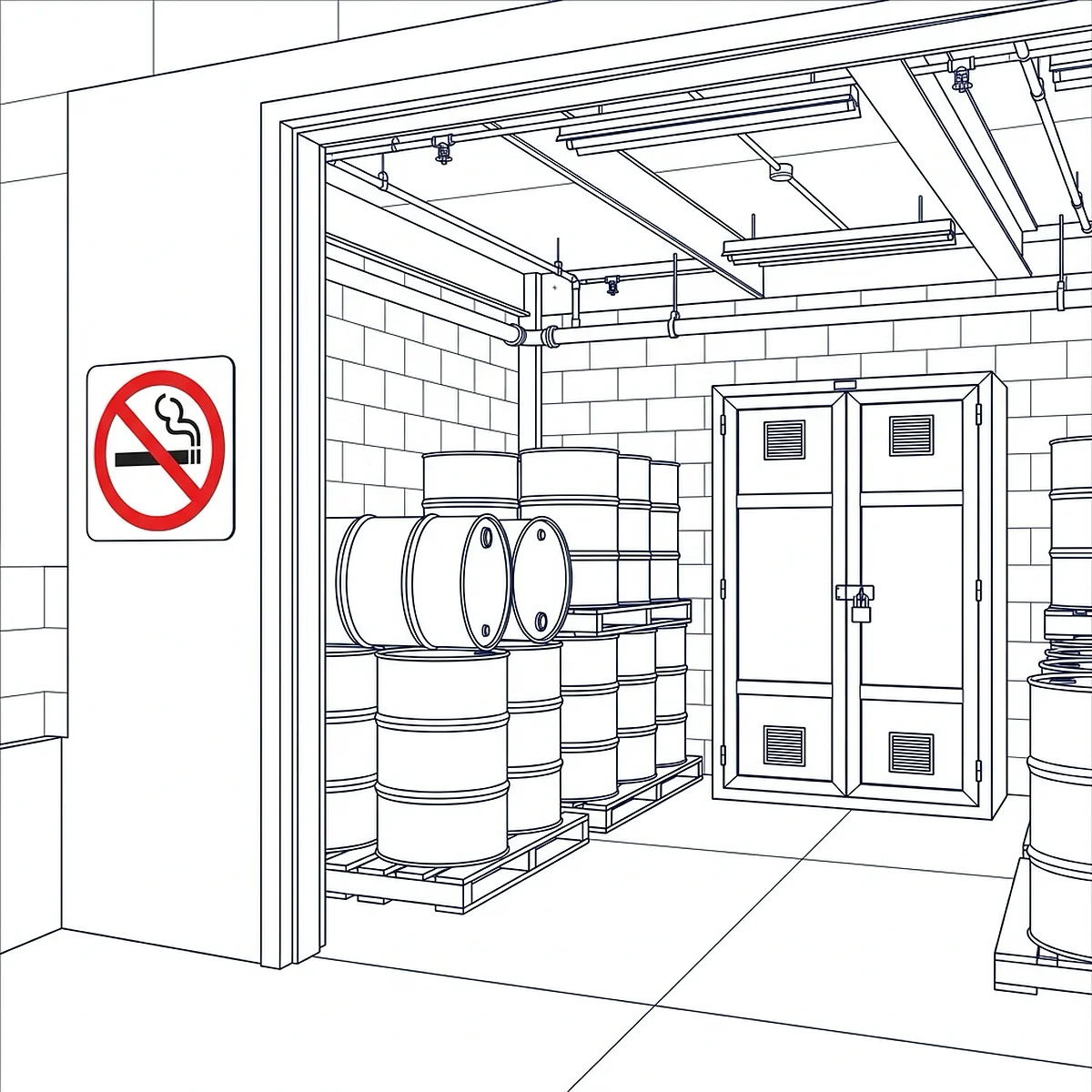
Common Prohibition Signs
The P-series signs most commonly posted in US commercial and industrial facilities. Every sign uses a round shape with a red circle, red diagonal bar, white background, and black pictogram.
| Code | Meaning | Description | Where Used |
|---|---|---|---|
| P001 | General prohibition | Do not do this | Various locations where a specific prohibition sign does not exist |
| P002 | No smoking | Smoking is not permitted | All buildings, workplaces, fuel storage areas, warehouses |
| P003 | No open flame | No fire, open ignition source, or smoking | Fuel storage, laboratories, chemical handling areas, paint booths |
| P004 | No thoroughfare | Do not walk or stand in this area | Construction zones, loading docks, crane operating areas |
| P006 | No access for unauthorized persons | Restricted area, authorized personnel only | Mechanical rooms, electrical vaults, server rooms, rooftop access |
| P010 | Do not touch | Do not touch this surface or equipment | Hot equipment, live electrical panels, moving machinery |
| P011 | Do not extinguish with water | Water-based extinguishers are prohibited here | Electrical rooms, server rooms, metal fire areas |
Tip: P011 (Do not extinguish with water) is critical in electrical rooms and server rooms where water-based extinguishers can cause electrocution or equipment damage. Always pair it with the correct F-series fire equipment sign showing the appropriate extinguisher type for that area.
Design Requirements
ISO 3864-1 defines the exact proportions for prohibition signs. The visual elements are strictly controlled so the sign is instantly recognizable at a distance.
Shape and color
Round sign with a white background, red circular band, and red diagonal bar running from upper left to lower right at 45 degrees. The black pictogram sits centered behind the bar.
Red coverage
The red circle and bar must cover at least 35% of the total sign area. The red color must match ISO 3864-4 colorimetric values (Pantone 485 C is the closest standard reference).
Bar placement
The diagonal bar always overlays the pictogram. The bar runs from upper-left to lower-right. The pictogram must remain recognizable even with the bar crossing it.
Minimum Size by Viewing Distance
The ISO 3864-1 formula h = L / Z determines minimum sign diameter based on the maximum distance a person needs to read the sign. For normal indoor lighting (over 100 lux), Z = 200.
| Viewing Distance | Minimum Diameter |
|---|---|
| Up to 4 m (13 ft) | 50 mm (2 in) |
| 4 to 6 m (13 to 20 ft) | 100 mm (4 in) |
| 6 to 10 m (20 to 33 ft) | 200 mm (8 in) |
| 10 to 16 m (33 to 52 ft) | 300 mm (12 in) |
| 16 to 20 m (52 to 66 ft) | 400 mm (16 in) |
| Over 20 m (66 ft) | 600 mm (24 in) or larger |
Warning: In areas with reduced lighting (below 100 lux), the distance factor Z drops to 100, which doubles the required sign size. Dimly lit corridors, parking garages, and storage areas often need larger signs than you would expect.
OSHA vs ISO 7010
In the United States, ANSI Z535 is the domestic standard for safety signs. ANSI prohibition signs typically use a red circle-and-bar pictogram combined with English-language text panels that say "DANGER" or "WARNING" followed by a description of what is prohibited.
ISO 7010 prohibition signs rely on pictograms alone without text, making them effective in multilingual workplaces. OSHA does not mandate one system over the other. OSHA 29 CFR 1910.145 requires that safety signs be posted where hazards exist, and both ANSI Z535 and ISO 7010 signs satisfy this requirement.
Multinational facilities, buildings with non-English-speaking workers, and companies operating across borders increasingly standardize on ISO 7010 for consistency. Some facilities post both: an ISO 7010 pictogram paired with an ANSI text panel for maximum clarity.
For a detailed side-by-side comparison across all sign categories, see the ISO 7010 vs ANSI Z535 comparison in our main ISO 7010 guide.
Frequently Asked Questions
What does a red circle with a diagonal bar mean on a safety sign?
A red circle with a diagonal bar is the international symbol for prohibition. It means the action shown by the pictogram inside the circle is not allowed. For example, a cigarette inside the red circle-and-bar means no smoking. This format is defined by ISO 7010 and ISO 3864-1.
Are ISO 7010 prohibition signs required in the US?
OSHA does not specifically require ISO 7010 signs. However, OSHA 29 CFR 1910.145 requires employers to post signs that identify hazards and prohibited actions. Both ANSI Z535 and ISO 7010 prohibition signs satisfy this requirement. Many US facilities adopt ISO 7010 for multilingual workforces or to align with international standards.
What is the difference between P001 and other prohibition signs?
P001 is the general prohibition sign showing only the red circle and bar without a specific pictogram. It is used when no specific prohibition sign exists for the action being restricted. All other P-series signs include a black pictogram inside the circle that identifies the specific prohibited action, such as smoking (P002) or open flame (P003).
ISO 7010 Signs We Carry


Our ISO 7010 sign catalog starts with F-series fire equipment signs and is expanding. We do not stock P-series prohibition signs yet.
Was this page helpful?
Your feedback helps us improve our technical resources.