
ISO 7010 Fire Safety Equipment Signs: Complete F-Series Guide
Every F-series fire fighting equipment sign with US code references, placement requirements, and facility-type guidance
Last updated: July 14, 2026
Overview
The ISO 7010 F-series defines standardized fire safety equipment signs used to mark the location of fire fighting equipment in buildings and facilities. Each sign uses a red square or rectangle with a white pictogram — a format designed to be understood instantly regardless of language. For the full ISO 7010 standard covering all sign categories (prohibition, warning, mandatory, emergency, and fire equipment), see our complete ISO 7010 safety signs guide.
US facilities are increasingly adopting ISO 7010 signage alongside traditional ANSI/OSHA signs. The drivers are practical: multinational workforces that need language-independent pictograms, cleaner modern design that improves visibility, and alignment with international building standards. ISO 7010 fire equipment signs are not yet mandatory under US federal code, but OSHA accepts them as equivalent when they meet the intent of 29 CFR 1910.144 (red for fire equipment) and 29 CFR 1910.157 (fire extinguisher visibility).
This guide covers all 19 signs in the F-series (F001 through F019), maps each to the US code that drives the requirement, and helps you determine which signs your facility needs.
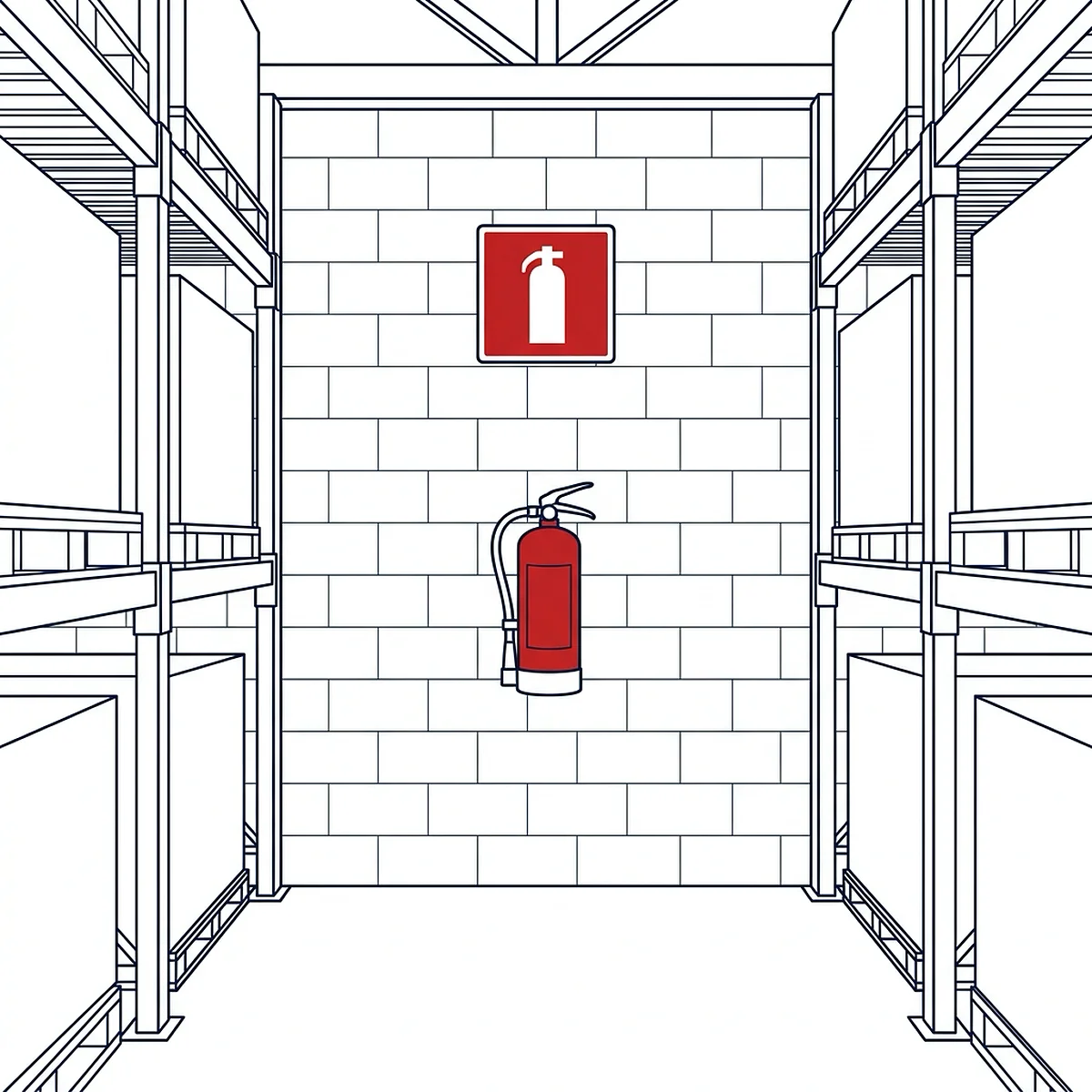
Complete List of ISO 7010 F-Series Fire Fighting Equipment Signs
All 19 standard fire safety equipment signs under ISO 7010. Every sign uses a red background with white pictogram in a square or rectangular format.
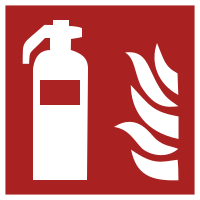
F001: Fire extinguisher
Above or adjacent to each fire extinguisher location, mounted 60–80 inches from floor
NFPA 10 §6.1.3.3 (identification), OSHA 29 CFR 1910.157(c)(1) (visibility/access)
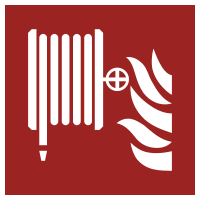
F002: Fire hose reel
Above or adjacent to each fire hose reel cabinet
NFPA 14 §5.4, IBC §905 (standpipe/hose identification)

F003: Fire ladder
At the base of each fixed fire ladder or access point
IBC §1011.12 (fire escape/ladder identification)

F004: Collection of fire-fighting equipment
At centralized fire equipment stations or cabinets
NFPA 10 §6.1, OSHA 29 CFR 1910.157 (visibility/access)
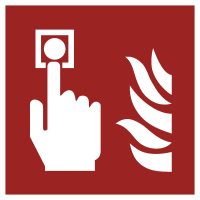
F005: Fire alarm call point
Adjacent to each manual pull station, at exits and stairwells
NFPA 72 §17.14 (manual fire alarm box identification), IBC §907.4.2

F006: Fire emergency telephone
Adjacent to fire emergency phone locations in stairwells or lobbies
NFPA 72 §24.5 (emergency communication), IBC §403.4.4 (high-rise)
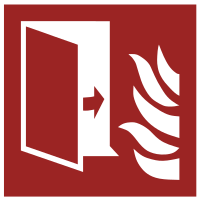
F007: Fire extinguisher (alternate)
Same as F001 — used in regions where F007 variant is standard
Same as F001

F008: Fire-fighting hose (with nozzle)
Adjacent to fire hose connections and standpipe outlets
NFPA 14 §7.3 (hose connection identification)
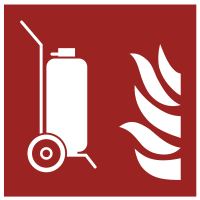
F009: Fire-fighting water supply pipe (hydrant)
Near fire hydrant locations, especially indoor or concealed hydrants
NFPA 24 §7.3, OSHA 29 CFR 1910.144(a)(3) (red for fire equipment)
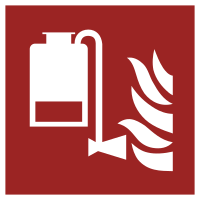
F010: Fire-fighting water pipe (sprinkler riser)
At sprinkler riser rooms, FDC connections, and control valve locations
NFPA 13 §6.1 (identification of risers), NFPA 25 §13.1

F011: Wheeled fire extinguisher
Adjacent to each wheeled extinguisher location
NFPA 10 §6.1.3.3 (identification), OSHA 29 CFR 1910.157
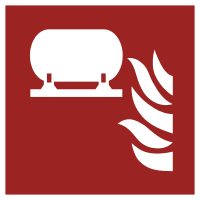
F012: Fire blanket
Above or adjacent to fire blanket container, typically in kitchens or labs
NFPA 10 §5.5.5, OSHA 29 CFR 1910.157 (supplemental protection)

F013: Portable foam applicator
Adjacent to portable foam fire-fighting equipment
NFPA 11 (foam application), NFPA 10 §5.4 (selection)

F014: Fire-fighting breathing apparatus
At SCBA storage cabinets, staging areas, or rescue equipment stations
OSHA 29 CFR 1910.134 (respiratory protection), NFPA 1852 (SCBA care)
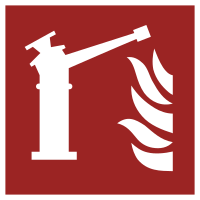
F015: Firefighter's helmet
At fire brigade equipment lockers or staging locations
OSHA 29 CFR 1910.156 (fire brigades), NFPA 600 (facility fire brigades)
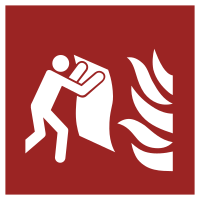
F016: Wheeled fire extinguisher (alternate)
Same as F011 — alternate pictogram style
Same as F011
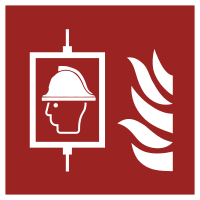
F017: Fire-fighting smoke detector
At smoke detector locations, typically for testing/maintenance marking
NFPA 72 §14.4 (detector identification), IBC §907
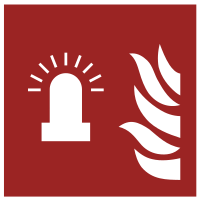
F018: Fire-fighting water monitor/cannon
Adjacent to fixed or portable water monitor equipment
NFPA 15 (water spray systems)

F019: Fire pump room
On or adjacent to fire pump room doors
NFPA 20 §4.13 (fire pump room identification), IBC §913
Common Fire Safety Equipment Signs Under ISO 7010
Most US facilities need only a subset of the full F-series. These are the signs you will encounter in the majority of commercial buildings.
F001 — Fire Extinguisher
The most common fire safety equipment sign. Required wherever portable fire extinguishers are installed.NFPA 10 §6.1.3.3 requires extinguisher locations to be clearly identified, and OSHA 29 CFR 1910.157(c)(1) requires they be visible and accessible. Mount the sign 60–80 inches from the floor, above or adjacent to the extinguisher. In large open spaces, ceiling-mounted signs or projecting signs improve visibility.
F005 — Fire Alarm Call Point
Marks manual pull stations (fire alarm call points). NFPA 72 §17.14 requires manual fire alarm boxes to be conspicuously identified. Place the sign directly above or beside each pull station, typically at exits and stairwell entrances. Required in all buildings with fire alarm systems.
F002 — Fire Hose Reel
Identifies fire hose reel cabinets in buildings with standpipe systems. Required under NFPA 14 for Class II and Class III standpipe systems. Common in high-rise buildings, large warehouses, and manufacturing facilities.
F010 — Sprinkler Riser / Fire Water Pipe
Marks sprinkler riser rooms, FDC (fire department connection) locations, and control valve access points. NFPA 13 §6.1 requires identification of sprinkler risers, and NFPA 25 requires control valves to be clearly marked. Essential in all sprinklered buildings.
F012 — Fire Blanket
Identifies fire blanket locations, most commonly in commercial kitchens, laboratories, and welding shops. While not universally required, fire blankets are mandated by many local codes for commercial cooking areas and are recommended wherever hot work (welding, cutting, brazing) is performed.
Which ISO 7010 Fire Signs Does Your Facility Need?
This matrix maps the most relevant F-series signs to common facility types. "Required" means a US code (OSHA, NFPA, or IBC) mandates the underlying equipment and its identification. "Recommended" means the equipment is commonly installed but not universally required.
| Facility Type | F001 | F002 | F004 | F005 | F006 | F010 | F011 | F012 | F014 | F019 |
|---|---|---|---|---|---|---|---|---|---|---|
| Restaurant / Commercial Kitchen | Req | Rec | — | Req | — | Rec | — | Req | — | — |
| Office Building | Req | — | — | Req | Rec | Rec | — | — | — | — |
| Warehouse / Manufacturing | Req | Rec | Req | Req | — | Req | Rec | — | Rec | — |
| School / University | Req | Rec | — | Req | — | Rec | — | — | — | — |
| Retail | Req | — | — | Req | — | Rec | — | — | — | — |
| Healthcare | Req | — | — | Req | Rec | Req | — | Rec | — | — |
| High-Rise Residential | Req | Req | — | Req | Req | Req | — | — | — | Rec |
= Required by code
= Recommended
Sign Materials
ISO 7010 fire equipment signs are available in several substrate options. The right choice depends on the installation environment and durability requirements.
| Material | Best For | Durability | Notes |
|---|---|---|---|
| Self-adhesive vinyl | Indoor, temporary, low-traffic | 1–3 years | Lowest cost, easy to apply and replace |
| Rigid PVC | Indoor permanent installations | 5–10 years | Lightweight, screw or adhesive mount |
| Aluminum | Outdoor, high-traffic, industrial | 10+ years | Weather-resistant, most durable |
| Photoluminescent | Egress-adjacent, power-failure visibility | 10+ years | Glows in dark per UL 1994, required in some high-rises |
Restaurant & Commercial Kitchen Fire Sign Compliance
Restaurants and commercial kitchens face the most fire sign requirements of any facility type — cooking hazards, public occupancy, and employee safety obligations all overlap. Here is what a typical kitchen needs, zone by zone. For a deeper walk-through of the three signs every restaurant needs and how they map to OSHA, NFPA 96, and NFPA 101, see our restaurant fire safety signs ISO 7010 compliance guide.
Cooking Line — F012 Fire Blanket
Mount adjacent to the fire blanket container, within arm's reach of cooking stations. Required by most local fire codes for commercial cooking areas per NFPA 10 §5.5.5.
Cooking Line — F001 Fire Extinguisher (Class K)
Above or beside the Class K wet chemical extinguisher, 60–80 inches from the floor. Class K units are required within 30 ft travel distance of commercial cooking appliances per NFPA 10 §6.1.3.3 and §5.4.1.1.
Back of House / Hallway — F001 Fire Extinguisher (ABC)
Above or beside each ABC dry chemical extinguisher along the egress path. OSHA 29 CFR 1910.157 requires extinguishers to be visible and accessible. Most restaurants need 2–3 ABC units in addition to the kitchen Class K.
Exit Doors / Dining Room — F005 Fire Alarm Call Point
Beside each manual pull station at exit doors. NFPA 72 §17.14 requires alarm boxes to be conspicuously identified. Typically 1–2 per restaurant depending on layout and exit count.
Beyond signs: other kitchen fire safety requirements
Signs mark the equipment, but the equipment itself must also comply. Commercial kitchens need a UL 300-listed hood suppression system (see NFPA 96 and UL 300), compliant grease duct construction (see grease duct comparison), and regular inspections per your local fire marshal's schedule (see fire inspection guide).
ISO 7010 vs ANSI Z535 for Fire Safety Signs
In the US, fire safety signs traditionally follow ANSI Z535 with English text headers ("FIRE EXTINGUISHER," "FIRE ALARM"). ISO 7010 replaces text with standardized pictograms that work across languages. Both approaches are accepted by OSHA, and many facilities now use them together — ISO pictograms for universal recognition plus ANSI text for explicit clarity.
For a detailed side-by-side comparison of the two systems across all sign categories, see the ISO 7010 vs ANSI Z535 comparison in our main ISO 7010 guide.
Frequently Asked Questions
Are ISO 7010 signs required in the US?
ISO 7010 signs are not federally mandated in the US. However, OSHA accepts them as equivalent to ANSI signage when they meet the intent of the applicable standard (e.g., red for fire equipment per 29 CFR 1910.144, visible identification per 29 CFR 1910.157). Many facilities adopt them voluntarily for multilingual workforces and cleaner design.
What is the difference between ISO 7010 and ANSI fire safety signs?
ANSI Z535 fire signs use English text headers (e.g., "FIRE EXTINGUISHER") with optional pictograms. ISO 7010 uses standardized pictograms without text, making them language-independent. Both are OSHA-accepted. Many US facilities use both together — ISO pictograms for universal recognition and ANSI text for explicit clarity.
Where do fire extinguisher signs need to be mounted?
NFPA 10 §6.1.3.3 requires fire extinguisher locations to be conspicuously identified. Mount signs 60–80 inches from the floor, directly above or adjacent to the extinguisher. In large open areas where extinguishers may not be immediately visible, use ceiling-mounted or projecting signs.
What do the ISO 7010 F-series sign numbers mean?
The "F" prefix stands for Fire equipment. The number (001–019) is a sequential identifier assigned by ISO. F001 is the fire extinguisher sign, F005 is the fire alarm call point, and so on. The numbering does not imply priority — it is simply a catalog reference.
Can I use ISO 7010 signs alongside ANSI Z535 signs?
Yes. There is no regulation prohibiting mixed signage systems. Many facilities use ISO 7010 pictograms in combination with ANSI text signs, particularly in areas with multilingual workers. The key requirement is that all fire equipment is clearly identified per OSHA and NFPA standards, regardless of which sign format you choose.


Order ISO 7010 Fire Safety Signs
We are expanding our safety signage line to include the full ISO 7010 F-series in multiple materials and sizes. Enter your email to be notified when these signs are available, or to request a quote for your facility.
Was this page helpful?
Your feedback helps us improve our technical resources.