
Restaurant Fire Safety Signs: ISO 7010 Compliance Guide
Which fire safety signs your commercial kitchen needs, where to mount them, and how ISO 7010 F001, F005, and F012 map to OSHA, NFPA, and local fire code requirements
Overview
If you run a restaurant or commercial kitchen, fire safety signs are the cheapest piece of compliance you will ever buy and the first thing a fire marshal looks for. The signs themselves are inexpensive, but the rules around which ones you need, where they go, and how high to mount them come from a stack of overlapping standards: OSHA, NFPA 10, NFPA 72, NFPA 96, NFPA 101, and your local fire code.
This guide focuses on the three signs that nearly every commercial food service operation needs under the international ISO 7010 system: F001 (fire extinguisher), F005 (fire alarm call point), and F012 (fire blanket). It covers what each one means, where it has to go in a typical kitchen layout, the US code references that drive the requirement, and how to keep them inspection-ready.
Audience: restaurant owners, facility managers, kitchen designers, and general contractors building or remodeling food service spaces. If you are looking for the broader fire equipment sign catalog, see our complete ISO 7010 F-series guide.
What Is ISO 7010 and Why It Matters Internationally
ISO 7010 is the international standard for safety sign pictograms. Every sign uses a standardized symbol on a color-coded shape — red square for fire equipment, green square for safe condition, yellow triangle for warning, blue circle for mandatory action, and red circle with diagonal bar for prohibition. The point of the system is that the symbols communicate without words, so a kitchen worker whose first language is not English can recognize a fire extinguisher location instantly.
In the US, ISO 7010 is not federally mandated. Traditional ANSI Z535 signs with English text headers (FIRE EXTINGUISHER, FIRE ALARM) are still the default and are also OSHA-accepted. ISO 7010 is gaining traction in restaurants because multilingual kitchen staff are common, the modern pictogram design is cleaner, and international brands prefer a single sign system across all locations.
Bottom line: OSHA accepts ISO 7010 signs as equivalent to ANSI signage as long as they meet the intent of 29 CFR 1910.144 (red identifies fire equipment) and 29 CFR 1910.157 (extinguishers must be visible and accessible). You can use ISO 7010, ANSI, or both side by side.
F001, F005, and F012 Explained
These three ISO 7010 signs cover the equipment every commercial kitchen is either required to have or commonly installs as a layered safeguard.
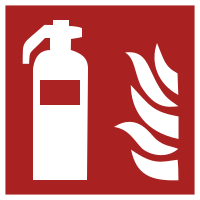
F001 — Fire Extinguisher
Marks every portable fire extinguisher location. In a restaurant, you need this above each Class K wet chemical unit on the cook line and each ABC dry chemical unit in back-of-house, hallways, and dining areas.
Placement: Above or beside each extinguisher, 60–80 inches from the floor.
Code reference: NFPA 10 §6.1.3.3 (extinguisher identification), OSHA 29 CFR 1910.157(c)(1) (visible and accessible).
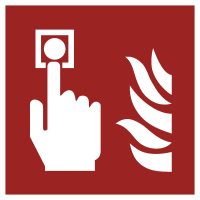
F005 — Fire Alarm Call Point
Marks each manual pull station. Required wherever the building has a fire alarm system. Most restaurants have at least one pull station near the main exit and additional stations at secondary exits and stairwells.
Placement: Directly above or beside each pull station, at exits and along the egress path.
Code reference: NFPA 72 §17.14 (manual fire alarm boxes conspicuously identified), IBC §907.4.2.

F012 — Fire Blanket
Marks the location of a fire blanket. Common in commercial kitchens for smothering small grease and clothing fires before they reach the hood. Many local fire codes require fire blankets in restaurant cooking areas as supplemental protection alongside the Class K extinguisher.
Placement: Above or beside the fire blanket container, within arm’s reach of the cooking line.
Code reference: NFPA 10 §5.5.5 (supplemental protection), local fire code where adopted.
OSHA, NFPA, and Local Code Requirements for Restaurants
The legal basis for fire safety signage in a restaurant comes from federal OSHA rules layered on top of NFPA standards adopted by your state and local fire code. Here is how the pieces fit together.
| Standard | What It Requires | Sign Impact |
|---|---|---|
| OSHA 29 CFR 1910.157 | Portable fire extinguishers must be conspicuously located, identified, and accessible to employees. | Drives F001 placement at every extinguisher. |
| OSHA 29 CFR 1910.144 | Red identifies fire protection equipment, danger, and emergency stops. | Validates the red ISO 7010 background as compliant color coding. |
| NFPA 10 | Selection, placement, and identification of portable fire extinguishers. §6.1.3.3 requires extinguisher locations to be clearly marked. | F001 above each extinguisher, 60–80 inches from the floor. |
| NFPA 72 | National Fire Alarm and Signaling Code. §17.14 requires manual fire alarm boxes (pull stations) to be conspicuously identified. | F005 above or beside each pull station. |
| NFPA 96 | Standard for ventilation control and fire protection of commercial cooking operations. Drives the layered fire protection scheme that the signs identify. | Creates the requirement for a Class K extinguisher (and therefore an F001 sign) within 30 ft of cooking appliances. |
| NFPA 101 | Life Safety Code. Requires clear identification of fire equipment along the egress path and at exits. | Reinforces F001 and F005 placement near exits, in corridors, and in assembly areas. |
| Local fire code | Your jurisdiction adopts NFPA standards by reference, often with local amendments. Many cities require fire blankets in commercial kitchens, which means an F012 sign too. | Check with the local fire marshal — requirements vary. |
Watch out: Local amendments are where most restaurants get tripped up. A city may adopt NFPA 96 (2021) but require fire blankets where the base standard does not, or mandate photoluminescent signs in egress corridors. Always verify with your local fire marshal before final inspection.
Where to Place Signs in a Typical Restaurant Kitchen
Walk through any commercial food service space and you can identify the sign locations zone by zone. Here is the layout most restaurants need.
Cook line — Class K extinguisher
F001 above or beside the wet chemical Class K unit. NFPA 10 §5.5.1 requires a Class K extinguisher within 30 ft of cooking appliances that produce grease-laden vapors. The sign goes 60–80 inches from the floor so it is visible above the line.
Cook line — fire blanket
F012 above the fire blanket container. Position the blanket within arm’s reach of the cooking station so a line cook can grab it before a flame jumps to the hood. Many jurisdictions require this in addition to the Class K unit.
Back of house — ABC dry chemical
F001 above each ABC dry chemical extinguisher in dry storage, prep areas, walk-in approach corridors, and dishwashing zones. OSHA 29 CFR 1910.157(d)(2) sets a maximum 75 ft travel distance to the nearest unit for Class A hazards.
Exits and egress path — pull stations
F005 beside each manual pull station at the main exit, rear service door, and any secondary exits. NFPA 72 requires pull stations to be within 5 ft of every exit door and no more than 200 ft of travel distance apart.
Dining room and bar
F001 above the ABC extinguisher serving the dining area. In larger dining rooms, multiple units may be required to meet the 75 ft travel distance. Mount signs at the same height for visual consistency.
Mounting Height, Lighting, and Visibility
A compliant sign in the wrong location is still a violation. These are the practical mounting rules that fire marshals look for.
- Height: 60–80 inches from finished floor to the center of the sign. Below 60 inches the sign disappears behind equipment; above 80 inches it falls outside the natural cone of vision when an employee approaches.
- Visible from approach: The sign must be visible from the direction someone would approach the equipment, not just from directly in front of it. In open kitchens, use double-sided projecting signs so the pictogram is visible from both sides.
- Lighting: The sign must be visible under normal lighting and under emergency lighting. NFPA 101 requires emergency illumination of egress paths, which includes the route to fire equipment. Photoluminescent signs that glow after a power failure satisfy this without wiring.
- Viewing distance: Standard 200×200 mm (8×8 in) signs are legible at about 25 ft. For larger spaces or open ceilings, step up to 300×300 mm (12×12 in). ISO 3864-1 sets the formal viewing distance calculation as distance ≤ height × 100.
- Contrast: Mount on a wall surface that contrasts with the red background. A red sign on red tile is technically compliant but effectively invisible. Inspectors will flag low-contrast installations.
- Obstruction: Nothing can block the sign — not wall menus, not coat hooks, not seasonal decor. This is the number one inspection finding for restaurants because the kitchen layout changes after the sign goes up.
Inspection and Maintenance Expectations
Fire safety signs are not a one-time install. They are part of every annual fire marshal inspection and most insurance carrier walk-throughs. Here is what inspectors look for and how to keep the signs in compliance year over year.
What inspectors check
- Each fire extinguisher has a visible F001 (or equivalent ANSI) sign at the correct mounting height.
- Each manual pull station has a visible F005 sign and is unobstructed.
- Fire blankets, where installed, are marked with F012 and are within reach of the cook line.
- Signs are clean, legible, and not faded or grease-coated. Kitchen environments degrade vinyl quickly.
- Sign locations have not been blocked by new equipment, shelving, or seasonal layout changes.
- Photoluminescent signs glow appropriately after the lights are turned off (some inspectors test with a flashlight).
Maintenance schedule
- Monthly: Visual check during the routine fire extinguisher inspection. Confirm every sign is present, visible, and unobstructed.
- Annually: Wipe down or replace any signs that are grease-coated, faded, or peeling. Record the inspection in your fire protection log.
- After any layout change: Re-evaluate sign positions when you add equipment, remodel the line, or change the dining room layout.
Tip: Aluminum or rigid PVC signs hold up better than vinyl decals in commercial kitchens. Grease and steam destroy adhesive backings within a year, while rigid substrates last 5–10 years and survive hood cleaning.
Frequently Asked Questions
Are ISO 7010 fire safety signs required in US restaurants?
ISO 7010 signs are not federally mandated in the US. OSHA accepts them as equivalent to ANSI Z535 signs as long as they meet the intent of 29 CFR 1910.144 (red for fire equipment) and 29 CFR 1910.157 (extinguishers visible and accessible). What is required is that fire equipment be clearly identified — the choice of pictogram standard is up to the operator.
Where do fire extinguisher signs need to go in a commercial kitchen?
Above or beside every fire extinguisher, mounted 60–80 inches from the floor. In a typical restaurant, that means one sign at the Class K wet chemical unit on the cook line, additional F001 signs at each ABC dry chemical extinguisher in back-of-house and dining areas, and one at the bar if a separate unit is installed there.
Do I need a fire blanket sign (F012) if I already have a Class K extinguisher?
It depends on your local code. NFPA 96 and NFPA 10 do not require a fire blanket as a substitute for a Class K extinguisher, but many cities and counties require fire blankets in commercial kitchens as supplemental protection. Where the blanket is required (or installed voluntarily), an F012 sign must mark its location. Check with your local fire marshal.
What is the difference between ISO 7010 and ANSI Z535 fire signs?
ANSI Z535 fire signs use English text headers like FIRE EXTINGUISHER and FIRE ALARM with optional pictograms. ISO 7010 uses standardized pictograms without text, designed to be language-independent. Both are accepted by OSHA. Many restaurants with multilingual staff install both — ISO pictograms for instant recognition and ANSI text for explicit clarity.
How high should fire safety signs be mounted in a kitchen?
Mount the sign 60–80 inches from the finished floor to the center of the sign. Below 60 inches it disappears behind cooking equipment and shelving; above 80 inches it sits outside the natural cone of vision when someone walks toward the extinguisher.
Do restaurant fire safety signs need to be photoluminescent?
Federal code does not require photoluminescent signs for fire equipment in restaurants. NFPA 101 requires emergency illumination of the egress path, which can be satisfied by emergency lighting. Some jurisdictions require photoluminescent or self-luminous signs in specific occupancies, especially high-rise buildings. Photoluminescent versions are a low-cost upgrade that keeps the pictogram visible if power fails during a fire.
How often should I inspect fire safety signs in a restaurant?
Visually inspect signs monthly when you check the fire extinguishers — make sure each sign is present, visible, and not obstructed by new equipment or decor. Replace any sign that is faded, grease-coated, or peeling. Document the inspection in your fire protection log so it is available for the fire marshal.
Featured: Restaurant Fire Safety Sign Kit (3-Pack)
We bundle the three ISO 7010 signs every commercial kitchen needs into a single kit so you can outfit a restaurant in one purchase.
F001 + F005 + F012 — included in the kit
Restaurant Fire Safety Sign Kit ISO 7010 F001 + F005 + F012 (3-Pack)
Three ISO 7010 compliant fire safety signs in one bundle. Designed for commercial kitchens, restaurants, and food service operations that need to meet OSHA, NFPA 10, and NFPA 72 identification requirements without sourcing each sign separately.
What is included:
- F001 Fire Extinguisher — for above each Class K and ABC unit
- F005 Fire Alarm Call Point — for above each manual pull station
- F012 Fire Blanket — for above the cook line fire blanket container
Was this page helpful?
Your feedback helps us improve our technical resources.