
STC 50 Wall Assemblies: How to Meet Code and Pass the Field Sound Test
Walls between apartments, condos, and hotel rooms have to block sound, and the code puts a number on it. This guide explains the requirement in plain English, why finished walls fail the test, and the two inexpensive products that protect the rating.
Last updated: June 11, 2026
On This Page
The Test Your Finished Wall Has to Pass
If you build walls between apartments, condos, hotel rooms, dorm rooms, or senior living units, the building code requires those walls to block a measured amount of sound. The rating can be checked on the finished building with a field sound test. A professional field test often runs $800 to $1,500 for the first wall assembly, depending on market and scope, and the builder or owner pays for it.
Failing is far more expensive than the test. The usual failure is not the wall design. It is small air gaps: an uncaulked joint where the wall meets the floor, or bare electrical boxes set back to back in the same stud cavity. Finding those leaks after paint means opening finished walls, resealing, patching, repainting, and paying for a retest.
The short version: the cheapest materials in the wall, acoustical sealant and putty pads, are what decide whether the most expensive test passes. Sealing before drywall costs a few hundred dollars. Fixing after paint costs thousands.
This guide covers what the code actually requires, what happens during a field test, why properly designed walls still fail, and how much sealing material a project needs. If you want the deeper product detail, our acoustic sealant guide and putty pads guide cover application step by step.
Five Terms in Plain English
Sound control has its own vocabulary. These five terms are the only ones you need for the rest of this guide.
STC (Sound Transmission Class)
A single score for how well a wall blocks voice range sound. Think of it as how many decibels the wall knocks off. At STC 35 you can hear and understand your neighbor talking. At STC 50 loud speech is barely audible.
Acoustical sealant
Caulk that never fully hardens, used to seal the gaps where a wall meets the floor, ceiling, and other walls. Sound leaks through air gaps. This closes them.
Shop Sound Seal 90 acoustical sealantPutty pad
A moldable pad you press over the back of an electrical outlet box inside the wall. Outlet boxes are holes in the wall. The pad plugs the hole acoustically and is also fire rated.
Shop fire rated putty padsDemising wall
Construction speak for the shared wall between two apartments, condos, or hotel rooms. Also called a party wall or unit separation wall.
Field test
A technician with a speaker and a meter measures the actual built wall. Lab numbers stop counting once someone tests on site.
What the Code Requires
The International Building Code, the base code adopted across nearly all US states, requires walls, partitions, and floor ceiling assemblies that separate dwelling units or sleeping units from each other, or from public areas like hallways and corridors, to achieve a sound transmission class of at least 50 by design. If the built assembly is field tested instead, the minimum is 45. That applies to apartments, condos, hotels, motels, dorms, and senior living. Townhouses built under the residential code are covered only where the local jurisdiction adopts the optional sound transmission appendix. Section numbering varies by edition, which trips up a lot of spec writers: see our IBC sound transmission page for the edition by edition table.
The part that matters most on a jobsite is the penetration rule. The code says, verbatim:
“Penetrations or openings in construction assemblies for piping; electrical devices; recessed cabinets; bathtubs; soffits; or heating, ventilating or exhaust ducts shall be sealed, lined, insulated or otherwise treated to maintain the required ratings.”
In plain English: each hole cut into a sound rated wall, for outlets, pipes, or ducts, must be sealed or the rating does not count. Acoustical sealant and putty pads are what that sentence means in practice. One carve out worth knowing: unit entrance doors are exempt from the STC rating, but the code still requires them to fit tight to the frame and sill.
California adds enforcement teeth. The state has required sound rated separations in multifamily buildings since 1974 under its Noise Insulation Standards, carried today in the California Building Code. Building officials there can order field tests when a separation looks compromised, and on a failed complaint test the building owner ends up paying for the testing and the fix.
What Happens on Test Day
A field sound test is simple to picture. A technician sets a loudspeaker in one unit, plays loud broadband noise, and measures with a calibrated meter how much of it arrives in the unit next door. The result is worked into a single number that can be compared against the code minimum of 45.
Two things about that number surprise builders. First, the lab rating on the wall design stops counting the moment someone tests on site. A wall built from an assembly that earned STC 53 in a laboratory, measured per ASTM E90, does not get credit for the 53. It gets the number the meter reads. Second, field results routinely come in 3 to 7 points below the lab rating even on well built walls, because real buildings have outlets, pipes, joints, and flanking paths a lab specimen does not.
That is why the code gives a 5 point allowance between the designed rating of 50 and the field minimum of 45. The allowance is the builder's entire safety cushion, and as the next section shows, sloppy sealing can eat more than all of it.
Why Finished Walls Fail: The 5 Point Budget
Think of the gap between the designed 50 and the field minimum 45 as a budget of 5 points. Each sealing shortcut spends points. The two largest line items have hard published numbers behind them:
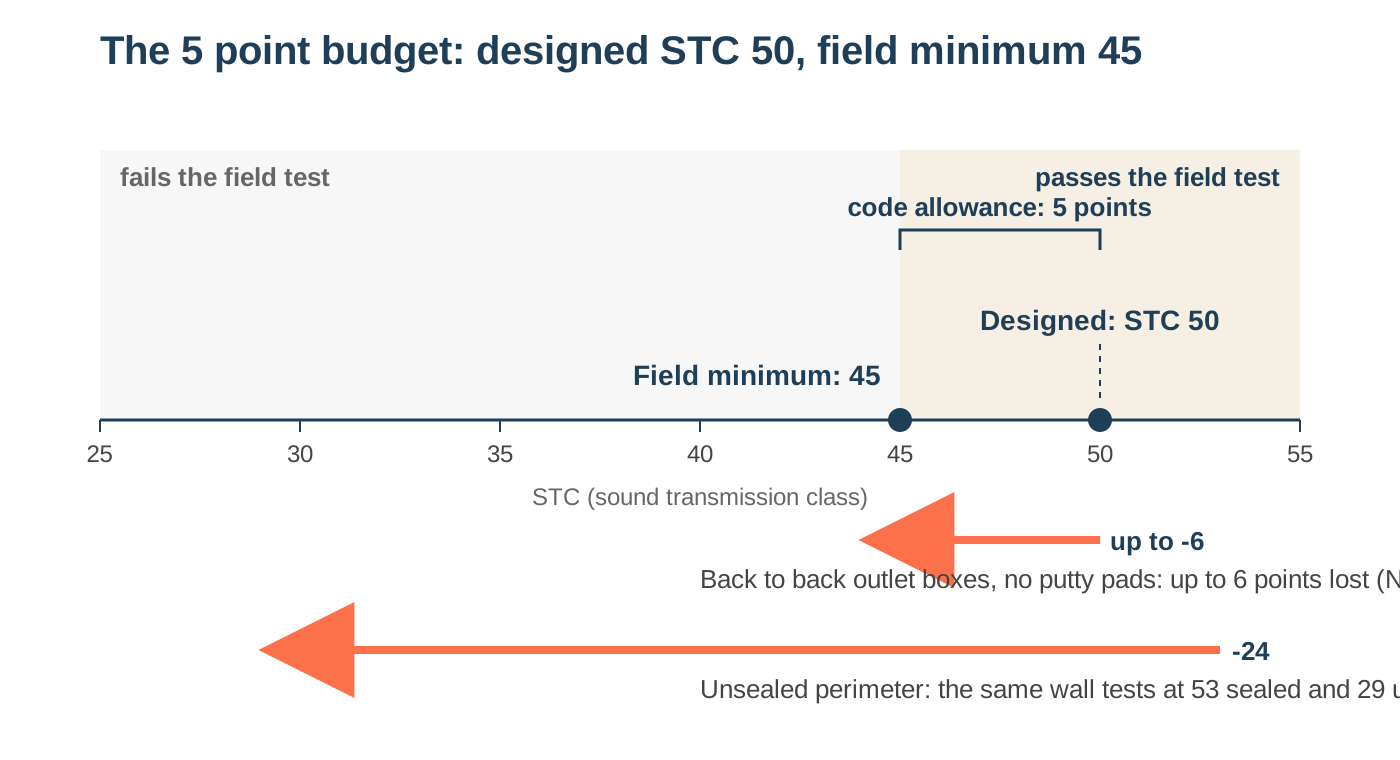
- Unsealed perimeter: catastrophic. USG, the largest US drywall manufacturer, publishes test data in its Acoustical Assemblies brochure showing the same wall assembly testing at STC 53 with the perimeter sealed and STC 29 with the perimeter left unsealed. Skipping roughly $40 of caulk makes a code wall perform like a hollow core door.
- Bare outlet boxes: up to 6 points. Canada's National Research Council measured walls with electrical boxes and found losses of up to 6 STC points when boxes sit back to back or share a stud cavity. That single detail can spend more than the entire 5 point budget.
The bead count matters too. Published sealant test data, reproduced widely in gypsum industry literature on acoustical sealing practice, shows the same partition scoring STC 29 with no sealant, 49 with a single bead at the runners, and 53 with a double bead. The full table and bead placement detail live on our ASTM C919 page.
Caution: back to back outlets can cost 6 points and the code only forgives 5. If one trade roughs in boxes back to back and nobody pads them, the wall can fail before the drywall crew makes a single mistake.
The Two Product Fix
Acoustic consultants publish pre drywall checklists for exactly this problem, and they pair the same two products: acoustical sealant at the perimeter and penetrations, putty pads on the electrical boxes. Each one closes a leak path the other cannot reach.
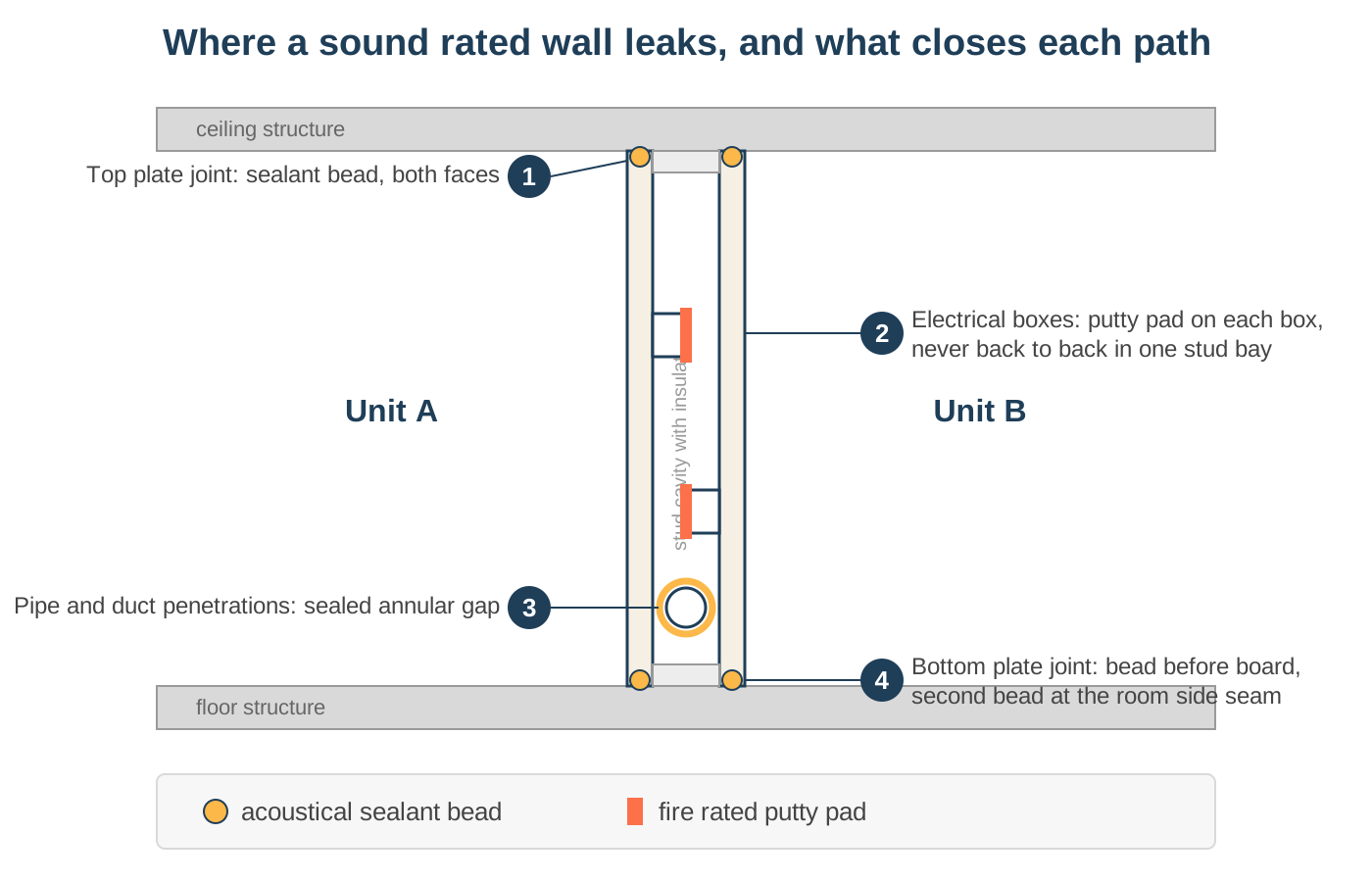
Acoustical sealant closes the linear gaps: where the wall meets the floor, the ceiling, and intersecting walls, plus cutouts and penetrations for pipe and duct. It stays permanently flexible instead of curing hard, so the seal survives framing movement. The product we stock, Everkem Sound Seal 90, is tested to ASTM E90 and C919, meets ASTM C834, is paintable, and runs 23.3 grams per liter VOC, low enough for LEED v4 low emission credit paths. Application detail is in the acoustic sealant guide.
Acoustical Sealant in Stock

Putty pads close the point leaks: the electrical boxes. Each pad molds over the back and sides of a box in about a minute. The Everkem pad is 7 by 7 inches, carries up to a 2 hour fire rating, and was tested in a 60 STC assembly per ASTM E90, so one product treats both the fire requirement and the sound requirement on the same box. Install detail is in the putty pads guide.
Fire Rated Putty Pads in Stock

Who Installs What
On a large project these two products belong to two different trades, in two different spec sections. The drywall subcontractor typically runs the acoustical sealant beads, specified under acoustical joint sealants (CSI 07 92 19) and often folded into the gypsum board assembly section. The putty pads are specified under firestopping (CSI 07 84 00) and usually installed by the electrician at rough in, though some projects hand them to a firestop contractor or the GC. Two trades, two suppliers, two chances for the detail to fall through the cracks.
On small projects the picture is different. On a 4 to 40 unit infill building, a townhome to condo conversion, an ADU over a garage, or a hotel room renovation, there is usually no specialty firestop sub and no full time spec enforcement. The general contractor is the single point of responsibility, buys the materials, and hands them to whoever is on site. If the boxes never get padded or the plates never get caulked, the GC owns the failed test.
That is the buyer this guide is built for: the one person responsible for getting both products into the wall before the drywall goes up.
How Much You Need
Quantity math is straightforward once you know the coverage rates. Sound Seal 90 lays about 61 linear feet per 20 oz tube at a 1/4 inch bead, or about 27 linear feet at the heavier 3/8 inch bead used at floor and ceiling runners. A case of 16 tubes covers roughly 980 linear feet at 1/4 inch or roughly 435 linear feet at 3/8 inch.
| Package | Coverage at 1/4 inch bead | Coverage at 3/8 inch bead | Best for |
|---|---|---|---|
| 20 oz tube | ~61 lf | ~27 lf | One room or punch list |
| Case of 16 tubes | ~980 lf | ~435 lf | Shared walls of 2 to 4 units |
| 5 gallon pail | ~1,950 lf | ~870 lf | Floor plates and pail programs |
Putty pads count one per single gang box, two for larger multi gang boxes. A typical small unit has 10 to 20 boxes in its sound rated walls. A case of 20 pads plus a case of 16 sealant tubes covers the demising surfaces of roughly 2 to 4 units.
Sealing more than a few units?
We quote case and pail programs on Sound Seal 90 and putty pads for multifamily and hospitality projects. Tell us the unit count and we will price it.
or call 714-248-6555 · email partners@usmadesupply.com
The Pre Drywall Checklist
Hand this sequence to whoever is closing up the walls. It is the order acoustic consultants use, and each step exists because skipping it has a measured cost.
- Bead before board: run a continuous acoustical sealant bead on the top and bottom runners before drywall goes up, both sides of the wall. Bead sizes and tooling are covered in how to apply acoustic sealant.
- Second bead at the room side seam: after the board is hung, seal the joint where the board meets the floor before base trim covers it.
- Pad each box: press a putty pad over the back and sides of each electrical box in the rated wall after cables are pulled and before faceplates. Our putty pads guide covers when putty pads are required box by box.
- Never share a stud bay: outlet boxes on opposite sides of the wall belong in different stud cavities, ideally separated by 16 inches or more.
- Seal each penetration: pipe, conduit, and duct openings get sealant or the appropriate treatment, not just insulation stuffed in the gap.
- Photo document before close up: a phone picture of each sealed plate line and padded box is the cheapest insurance you can buy against a dispute later.
On walls that carry a fire rating as well as a sound rating, which covers most demising walls, the firestop side has its own product rules. Our firestop product selection guide covers which sealant goes where when the wall is rated for both. And for jobs that run past acoustical work, our commercial guide to sealant types compares every chemistry we stock.
Frequently Asked Questions
What STC rating is required between apartments?
The International Building Code requires walls and floor ceiling assemblies separating dwelling units, or separating units from corridors and service areas, to be designed to STC 50, or to achieve 45 if the built wall is field tested. The same rule covers hotel rooms, dorms, and senior living units.
Do townhouses need STC 50 walls?
Not automatically. Townhouses built under the International Residential Code are covered only where the jurisdiction adopts the optional sound transmission appendix, which sets STC 45. Townhome style condos and buildings more than three stories above grade fall under the IBC and get the full STC 50 requirement.
How much does a field sound test cost?
Professional field STC testing typically runs $800 to $1,500 for the first wall assembly, with additional assemblies on the same visit priced lower. The builder or owner pays. In California, a failed complaint test also puts the cost of testing on the building owner.
What happens if an apartment sound test fails?
The leaks have to be found and sealed, which usually means removing base trim, cutting open finished drywall at plate lines and outlet boxes, resealing, patching, repainting, and paying for a retest. The materials that would have prevented the failure cost a few hundred dollars before drywall.
Do electrical outlets really matter for soundproofing?
Yes, more than almost any other detail. Canada's National Research Council measured losses of up to 6 STC points from outlet boxes placed back to back or in a shared stud cavity. The code only allows a 5 point drop between the designed rating and the field test, so bare boxes alone can fail a wall. Putty pads and separated boxes prevent the loss.
Who installs acoustical sealant and putty pads on a job?
On large projects the drywall subcontractor typically applies the acoustical sealant and the electrician usually installs putty pads at rough in. On small projects, 4 to 40 units, conversions, and ADUs, the general contractor typically buys both and assigns whoever is on site. Either way the sequence matters: beads before board, pads after cable pull.
Can regular caulk pass a sound test?
A fresh bead of rigid caulk seals air gaps at first, but hardening caulks crack as framing shrinks and moves, and the sound leak comes back. The assemblies that earn STC ratings are tested with non hardening acoustical sealant, which stays flexible for the life of the wall. Tested assemblies and acoustical sealing practice specify that product class at sound rated joints.
How much acoustical sealant do I need per wall?
Measure the linear feet of perimeter joints, top plate, bottom plate, and wall edges, on both sides of the wall, and add the penetrations. A 20 oz tube covers about 61 linear feet at a 1/4 inch bead or about 27 linear feet at 3/8 inch. A case of 16 tubes plus a case of 20 putty pads covers the shared walls of roughly 2 to 4 typical units.
Was this page helpful?
Your feedback helps us improve our technical resources.
