
Commercial Freezer & Walk-In Cooler Sealant Guide
Where to seal, what to seal with, and how to apply sealant in rooms that stay cold
Quick Answer
Two questions decide every cold-room sealant job.
1. Can the box be warmed for the work?
If yes, any NSF 51 silicone rated for the zone, applied within its temperature range, works. If the room stays cold, the sealant's application temperature floor on the technical data sheet has to cover the actual room temperature.
2. Which joint are you sealing?
Interior panel joints, cove and screed lines, trim, and penetrations take an NSF-listed silicone bead. The cam-lock panel joint itself is sealed by the factory compression gaskets and, on freezers, the butyl bead the installer runs along the warm side of the joint. An interior silicone bead does not replace either.
At least one panel maker's installation manual calls interior caulking advisable but not absolutely necessary, and specifies NSF-approved silicone for it.
What we stock for cold rooms

Whichever way the first question goes, we stock one sealant for the job, NSF 51 silicone for walk-in coolers (TruSil 100). Everkem's data sheet lists walk-in coolers, ice machines, and refrigeration units among its applications, and its -25°F application floor covers operating coolers and holding freezers down to that temperature.
- Application temperature: -25°F to 120°F
- Service temperature: -55°F to 400°F
- NSF/ANSI 51 certified for food contact
- Meets ASTM C920 with ±25% joint movement
- One-part acetoxy cure, 30 g/L VOC
- Colors: clear, white, black, aluminum, and a mildew-resistant translucent white
- Packaging: 10.1 oz tubes, case of 12, ships free in the contiguous US
Made by Everkem Diversified Products in Winston-Salem, NC.
Where TruSil 100 is the wrong product
- Not paintable, like any 100% silicone.
- Not for prolonged water immersion. A trench drain or any joint that holds standing water needs a different product.
- Not for porous surfaces such as masonry.
- Not for structural glazing.
- ±25% is its movement rating. A floor expansion joint is specified by its calculated movement under ASTM C920, not by its width, and can call for a Class 50 sealant; start with the joint movement class decoder.
For the hot end of the same NSF 51 family, ovens, flues, and exhaust at up to 500°F continuous, see the heat-resistant sealant selection guide.
How Walk-In Panels Are Built and Sealed
A walk-in is a kit of tongue-and-groove insulated panels: a foam core between two metal skins, pulled tight by cam-lock fasteners. Compression gaskets line the inside and outside edges of each panel, and when the cam locks draw the panels together the gaskets seal against each other to form the air and moisture barrier.
On freezers the installer adds a continuous 3/8 inch bead of non-drying butyl at every panel joint, on the warm side of the panel, before the cam locks are drawn tight. Butyl stays permanently flexible and never skins over, which is exactly what a buried vapor seal needs.
Field-applied silicone has a different job. It is the interior finish bead: a smooth, cleanable, NSF-listed cap over interior joints, penetrations, trim, and repairs. If a joint is leaking air or growing ice, the fix is the gasket, the butyl, or the cam-lock tension, not a thicker bead of caulk over the cold side.
Why this split matters: on most panel systems the gaskets and butyl are the working vapor seal and the silicone bead is the sanitation layer. Some makers treat the interior bead as part of the moisture barrier too (at least one maker's manual does), so the assembly drawing governs. Either way, it is the surface bead, not the joint, that gets recaulked over the life of the box.
Why Ice Forms at Joints
Condensation forms when a surface sits below the dew point of the air touching it. In a freezer that condensation freezes, and it freezes first at the panel joints because the joint and its frame conduct heat better than the foam core. One panel maker puts a wood frame's insulating value at roughly R-1.2 per inch against R-7 to R-8 per inch for the foam, which makes every wood-framed joint a cold stripe on the wall. Some makers use a wood-free panel edge for exactly this reason.
Warm air carries far more moisture than cold air, so vapor pressure constantly pushes moisture from the warm side of the box toward the cold side. That is why the continuous vapor seal belongs on the warm side of the panel: moisture that gets into a joint condenses, freezes, and the ice slowly pushes the joint open from the inside.
In practice, a failed interior bead is mostly a cleanability problem. Ice tracing a joint line means humid air is reaching a cold frame, through a vapor-seal breach, an air leak, or simply high humidity around the box; one panel maker's guidance says it gets worse fast past about 55 percent relative humidity.
Never caulk over frost or ice. Sealant does not bond to a frosted surface, and every data sheet says so. Find and fix the air leak, defrost, dry the joint, then seal.
Where to Seal: Joint by Joint
Manufacturers' installation guides are blunt about penetrations: every wall penetration needs an airtight seal. Interior caulking is recommended practice in some manuals and required at specific seams in others, so the assembly drawing governs. Here is the full map.
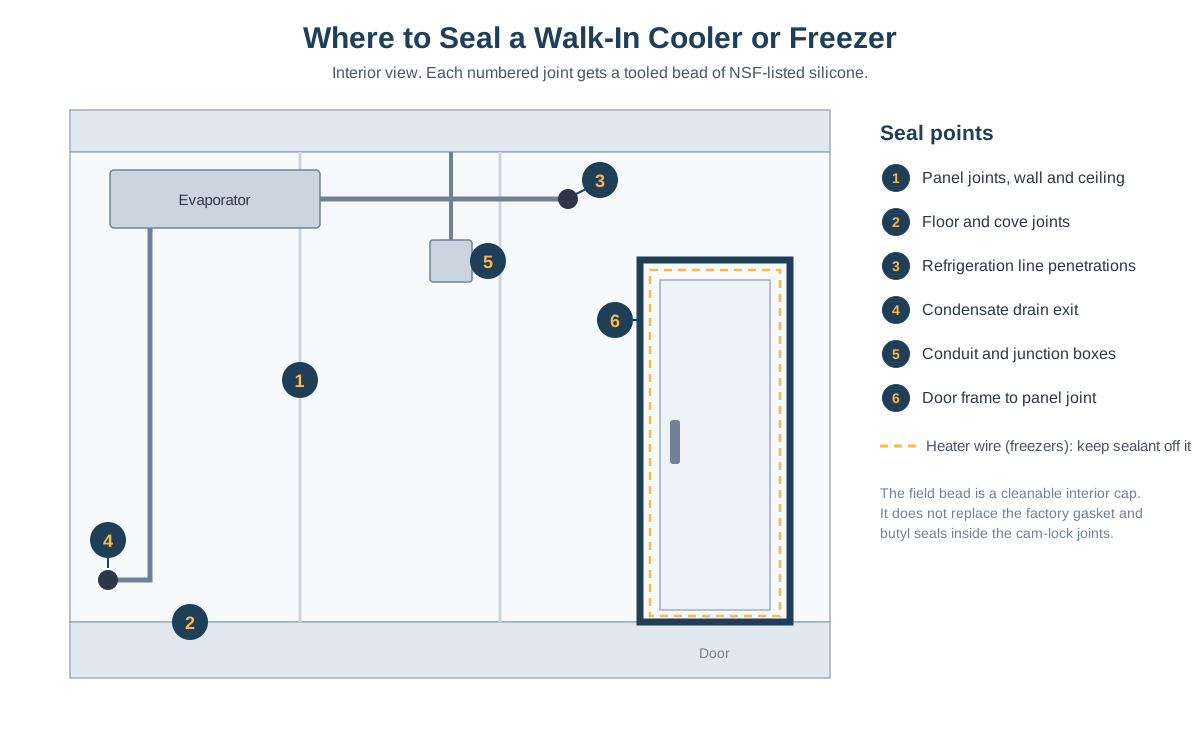
| Location | What to use | Notes |
|---|---|---|
| 1. Interior panel joints (wall to wall, wall to ceiling) | NSF-listed silicone | Advisable per at least one panel maker's manual; tool smooth for cleanability |
| 2. Floor and cove joints, screed lines | NSF-listed silicone | Slab-mounted boxes get beads inside the wall line and along each inside screed edge during install |
| 3. Refrigeration line set penetrations | Silicone over the insulated lines; some makers fill the void with foam first | Manufacturers require an airtight seal at every wall penetration |
| 4. Condensate drain exit | Silicone around the drain line | Seal the gap where the line passes through the panel, never the drain opening itself |
| 5. Electrical conduit openings | Silicone | Sealing conduit openings keeps moisture out of junction boxes |
| 6. Door frame to panel joint | Silicone at the frame-to-panel joint only | Freezer door frames carry a perimeter heater wire; check the door maker's service detail before sealing near it |
A dry sprinkler that drops through the freezer ceiling is a penetration too. Its maker's instructions require the gap around the barrel to be sealed against air movement, or warm, humid air condenses and builds ice around the sprinkler. For a field example, see Paragon Fire Protection's write-up of an iced-over dry sprinkler in a Dallas walk-in freezer.
Tooling tip: cold joints sit near their widest dimension. Tool the bead concave so it survives compression if the box is ever warmed, and so the cured bead presents the smooth face inspectors want.
Metal trim and coated aluminum: bare, painted, powder-coated, and anodized aluminum are different surfaces to bond to, and a bead can sit on a coating without ever gripping it. Clean the metal with the solvent the sealant maker names, checking that it is also safe for the finish, using two clean cloths: wipe on with the first and wipe dry with the second before the solvent evaporates. Do not sand an anodized or coated finish unless the sealant maker and the finish maker both approve it, because sanding can strip the finish. Then run a short test bead on the actual trim, let it cure, and peel it. If it tears inside the bead, the sealant is gripping that finish. If it lets go clean from the metal, that finish needs a primer or a different sealant, so check with the sealant maker before you seal the whole box.
One more metal check: acetoxy silicones, the kind this guide recommends, give off acetic acid (the vinegar smell) while they cure, and several silicone makers warn against some acetoxy grades on copper, brass, zinc, and galvanized steel. If a panel skin or trim is one of those, get the sealant maker's written okay first or use a neutral-cure silicone.
The TruSil 100 covered in the Quick Answer lists walk-in coolers among its applications, but check each joint against its data sheet before you seal. It rules out porous surfaces such as masonry, so a floor or cove joint against bare concrete needs a different product, and metal trim needs the checks above. Sealing for more than one job or site? Ask about standing case pricing below.
How Much Sealant to Buy
Coverage comes down to the bead, not the box. A 10.1 fl oz tube holds about 18 cubic inches of sealant, so the feet you get from it depend on the size of the bead you run.
| Bead size | Feet per 10.1 fl oz tube | Feet per case of 12 |
|---|---|---|
| 1/8 in x 1/8 in | about 97 | about 1,165 |
| 1/4 in triangular fillet (corner bead) | about 49 | about 585 |
| 1/4 in x 1/4 in | about 24 | about 290 |
| 1/2 in wide x 1/4 in deep | about 12 | about 145 |
| 3/8 in x 3/8 in | about 11 | about 130 |
Worked out from the tube's volume, with nothing allowed for waste. Real coverage runs lower.
To size a job, add up the joints you plan to seal: the vertical corners, the ceiling and floor perimeters, each interior panel seam, the door frame, and every penetration. An 8 by 10 foot box with 8 foot walls has about 104 feet of corner and perimeter joints alone. At a 1/4 by 1/4 inch square bead that is about 4.3 tubes in theory, so at least 5, before panel seams and penetrations. Then add for waste: tooling, the nozzle, and part tubes left to skin over all use product. One sealant maker's estimating guidance suggests 10 to 15 percent for routine work and more for irregular joints.
Application Temperature vs Service Temperature
A sealant's service temperature is how cold the cured bead can get and still perform. Its application temperature is the surface and air temperature you are allowed to apply it at. The two numbers are far apart for most products, and mixing them up is the mistake that ruins cold-room jobs.
One major sealant manufacturer publishes these floors for its own lines in a low-temperature application bulletin, which is a fair picture of how the chemistries rank. The specific product's technical data sheet always governs.
| Sealant chemistry | Published minimum application temperature |
|---|---|
| Architectural and glazing silicone | -20°F |
| Polyurethane | 20°F |
| Architectural hybrid | 20°F |
| Polysulfide | 20°F |
| Latex (water-based) | 32°F, never below freezing |
| Traffic-grade silicone | 40°F |
- Surfaces must be clean, dry, and frost-free, no exceptions. Frost is named explicitly in sealant TDS surface-prep requirements.
- Never apply at or below the dew point. If dew or frost is forming on the joint face, stop.
- Never use water-based (latex) sealant below freezing.
- Silicone is the chemistry least affected by cold, per that bulletin, which is why it still guns and tools in an operating cooler.
TruSil 100's TDS sets its application range at -25°F to 120°F, with a cured service range of -55°F to 400°F. That application floor is what makes it usable inside an operating freezer rather than only in a warmed one. For the full chemistry rundown, see the silicone sealant section of the main selection guide.
Warm the box or work cold? If the freezer can be powered down and warmed above a product's application floor for the work, any NSF 51 silicone rated for the zone and the joint qualifies, and the cure speeds up. If product can't be moved and the box stays at temperature, pick by the TDS application floor and plan around a slow cure. TruSil 100's -25°F application floor covers either path; cases are on the product page.
Curing in a Room That Stays Cold
TruSil 100 is an acetoxy silicone, which means it cures by pulling moisture out of the air. Its datasheet numbers (skins over in 5 minutes, dry to the touch in 1 hour, cures and bonds in 24 hours, full cure in 24 to 48 hours, 7 days to maximum strength) assume 75°F and 50 percent relative humidity.
A cold room offers neither of those conditions. Cold slows the cure reaction itself, and air at freezer temperatures holds very little moisture to begin with, so both effects stack. Plan on days rather than hours, and keep traffic, product contact, and washdown off the bead until it has fully cured.
- Keep tubes at room temperature, 50°F to 80°F per the same low-temperature bulletin, and bring them into the box one at a time. A warm tube guns and tools far better.
- Schedule the bead after a defrost cycle, once the joint is dry, frost-free, and above the dew point. A defrost can leave condensation behind.
- Flag or cone off fresh beads in working coolers. A slow-curing bead stays tacky and vulnerable much longer than the datasheet suggests.
Compliance in Two Minutes
NSF/ANSI 7 is the food-equipment standard that covers walk-in coolers and freezers (current edition 2024; the clause text here is from the public 2007 edition). For prefabricated walk-ins it requires gaskets applied to panel perimeters at the time of manufacture, says caulk and sealant are not to seal panel-to-panel joints except for minor repairs, requires other permanent interior seams to be sealed, and points materials to the requirements of NSF/ANSI 51 for the zone where each material is used. It sets no installation requirements of its own. That is why the interior bead, wherever a panel maker calls for one, is an NSF 51 material.
- FDA Food Code, the model code most states adopt: 6-201.11 requires floors, walls, and ceilings to be smooth and easily cleanable, and 6-101.11 requires nonabsorbent materials in areas subject to moisture, walk-in refrigerators named among them.
- 21 CFR 117.20 (FSMA CGMPs): plants must be built so floors, walls, and ceilings can be kept clean and in good repair, and so drip or condensate does not contaminate food, food-contact surfaces, or packaging.
- USDA-inspected meat and poultry plants: 9 CFR 416.2(b) requires walls, floors, and ceilings of durable materials impervious to moisture, and 416.2(d) requires ventilation adequate to control condensation.
For the certification side, including NSF-51 vs NSF-Listed sealant requirements for food facilities and the rules for sanitary wash-down zones the cold room often shares a wall with, see the food processing sealants guide.
One boundary worth stating plainly: NSF 51 is a food-equipment materials certification. It is not NSF/ANSI 61, the drinking-water standard, so an NSF 51 listing does not make a sealant suitable for potable water or immersion service.
Frequently Asked Questions
What sealant should you use for walk-in freezer panels?
Two different seals do two different jobs. Inside the cam-lock joint, the factory compression gaskets and the butyl bead the installer runs on the warm side make the seal, and interior caulk does not replace them. On interior panel joints, cove lines, trim, and penetrations, use an NSF-listed 100% silicone, which is what at least one panel maker's manual recommends for caulking interior joints. If the box is running, check the application temperature on the TDS first.
Can you apply silicone sealant inside an operating freezer?
Only if the product's TDS application floor covers the room temperature. Many sealants cannot be applied anywhere near freezer temperatures even though the cured bead survives far colder; one major maker's published floors run from -20°F to 40°F across its lines. TruSil 100's TDS allows application from -25°F on a clean, dry, frost-free surface. Never apply at or below the dew point, and expect a much slower cure in cold, dry air.
What temperature is too cold to caulk?
It depends on the product. One major sealant manufacturer's published floors for its own lines run from -20°F for architectural silicones to 20°F for polyurethanes, hybrids, and polysulfides, 32°F for latex (never below freezing), and 40°F for traffic-grade silicone. The specific product's TDS governs, and the surface must be frost-free regardless of the air temperature.
Can you caulk a wet surface in a walk-in cooler or freezer?
Not with silicone. Silicone needs a clean, dry, frost-free joint, and water on the surface keeps the bead from bonding. In a freezer that water turns to frost. Dry the joint first: defrost, warm, or dehumidify as needed, then check that the surface is dry, frost-free, and above the dew point before you seal. A defrost cycle alone can leave condensation behind. Some hybrid-polymer sealants are sold for damp or wet surfaces, but not all of them, and their published application floors commonly sit well above freezer temperatures. Check the wet-surface claim, the application floor, and the NSF 51 listing on the same product before using one in a walk-in.
How long does silicone take to cure inside a cold room that stays cold?
Longer than the datasheet says. Cure times like 24 to 48 hours assume 75°F and 50 percent relative humidity. Cold slows the cure reaction and freezer air carries very little of the moisture an acetoxy silicone needs, so plan on days rather than hours and protect the bead from contact and washdown until it has fully cured.
Why does ice keep forming at my freezer panel joints?
Warm, humid air is reaching a surface that sits below its dew point, and on wood-framed panels the joint is the coldest line on the wall because the frame conducts more heat than the foam core. Check for an air leak or vapor-seal breach first, then the humidity around the box, which one panel maker says makes joint icing worse past about 55 percent. Never caulk over an icy joint; sealant will not bond to frost.
Do walk-in cooler joints need to be caulked at all?
At least one major panel maker calls interior caulking advisable rather than mandatory: the gaskets and butyl make the seal, and the interior NSF silicone bead adds a smooth, cleanable surface and protects the gaskets. Health inspectors care that joints are sealed and cleanable, so an interior bead is the safe default even where the manual calls it optional.
Is NSF 51 required for a walk-in cooler wall joint?
NSF/ANSI 7, the walk-in equipment standard, points every material in the box to the NSF/ANSI 51 requirements for the zone where it is used, so the answer depends on whether that wall is a food, splash, or nonfood zone. Stocking one NSF 51 silicone for the whole box removes the zone-by-zone judgment call. The full NSF-51 vs NSF-Listed breakdown is in our food processing sealants guide.
What do you seal refrigeration line and drain penetrations with?
Whatever the panel maker's drawing calls for, after the penetration is insulated: some makers specify silicone alone, others fill the void with spray foam and finish with silicone. Manufacturers require an airtight seal at every wall penetration, which includes refrigeration line sets, condensate drain lines, and electrical conduit. Seal the gap around the line, not the drain opening itself, and seal conduit openings to keep moisture out of junction boxes.
Can I use spray foam on a walk-in freezer panel joint?
Not in place of the gasket or butyl bead the panel maker specifies at the joint. Foam belongs at penetrations and in large voids behind trim: at least one panel maker seals penetrations with spray foam and then silicone over the exposed face. For the joint itself, use a low-temperature-rated silicone. The Quick Answer at the top of this guide covers the one we carry.
Sealing for more than one job or site?
Refrigeration and mechanical contractors, foodservice installers, and operators who recaulk on a schedule: tell us roughly how many jobs or sites you seal in a year, and we can set up standing case pricing. We usually reply within one business day.
or call 714-248-6555 · email partners@usmadesupply.com
Was this page helpful?
Your feedback helps us improve our technical resources.

Recommended in this guide
Everkem TruSil 100, 100% Silicone Sealant
Clear / Case of 12 (10.1 oz Tubes)
NSF-51 food-equipment certified. -25°F application, -55°F to 400°F service.