
NFPA 407: Aircraft Fuel Servicing Fire Extinguisher Requirements
Federal-AC-adopted standard for portable extinguishers on refueler tankers, hydrant carts, fueling positions, and airport fuel servicing aprons
Last updated: June 26, 2026
Contents
Also needed for compliance
NFPA 407 sets the aviation-specific extinguisher rules below. The standards below cover the general extinguisher placement, fuel storage, and aircraft maintenance hangar requirements that overlay this one.
- NFPA 10: portable extinguisher placement, inspection, and maintenance rules
- NFPA 30: flammable and combustible liquids storage at fuel farms
- DOT 49 CFR §393.95: extinguisher rules for the road portion of refueler vehicle operation
- FAA AC 150/5230-4C: the Advisory Circular that adopts NFPA 407 by reference
Overview
NFPA 407, Standard for Aircraft Fuel Servicing, is the consensus standard governing portable fire extinguisher selection, capacity, mounting, and placement at airport fueling operations. The current edition is 2022; the 2027 cycle is in development. It applies to fixed-base operators, into-plane fueling operators, airport fuel storage operators, and the refueler tank vehicles and hydrant carts they run on the apron.
The FAA references NFPA 407 in Advisory Circular 150/5230-4C Aircraft Fuel Storage, Handling, Training, and Dispensing on Airports. The AC is recommended guidance and one accepted means of meeting Part 139 airport-certification fueling requirements; it is also mandatory for AIP and PFC-funded projects. Local airport standards and the AHJ can specify additional or alternative requirements. Within NFPA 407 itself, the extinguisher rules in §4.1.10, §5.1.10, §6.1.10, and §8.1.10 are the load-bearing sections. They are short, specific, and consistent: at least 40-B:C rating, at least 20 lb of dry chemical agent, with ABC ammonium phosphate prohibited on fueling vehicles and on aircraft servicing ramps and aprons (and at airport fuel facilities within 500 ft of aircraft operating areas).
NFPA 407 is not the sole standard. NFPA 10 still applies for general placement, inspection, travel-distance, and maintenance rules; NFPA 30 governs fuel storage at the tank farm; NFPA 410 covers the aircraft maintenance hangar. This page covers the aviation-specific layer.
Quick reference: extinguisher spec by location
| Location | NFPA 407 section | Minimum count | Minimum rating | Minimum capacity |
|---|---|---|---|---|
| Refueler tank vehicle | §6.1.10.1 | 2 (one per side) | 40-B:C | 20 lb dry chem |
| Hydrant fuel servicing vehicle or cart | §6.1.10.2 | 1 | 40-B:C | 20 lb dry chem |
| Fueling vehicle loading position or rack | §5.1.10 | 1 (may serve two on a common island) | 40-B:C | 20 lb dry chem |
| Self-service / aircraft fueling facility dispenser | §8.1.10.1 | 1 at the dispenser | 40-B:C | 20 lb dry chem |
| Emergency fuel shutoff control | §8.1.10.2 | 1 | 40-B:C | 20 lb dry chem |
| Aircraft servicing ramp / apron | §4.1.10.1 | Per NFPA 410 | Per NFPA 410 | Per NFPA 410 |
All extinguishers must be UL listed (§4.1.10.2) and must not be ABC multipurpose dry chemical when located within 500 ft of aircraft operating areas (§4.1.10.3).
The ABC ammonium phosphate prohibition (§4.1.10.3)
The single rule most often missed by operations defaulting to commodity ABC units is §4.1.10.3. Verbatim:
“ABC multipurpose dry chemical fire extinguishers (ammonium phosphate) shall not be placed on aircraft fueling vehicles, airport fuel servicing ramps or aprons, or at airport fuel facilities that are located within 150 m (500 ft) of aircraft operating areas.”
The driving concern is corrosion. Monoammonium phosphate, the agent in standard ABC dry chem, leaves a residue that is corrosive to aluminum airframe skins and difficult to clean off avionics, control surfaces, and engine inlets. The bicarbonate-based BC agents do not have the same residue problem.
Two scope notes from the rule text are worth pulling out. First, the prohibition on fueling vehicles and on aircraft fuel servicing ramps or aprons is absolute — no 500 ft qualifier applies to those locations. ABC may not be placed on a refueler tanker, hydrant cart, or servicing apron regardless of distance from active aircraft. Second, the 500 ft qualifier only modifies the third item in the rule: airport fuel facilities (the fuel farm, the loading rack, the dispenser). At those fixed facilities, ABC is prohibited only when the facility itself is within 150 m (500 ft) of aircraft operating areas; a remote bulk-storage tank farm beyond that distance can use ABC unless the local AHJ requires otherwise. ABC units inside the FBO terminal building or the maintenance hangar are not governed by §4.1.10.3 either.
Compliant agents
The dry-chemical agents that meet §4.1.10.3 are the BC sodium and potassium bicarbonate formulations. The other compliant categories at airport fueling operations are AFFF foam (typically for ramp/apron coverage under NFPA 410) and water-based agents for Class A hazards inside the FBO building.
- Potassium bicarbonate (Purple K): the standard agent for aviation refueling. Roughly twice as effective as Regular dry chem or ABC on hydrocarbon-fuel pool fires by weight. A 20 lb PK unit clears NFPA 407’s 40-B:C / 20 lb floor with significant margin (most 20 lb PK handhelds carry a 120-B:C or higher rating).
- Sodium bicarbonate (Regular dry chem): compliant with §4.1.10.3 and the cheaper option. Lower B-rating per pound than Purple K, so you may need a larger unit to clear the 40-B:C minimum.
- AFFF foam: referenced for ramp/apron coverage and spill response under NFPA 410, not by NFPA 407’s portable-extinguisher minimums. Verify any AFFF use case against NFPA 410 and the local AHJ; note that PFAS-related regulatory restrictions on AFFF formulations are evolving.
- CO2: generally not selected for outdoor fueling apron use. Wind disperses the gas before it can reach the fuel surface, and the discharge range is short. NFPA 407 Annex C notes the limitation. CO2 is fine for inside-the-FBO electrical hazards where §4.1.10.3 does not apply.
Refueler tank vehicles (§6.1.10.1)
Verbatim §6.1.10.1: “Each aircraft fuel servicing tank vehicle shall have two listed fire extinguishers, each having a rating of at least 40-B:C and a minimum capacity of 9.0 kg (20 lb) of dry chemical agent, with one extinguisher mounted on each side of the vehicle.”
The rest of §6.1.10 covers mounting and visibility:
- §6.1.10.3: extinguishers shall be readily accessible from the ground.
- §6.1.10.4: the panel or tank surface directly behind each extinguisher must be painted a color that contrasts with the extinguisher.
- §6.1.10.5: extinguishers must be kept clear of ice and snow.
- §6.1.10.6 and §6.1.10.7: if mounted in an enclosed compartment, the unit must be readily accessible and the location must be marked with letters at least 50 mm (2 in) high in a contrasting color.
The road portion of refueler operation is also subject to DOT 49 CFR §393.95 if the vehicle uses public roads between the fuel farm and the apron. The two rules are layered, not alternatives.
Hydrant fuel servicing vehicles and carts (§6.1.10.2)
Verbatim §6.1.10.2: “One listed fire extinguisher having a rating of at least 40-B:C and a minimum capacity of 9.0 kg (20 lb) of dry chemical agent shall be installed on each hydrant fuel servicing vehicle or cart.” The same mounting, accessibility, contrast, and ice-clearing requirements (§6.1.10.3 through §6.1.10.7) apply. ABC ammonium phosphate is prohibited per §4.1.10.3.
Fueling vehicle loading positions and racks (§5.1.10)
Verbatim §5.1.10: “At least one fire extinguisher with a minimum rating of 40-B:C and a minimum capacity of 9.0 kg (20 lb) of dry chemical agent shall be provided at each fueling vehicle loading position or rack.”
- §5.1.10.1: a single extinguisher may serve up to two fueling vehicle loading positions on a common island.
- §5.1.10.2: travel distance to extinguishers must not exceed 15 m (50 ft).
The fuel storage and dispensing systems these loading racks feed are also governed by NFPA 30 for tank construction, separation distances, and bonding. NFPA 407 §5.1 cross-references those requirements.
Aircraft fueling facility dispensers and emergency shutoffs (§8.1.10)
Chapter 8 covers aircraft fueling facilities (self-service and supervised positions at smaller airports, off-airport fueling facilities, and similar fixed installations). The two extinguisher clauses:
- §8.1.10.1: “Each facility shall have a minimum of one fire extinguisher with a rating of at least 40-B:C and a minimum capacity of 9.0 kg (20 lb) of dry chemical agent located at the dispenser.”
- §8.1.10.2: “At least one fire extinguisher with a rating of at least 40-B:C and a minimum capacity of 9.0 kg (20 lb) of dry chemical agent shall be provided at each emergency fuel shutoff control.”
Same spec as the loading positions and hydrant carts. Same ABC prohibition applies (subject to the 500 ft qualifier on the fuel facility itself). The intent is that an operator at the dispenser, or at the emergency shutoff control, has a knockdown tool within reach.
Apron and ramp coverage (§4.1.10.1)
Verbatim §4.1.10.1: “During fueling operations, fire extinguishers shall be available on aircraft servicing ramps or aprons, in accordance with NFPA 410.” NFPA 407 hands off to NFPA 410 (Standard on Aircraft Maintenance) for the actual ramp coverage geometry.
NFPA 407 Annex A (informational, not mandatory) suggests planning ramp coverage so that no single-park gate has an extinguisher travel distance greater than 60 m (200 ft), and no double or triple-park gate has a travel distance greater than 30 m (100 ft). At larger gates, the annex suggests positioning units upwind so an operator can reach them without crossing the fuel spill, and notes that CO2 should generally be avoided because wind and short discharge range limit its effectiveness on outdoor fuel fires.
Training and inspection
FAA AC 150/5230-4C §2.1.8 requires hands-on hand-held extinguisher training every 24 consecutive calendar months for all fueling personnel, not just supervisors. New employees must complete the training within 60 days before or after their initial assignment. The training must cover purpose, classification identification, component inspection, proper PASS technique, and a live discharge demonstration (or realistic training device).
Inspection follows NFPA 10: monthly visual inspection (gauge, seal, hose, mounting), annual professional inspection by a certified service company, internal exam every 6 years for stored-pressure dry chem, and 12-year hydrostatic test on the cylinder. Inspection tags must be visible on the unit without obstructing the rating label.
Frequently Asked Questions
Why is ABC ammonium phosphate prohibited at airport fueling areas?
Two reasons. Monoammonium phosphate residue is corrosive to aluminum airframe skins and difficult to clean off avionics, control surfaces, and engine inlets. And on a jet-fuel pool fire it tends to clump on the fuel surface rather than blanket it. NFPA 407 §4.1.10.3 bans ABC dry chem from fueling vehicles, fuel servicing ramps and aprons, and airport fuel facilities within 150 m (500 ft) of aircraft operating areas. The compliant agents are sodium bicarbonate, potassium bicarbonate (Purple K), and AFFF foam.
What rating must my fueling-position extinguisher meet?
Per NFPA 407 §5.1.10, at least one extinguisher rated 40-B:C with at least 9.0 kg (20 lb) of dry chemical agent at each fueling vehicle loading position or rack. A single unit may serve up to two positions on a common island. Travel distance to the extinguisher must not exceed 15 m (50 ft). The agent must not be ABC ammonium phosphate.
How many fire extinguishers does an aircraft refueler tank vehicle need?
Two. NFPA 407 §6.1.10.1 requires two listed extinguishers, each at least 40-B:C and at least 9.0 kg (20 lb) of dry chemical agent, with one mounted on each side of the vehicle. They must be readily accessible from the ground, mounted against a contrasting-color panel, and kept clear of ice and snow.
Does NFPA 407 apply to a small Part 91 general aviation fueling operation?
It depends on local adoption. NFPA 407 §1.1 covers the fuel servicing of all types of aircraft using liquid fuel and is not scoped by FAR Part (91, 121, 135, 145). The binding effect on a specific operation comes from: (a) the FAA via AC 150/5230-4C as one accepted means of meeting Part 139 airport certification requirements (mandatory for AIP and PFC- funded projects), (b) the airport authority’s own minimum standards and lease conditions, and (c) the local fire marshal as AHJ. Many small Part 91 GA operations are still bound through one or more of those paths; some are not. Confirm with your airport authority and AHJ.
Can I use a CO2 extinguisher on the fueling apron?
Not as the primary unit. CO2 meets the B:C rating requirement, but NFPA 407 Annex C notes that CO2 should generally be avoided outdoors because wind disperses the gas before it reaches the fuel surface and the effective discharge range is short. Dry chemical (Purple K or Regular) and AFFF foam are the right primary choices for the apron. CO2 is appropriate inside the FBO building or hangar where §4.1.10.3 and the wind constraint do not apply.
How often must aviation fueling personnel be trained on hand-held extinguishers?
Every 24 consecutive calendar months for all fueling personnel, per FAA AC 150/5230-4C §2.1.8. The AC applies to supervisors and non-supervisors alike. New employees must complete the training within 60 days before or after their initial assignment. Training must include a live discharge of a hand-held unit (or a realistic training device) onto a fire.
Stocked Purple K option
NFPA 407 requires at least 9.0 kg (20 lb) of dry chemical agent and prohibits ABC ammonium phosphate at fueling vehicles, ramps, and aprons (and at airport fuel facilities within 500 ft of aircraft operating areas). The compliant agents are sodium bicarbonate and potassium bicarbonate (Purple K). From our current stocked catalog the closest fit is:
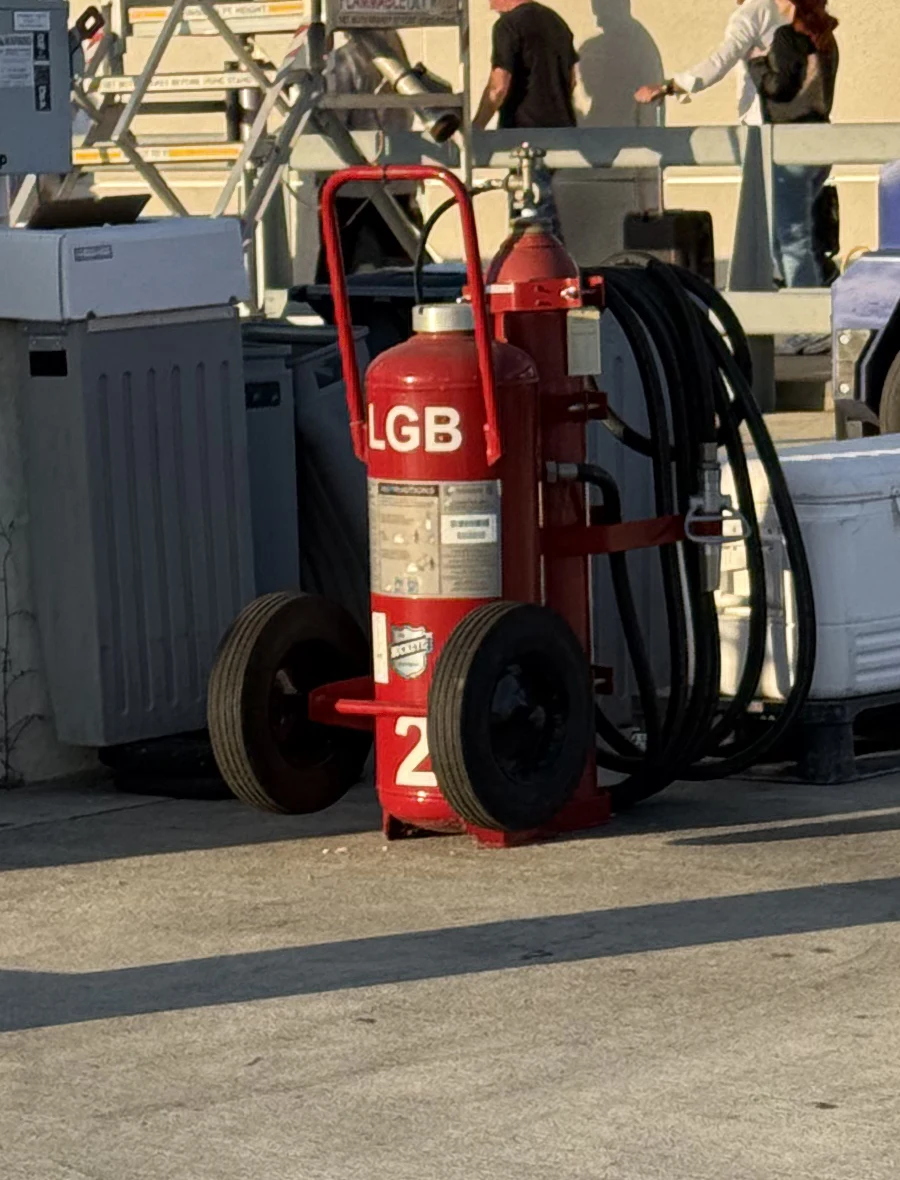
Buckeye 50 lb Purple K wheeled (K-50-SP)
Stored-pressure wheeled unit, 160-B:C rating, 50 lb of potassium bicarbonate agent on a two-wheel cart. Clears the 40-B:C / 20 lb minimums in §5.1.10 (loading racks), §8.1.10.1 (facility dispensers), and §8.1.10.2 (emergency shutoff stations) with significant margin. The BC agent is §4.1.10.3-compliant.
Not a fit for §6.1.10.1 or §6.1.10.2. Those clauses require listed extinguishers mounted on each side of an aircraft fuel servicing tank vehicle or installed on each hydrant fuel servicing vehicle or cart. A wheeled cart is not a vehicle-mount. For the side-mounted 20 lb Purple K handhelds required by §6.1.10.1 / §6.1.10.2, contact us for a quote — Buckeye builds the matching handheld in the same product family, and larger wheeled units (125 lb K-150-RG) are available for high-throughput fueling positions.
View the 50 lb Purple K wheeled (K-50-SP) →View the wheeled extinguisher collection →Aviation-Tagged Extinguishers in Stock

Manufacturer: Buckeye
Buckeye 10 lb CO2 Fire Extinguisher
$264.00

Manufacturer: Buckeye
Buckeye 10 lb Purple K Fire Extinguisher 80-B:C
$165.00

Manufacturer: Buckeye
Buckeye 125 lb Purple K Wheeled Fire Extinguisher 320-B:C
$3,154.00

Manufacturer: Buckeye
Buckeye 15.5 lb Halotron Clean Agent Fire Extinguisher
$1,513.00
$1,625.00

Manufacturer: Buckeye
Buckeye 2.5 lb Halotron Clean Agent Fire Extinguisher
$275.00

Manufacturer: Buckeye
Buckeye 2.5 lb Purple K BC Fire Extinguisher, Vehicle Bracket, UL Listed 10-B:C, Part 13515
$69.00
Outfitting a refueler fleet, hydrant cart, or FBO?
Volume pricing on §4.1.10.3-compliant BC dry chemical handhelds and wheeled units. Quotes include NFPA 10 inspection-tag templates and Buckeye USCG/UL listing certificates. Quote back within one business day.
or call 714-248-6555 · email partners@usmadesupply.com
Was this page helpful?
Your feedback helps us improve our technical resources.

Recommended in this guide
Buckeye 50 lb Purple K Wheeled