
Duct Sealing Requirements: Seal Classes, Code Rules, and Leakage Tests
What to seal, what to seal it with, and the leakage numbers your system has to hit, from SMACNA seal classes to CFM25 testing.
Last updated: June 10, 2026
Overview
Duct sealing usually lands on your desk one of three ways: the project spec calls out a SMACNA seal class, the HERS rater or test technician failed the duct leakage test, or the inspector flagged the tape on a flex connection. All three trace back to the same small set of rules, and none of them are complicated once the numbers are in front of you.
The stakes are real. ENERGY STAR estimates that in a typical house, about 20 to 30 percent of the air moving through the duct system is lost to leaks, holes, and poorly connected ducts. This guide covers three things:
- Which sealing products are code-legal, and why cloth duct tape is not one of them.
- What SMACNA seal classes A, B, and C actually require, and the leakage classes behind them.
- The leakage test limits: IECC numbers nationally and Title 24 thresholds in California.
Mastic vs Foil Tape vs Cloth Duct Tape
The definitive durability data comes from Lawrence Berkeley National Laboratory. Researchers Max Sherman and Iain Walker tested 19 sealant samples for three months under simulated HVAC conditions: hot air at 167°F and cold air at around 54°F, alternating every five minutes. Of everything tested, which included cloth duct tapes, clear plastic tape, foil-backed tape, mastic, and aerosol sealant, only cloth duct tape failed. In Sherman's words, it failed reliably and often quite catastrophically: 11 duct-tape samples failed within days against a 10 percent leakage threshold, and only one survived the full three months. The aerosol sealant was cycled for two years.
| Product | Typical markings | Code status | LBNL durability result |
|---|---|---|---|
| Cloth-backed rubber-adhesive duct tape | None (unlisted) | Not an accepted closure on its own; Title 24 prohibits it unless combined with mastic and drawbands | Only material that failed; most samples failed within days |
| Listed foil or film tape | 181A-P (duct board), 181B-FX (metal and flex) | Accepted where the marking matches the duct type | Held through the aging test |
| Duct mastic | 181A-M, 181B-M | Accepted; combine with mesh or tape over 1/4 inch openings | Held through the aging test |
| Aerosol sealant | Applied as a listed duct-closure system | Accepted in California per UL 723 or the UL 181 family | Cycled for two years |
The practical rule: mastic for joints and irregular gaps, listed foil tape where a clean flat seam makes tape faster, and never unlisted cloth tape. What makes a tape or mastic "listed" is its UL 181A or 181B marking, decoded in our UL 181 duct tape and mastic markings reference. The original research is summarized in the LBNL announcement .
SMACNA Seal Classes A, B, and C
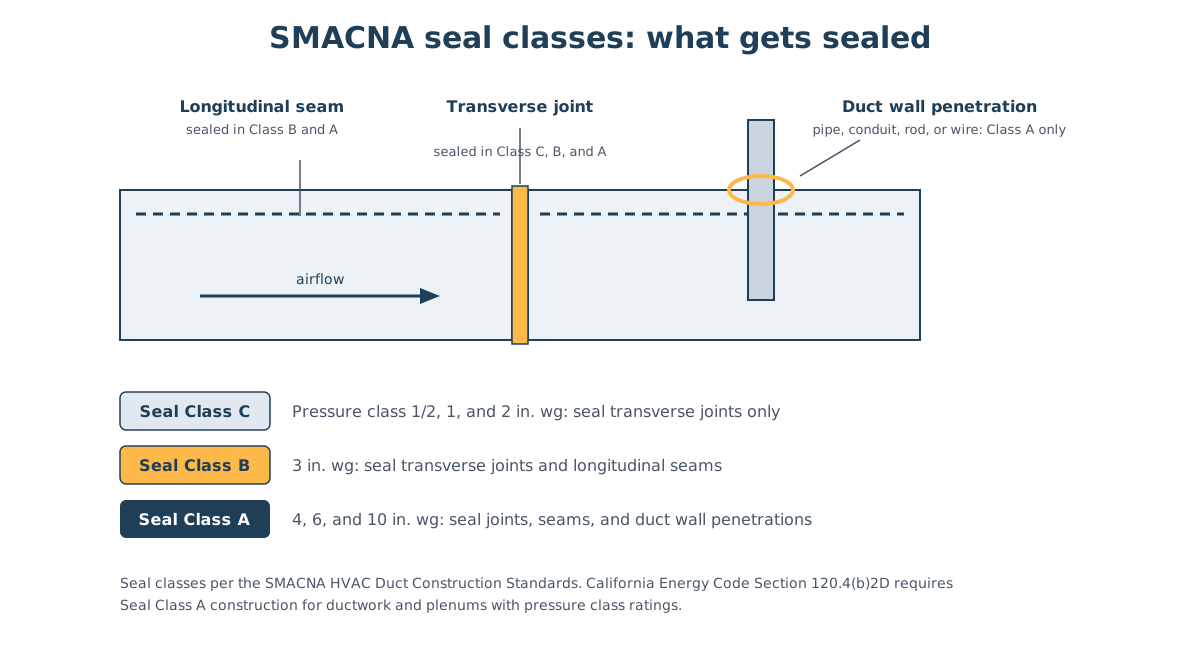
Commercial specs express duct sealing as a seal class. The class determines which parts of the duct get sealed, and it is tied to the duct's static pressure class. Seal Class A is defined in code language as sealing all transverse joints, longitudinal seams, and duct wall penetrations, where wall penetrations are the openings made by pipes, conduit, tie rods, or wires.
| Static pressure class | Seal class | What gets sealed |
|---|---|---|
| 1/2, 1, and 2 in. wg | C | Transverse joints only |
| 3 in. wg | B | Transverse joints and longitudinal seams |
| 4, 6, and 10 in. wg | A | Joints, seams, and duct wall penetrations |
The spec-gap trap
Caution: If the designer does not designate pressure class on the contract drawings, SMACNA's default basis of compliance is 2 in. wg for ducts between the supply fan and VAV boxes and 1 in. wg for everything else. That defaults the job to Seal Class C, which permits rectangular duct to leak at leakage class 24. Few owners would knowingly accept that. If you are writing or reviewing a spec, designate the pressure class and the seal class explicitly.
California removes the ladder entirely: the California Energy Code requires ductwork and plenums with pressure class ratings to be constructed to Seal Class A, regardless of pressure class. Details in the California section below.
Leakage Classes and What They Mean in Airflow
A leakage class (CL) converts a measured leak into a number you can specify and test against. The formula is CL = F divided by P to the 0.65 power, where F is the leakage rate in cfm per 100 square feet of duct surface and P is the test static pressure. Lower CL is tighter. SMACNA pairs the seal classes with these expected leakage classes:
| Seal class | Rectangular metal duct | Round metal duct |
|---|---|---|
| C | CL 24 | CL 12 |
| B | CL 12 | CL 6 |
| A | CL 6 | CL 3 |
At the same seal class, rectangular duct leaks at least twice as much as round and flat oval. Here is what the classes mean as a share of system airflow, at 1 in. wg operating pressure and a typical 2 cfm of fan airflow per square foot of duct surface:
| Leakage class | Leakage as percent of system airflow |
|---|---|
| CL 48 (typical of unsealed ductwork) | 24% |
| CL 24 | 12% |
| CL 12 | 6% |
| CL 6 | 3% |
| CL 3 | 1.5% |
Every step down the table is conditioned air that reaches the space instead of the ceiling plenum, and fan horsepower the system does not have to buy back.
National Code Requirements
IMC Section 603.9 sets the construction rule: joints, seams, and connections must be securely fastened and sealed with welds, gaskets, mastics, mastic-plus-embedded-fabric systems, liquid sealants, or tapes, built per the SMACNA duct construction standards for metal duct and the NAIMA standards for fibrous glass. Tapes and mastics have to carry the right UL 181 closure markings for the duct type. Continuously welded joints and locking-type longitudinal seams are exempt from additional closure on ducts below the 2 inch water column pressure class.
The energy code adds the test. The 2021 IECC requires residential ducts to be pressure tested at 25 Pa (0.1 in. w.g.) per ANSI/RESNET/ICC 380 or ASTM E1554, with these total leakage limits:
| Test stage | Limit (cfm per 100 sq ft of conditioned floor area at 25 Pa) |
|---|---|
| Rough-in, air handler installed | 4.0 |
| Rough-in, air handler not installed | 3.0 |
| Postconstruction | 4.0 |
| Ducts and air handler entirely inside the thermal envelope | 8.0 |
On the commercial side, energy codes based on the 2021 IECC require duct systems designed to operate at 3 in. w.g. or higher to be leak tested per the SMACNA HVAC Air Duct Leakage Test Manual, to leakage class CL 4 or better, with representative sections totaling at least 25 percent of the duct area tested.
California: Title 24 and the CMC
California has the most specific duct sealing rules in the country, written into Title 24 Part 6. Four construction rules apply before any test happens: duct connections must be mechanically fastened; openings must be sealed with mastic, tape, or aerosol sealant meeting UL 723 or a closure system meeting UL 181, 181A, or 181B; openings wider than 1/4 inch need mastic combined with mesh or tape; and cloth-backed rubber-adhesive duct tape is prohibited unless combined with mastic and drawbands. Section 120.4(b)2D then requires ductwork and plenums with pressure class ratings to be constructed to Seal Class A.
On the residential side, the 2022 Energy Code sets leakage thresholds by project type, verified by a certified HERS rater and filed in the HERS registry:
| Project | Total leakage limit (share of air handler airflow) |
|---|---|
| New construction, air handler installed (150.0(m)11) | 5% |
| Rough-in stage, air handler not yet installed | 4% |
| Replacement duct system, 75% or more of ducts replaced | 5%, tested in all climate zones |
| Extension of an existing system over 25 ft | 10% total, or 7% to outside, or HERS-verified sealing of accessible leaks |
| Altered ducts in garage spaces | 6%, or accessible leaks sealed and HERS verified |
| Equipment change-out (condenser, coil, or air handler) | 10% total, or 7% to outside, or accessible leaks sealed |
Commercial work in California follows the California Mechanical Code. Since January 1, 2020, CMC Section 603.10.1 requires leak testing of representative duct sections totaling not less than 10 percent of the installed duct area. If that sample fails, 40 percent gets tested; if that fails, the full system gets tested. The ductwork has to meet Leakage Class 6.
How a Duct Leakage Test Works (CFM25)
Residential duct tests use a calibrated fan, commonly called a duct blaster, connected at the air handler or a return grille, with the registers taped off. The fan pressurizes the duct system to 25 Pascals, about 0.1 inch of water column, and the airflow the fan needs to hold that pressure equals the leakage. That number is the CFM25. Codes normalize it per 100 square feet of conditioned floor area (IECC) or as a share of air handler airflow (Title 24).
Worked example
A 2,000 square foot house under the 2021 IECC postconstruction limit of 4.0 cfm per 100 square feet is allowed 2,000 / 100 x 4.0 = 80 CFM25 of total duct leakage. If the duct blaster reads 95 CFM25, the system fails and gets resealed and retested.
Commercial testing works differently: sections of duct are isolated and tested at the design pressure class per the SMACNA HVAC Air Duct Leakage Test Manual, and results are reported against the specified leakage class using the CL formula from the leakage classes section above.
What Actually Gets Sealed
Translating seal-class language to the physical system, the sealing checklist runs:
- Transverse joints: collar connections, slip-and-drive joints, and flanged connections where duct sections meet.
- Longitudinal seams: the lengthwise seams along rectangular trunk and snap-lock pipe.
- Branch takeoffs, taps, and spin-in fittings.
- Boot-to-drywall and boot-to-subfloor connections at registers.
- Air handler cabinet seams, filter rack, and plenum connections, which are routinely the biggest single leaks in residential systems.
- Flexible duct connections: mechanical fastener plus listed tape or mastic, in that order.
The IMC exempts continuously welded joints and locking-type longitudinal seams from additional closure on ducts operating below the 2 inch water column pressure class, which is why the lengthwise lock seam on snap-lock pipe is normally left unsealed even when the joints get mastic.
Three adjacent scopes are not duct sealing, and using duct closure products on them is a code problem: kitchen grease exhaust ducts are welded liquid-tight under NFPA 96; duct penetrations through fire-rated walls and floors take firestop systems tested to UL 1479; and combustion flues and vent connectors run hotter than duct closures are listed for, covered in the high-temperature sealant guide.
Frequently Asked Questions
What is SMACNA Seal Class A?
Seal Class A means sealing all transverse joints, all longitudinal seams, and all duct wall penetrations. SMACNA pairs it with static pressure classes of 4 inches water gauge and higher, and California requires Seal Class A construction for all ductwork with a pressure class rating.
What seal class is required at 2 inches water gauge?
Under the SMACNA table, 2 inch wg duct takes Seal Class C, which seals transverse joints only. Many specifications and energy codes now require more than the table minimum, so check the project spec and the adopted energy code before leaving seams unsealed.
What is a CFM25 duct leakage test?
The duct system is pressurized to 25 Pascals, about 0.1 inch of water, with a calibrated fan, and the airflow the fan needs to hold that pressure is the leakage, reported in CFM25. Residential codes set limits in CFM25 per 100 square feet of conditioned floor area.
How much duct leakage does the 2021 IECC allow?
Total leakage of 4.0 cfm per 100 square feet of conditioned floor area at 25 Pa for a postconstruction test or a rough-in test with the air handler installed, 3.0 without the air handler, and 8.0 where all ducts and the air handler are inside the thermal envelope.
What are California's duct leakage limits?
New single-family duct systems must test at or below 5 percent of air handler airflow. Alterations scale by scope: 5 percent when 75 percent or more of the ducts are replaced, 10 percent total or 7 percent to outside for extensions over 25 feet, and 6 percent for ducts in garages. A certified HERS rater verifies the results.
Should I use mastic or foil tape?
Both can comply when they carry the right UL 181 marking for the duct type. Mastic tolerates irregular joints and is the default for gaps up to 1/4 inch, with mesh required beyond that under Title 24. Listed foil tapes pass the same UL aging, mold, and burning tests. The one product that has no code path on its own is unlisted cloth duct tape.
Do ducts inside conditioned space still need sealing?
Yes. The IMC sealing requirement applies regardless of duct location. The 2021 IECC relaxes only the leakage test limit, to 8.0 cfm per 100 square feet, when all ducts and the air handler are entirely within the thermal envelope.
Sealing a duct system to pass a leakage test?
We source US-made duct mastics and UL 181 listed closure tapes by the case or pail for mechanical contractors and facility teams. Tell us the scope and we will be in touch with options.
or call 714-248-6555 · email partners@usmadesupply.com
Was this page helpful?
Your feedback helps us improve our technical resources.