
Asphalt Roof Coating
Last updated: May 31, 2026
Overview
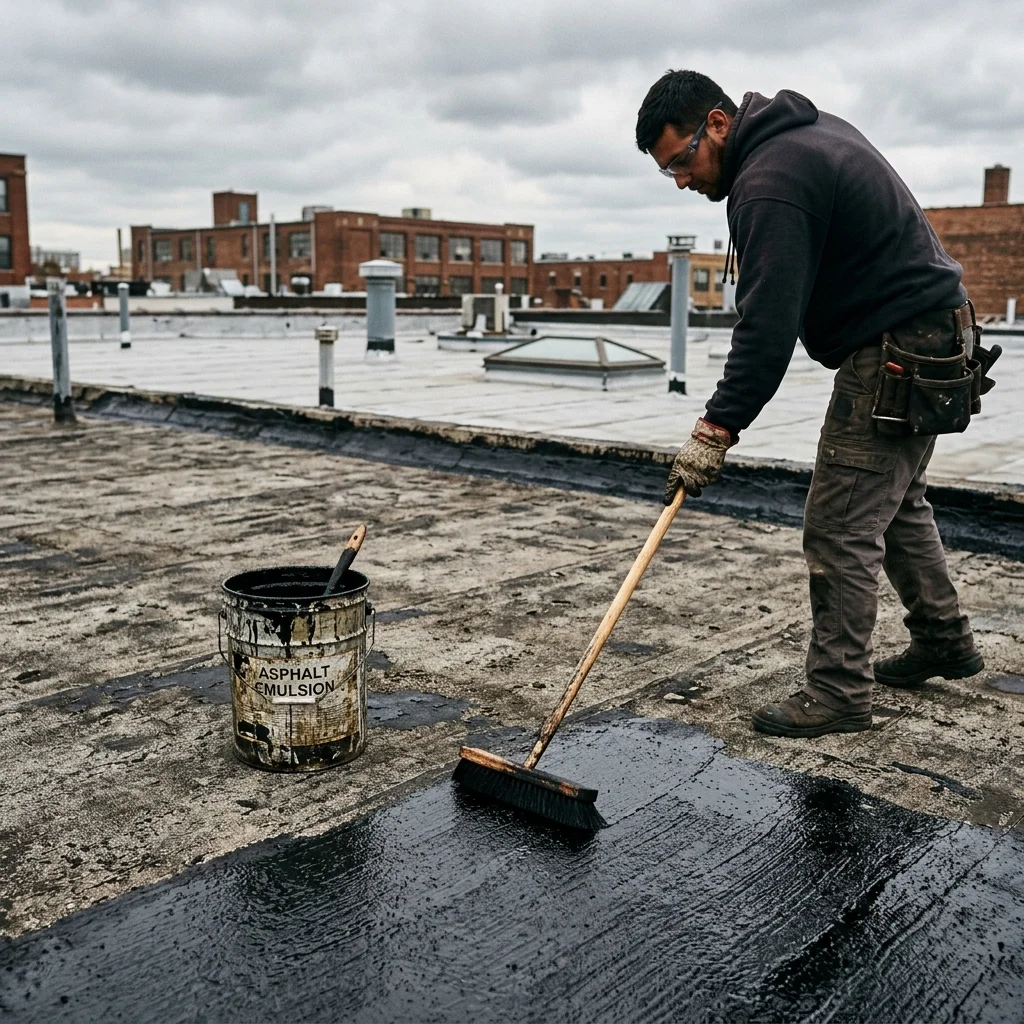
You reach for asphalt coating when the budget is tight, the roof is built-up or modified bitumen, and the horizon is short. It is the cheapest of the four coating chemistries. A single-coat emulsion recoat on smooth mod-bit runs roughly $0.75 to $1.50 per square foot installed, which reads like a no-brainer next to silicone at three or four times the price. The catch is service life: asphalt is a maintenance product on a 3 to 5 year recoat cycle, not a long-warranty restoration.
"Asphalt roof coating" is three different products, not one. Bituminous emulsion is water-based and freeze-sensitive while wet. Cutback asphalt is solvent-based and high VOC. Aluminum-pigmented asphalt is a cutback base with aluminum flakes that float into a reflective topcoat. Each uses a different ASTM standard and belongs on a different roof. This page covers when asphalt is the call, the three families and how they differ, the substrate rules, application targets, the ASTM map, cool-roof limits, cost by family, and warranty. For the four-chemistry overview and how asphalt compares to acrylic, silicone, and polyurethane, start with the elastomeric roof coating guide.
Key point: asphalt coatings were designed as sacrificial UV and weatherproof skins for reinforced membranes that carry the load. They are not elastomers. They do not bridge moving cracks and they do not deliver a cool roof unless they are aluminized, and even aluminized products commonly miss the thermal-emittance threshold. If cool-roof compliance or a long warranty is the controlling constraint, this is the wrong chemistry.
Is asphalt the right call?
Before you spec asphalt, name the controlling problem on this roof. The answer points you to the right chemistry, and asphalt is the right answer in a narrow set of cases.
If you need a cheap maintenance recoat on an asphaltic roof, asphalt is right. An aged built-up or modified-bitumen roof headed for tear-off in a few years, a facility manager who needs to buy time on a thin budget, a smooth mod-bit field that wants an aluminized topcoat to slow UV aging. This is chemistry matching: you recoat asphalt with asphalt, and it is roughly a quarter of the silicone cost.
If you need a cool roof, go acrylic or silicone. Black bituminous is never cool-roof eligible, and aluminized asphalt frequently misses the thermal-emittance test even when it passes on reflectance. White acrylic at roughly $1.00 to $2.50 per square foot or white silicone is the safer path when a code or CRRC threshold is binding. See the acrylic roof coating guide.
If the roof ponds, go silicone. Bituminous coatings degrade in standing water, and emulsion is the most ponding-sensitive of the three families. Silicone is the more ponding-tolerant chemistry. See the silicone roof coating guide.
Two more cases pull you off asphalt entirely. If the substrate is single-ply (TPO, EPDM, or PVC), asphalt is not in any major coating manufacturer's approved-system list: bitumen attacks EPDM and has no adhesion to TPO or PVC. If you need a 15-year warranty horizon, the system specs lean to silicone or aliphatic polyurethane, not asphalt.
Standing water fails the cheapest systems fastest. Asphalt coatings are the least tolerant of ponding and the shortest-lived to begin with. Positive slope and clear drainage are essential before coating, or the recoat cycle gets even shorter.
The three families
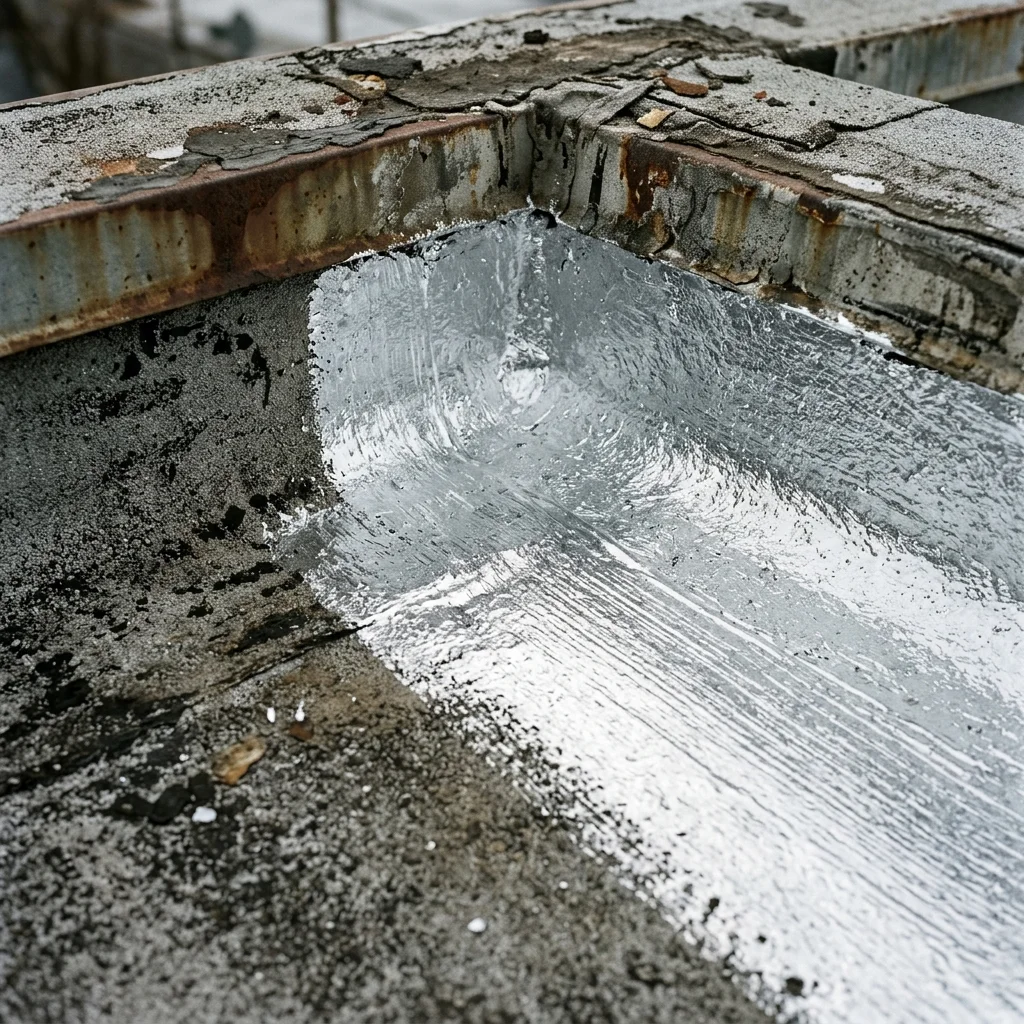
The single most common buyer mistake is treating these three as interchangeable. They cure differently, comply with different codes, and belong on different roofs. Each family maps to its own ASTM standard.
| Family | Carrier | How it cures | Typical role | Primary ASTM |
|---|---|---|---|---|
| Asphalt emulsion | Water-borne | Water evaporation; freezing while wet destroys it | Base coat, gravel BUR sealing | D1227 |
| Cutback asphalt | Solvent-borne | Solvent evaporation; high VOC (200 to 450 g/L) | Brush or spray field coat | D4479 (D4586 for trowel cement) |
| Aluminum-pigmented asphalt | Solvent-borne | Aluminum flakes leaf to a reflective metallic shield | Reflective UV topcoat over mod-bit / BUR | D2824 (apply per D3805) |
Emulsion disperses asphalt droplets in water through bentonite clay or chemical emulsifiers. It is solvent-free, typically under 50 g/L VOC, and non-flammable wet. Cutback is refined asphalt "cut back" with petroleum solvents plus clay and fiber stabilizers, which is where the high VOC comes from. Aluminum-pigmented (also called aluminized aluminum or fibered aluminum) is a cutback base carrying roughly 2 to 3 pounds per gallon of aluminum-flake leafing pigment that floats during cure to form the silver reflective layer.
Two-coat systems: the canonical mod-bit restoration is an emulsion base coat (often with polyester reinforcement) plus an aluminized topcoat. The emulsion base must fully cure (3 to 7 dry days) before the aluminized topcoat goes on. Applying aluminized over uncured emulsion guarantees delamination.
One naming trap: coal tar pitch is sometimes called "asphalt" casually, but it is chemically distinct (coal-derived aromatic versus petroleum aliphatic), self-heals in heat, and carries its own carcinogen concerns. It is only relevant on legacy coal tar built-up roofs. Do not substitute coal tar products for asphalt coatings or the reverse.
Performance
Be honest about the gap. Asphalt-based films are not elastomers in the schema.org sense. The ASTM specs for these families do not require a tensile-elongation value the way acrylic D6083 (at least 200%) or silicone D6694 do; D4479 measures mandrel-bend pliability and D2824 measures luminous reflectance and composition. Do not borrow elongation numbers off an acrylic or silicone data sheet and call them asphalt properties. These films move by softening, not by stretching.
| Property | Asphalt emulsion | Cutback asphalt | Aluminized asphalt |
|---|---|---|---|
| Solar reflectance, initial | ~0.05 (black) | ~0.05 (black) | 0.40 to 0.65 |
| Solar reflectance, 3-yr aged | ~0.05 | ~0.05 | 0.50 to 0.55 (Karnak 97: 0.55) |
| Thermal emittance | ~0.85 to 0.90 | ~0.85 to 0.90 | ~0.25 to 0.50 (metallic flakes lower it) |
| Crack bridging | None | None | None |
Values reflect published manufacturer data sheets (Karnak 220 emulsion and Karnak 97 fibered aluminum) and industry literature; confirm against the specific product's current data sheet before specifying.
The reflectance numbers tell the cool-roof story in one line. Black emulsion and plain cutback sit near 0.05 reflectance, so they trap heat. Aluminized asphalt reflects, but the same metallic flakes that buy the reflectance pull thermal emittance down into the 0.25 to 0.50 range, which is what breaks cool-roof compliance. More on that in the Cool Roof section below.
Substrate Compatibility
Asphalt belongs on asphaltic substrates. It works on the roofs it was built for and attacks or fails to bond on the ones it was not. The final call belongs to the coating manufacturer's approved-substrate list and the building's roofing-system manufacturer's approved-coating list; the examples below are the broad starting point.
Works on
- Aged built-up roof (BUR). The native substrate. New BUR has to weather 90-plus days before recoat, since fresh BUR exudes oils that re-mobilize and lift the coating.
- Aged modified bitumen (APP and SBS). The natural recoat path. Aluminized asphalt is the canonical mod-bit topcoat.
- Smooth metal corrugated decks with light rust. Many aluminized products go direct-to-metal as a rust inhibitor plus reflective coat.
- Concrete, with asphalt emulsion, typically over a primer.
- Gravel-surfaced BUR, with penetrating emulsion, but coverage climbs to 12 to 24 gallons per square (versus 4 to 6 on smooth). NRCA notes gravel coating is generally impractical.
Generally not specifiable
The following combinations are broadly inadvisable, and most manufacturers exclude them outright. Where a specific manufacturer publishes a tested system, follow that; otherwise treat these as failure modes.
- EPDM (rubber single-ply). Bitumen attacks EPDM and makes it brittle. Asphalt over EPDM is not a system any major asphalt-coating manufacturer specifies.
- TPO and PVC (thermoplastic single-ply). The surface is chemically inert, so standard asphalt coatings have no adhesion mechanism. For single-ply restoration, the specifiable systems are acrylic or silicone with the membrane manufacturer’s approved primer.
- Cured silicone. Bonding is broadly inadvisable. The conservative path is recoat with silicone after the silicone manufacturer’s prep protocol, or full removal before switching chemistry.
- Cured acrylic. Asphalt’s oils soften and stain acrylic; not specifiable as a topcoat over acrylic without a tested system.
- Asphalt shingles. NRCA advises against coating shingles entirely; coatings interfere with water-shedding and trap moisture.
The most expensive mistake in the field is specifying an asphalt-based coating over single-ply without the membrane manufacturer's approved-system sign-off. The coating either degrades the rubber or peels off the thermoplastic, and now you are paying to strip the failed coating before the real repair. When the substrate is single-ply, pull the membrane manufacturer's approved-coating list and spec the acrylic or silicone it names.
Application
Coverage, application temperature, and cure window differ by family. The numbers below are typical across published data sheets; the inspection control on any asphalt job is a wet-film check plus a hard look at the weather forecast, because emulsion freezes or washes off and cutback solvent flash stalls in the cold.
| Family | Coverage | Application temp | Dry / cure | VOC (typical) |
|---|---|---|---|---|
| Emulsion (fibered) | 4 to 6 gal/sq smooth, 12 to 24 gravel | At least 40°F, no freeze for 5 to 7 days | Dry 24 to 48 hr; full cure 3 to 7 d | Under 50 g/L |
| Cutback (fibered) | ~4 gal/sq | At least 40°F | Solvent flash plus cure | 200 to 450 g/L |
| Aluminized | 1 to 1.5 gal/sq topcoat | 50°F to 120°F | No moisture 24 to 48 hr; recoat 3 to 5 d | 400 to 450 g/L |
Coverage and VOC figures track the Karnak emulsion (220), cutback (71), and aluminum (97 / 169) product family; confirm against the specific product's data sheet.
Recoat cadence is the real cost driver
Treat asphalt as a maintenance product. Aged smooth-surface BUR wants a recoat every 3 to 5 years. Aluminum-pigmented topcoats on mod-bit run the same 3 to 5 year cadence, which is why a mod-bit roof "keeps getting aluminized recoats": that is the assumed maintenance cycle, not a failure. Budget the recoats over the roof's remaining life, not just the first coat, when you compare asphalt against a 15-year silicone spec.
VOC compliance trips up cutback and aluminized. Under SCAQMD Rule 1113 the generic roof-coating limit is 50 g/L and the aluminum roof-coating limit is 100 g/L. Off-the-shelf fibered cutback near 250 g/L and fibered aluminum near 450 g/L exceed those caps by 4 to 5 times. California districts and OTC-Model-Rule states (commonly NJ, NY, MA, CT, MD, DE, PA, RI, and VA) cannot legally use most of these off the shelf. Compliant low-VOC reformulations exist, but you have to ask for the compliant product code. Emulsion (often near 20 g/L) is compliant about everywhere.
Tip: for the prep-and-apply walkthrough that applies across chemistries, see the step-by-step application guide. For crew PPE and fall protection on a low-slope roof, see the roof coating safety kit guide.
ASTM Standards
There is no single "asphalt coating" ASTM standard. Each family carries its own. Cite the one that matches the product family on the can, not a catch-all. The standards below are the current designations.
| Standard | Covers |
|---|---|
| ASTM D1227/D1227M-13(2024) | Emulsified asphalt for roofs. Types I, II, III by fiber; Classes 1, 2 by emulsifier. Primary for asphalt emulsion. |
| ASTM D2824/D2824M-18(2024) | Aluminum-pigmented asphalt. Type I nonfibered, Type III non-asbestos fibered. Primary for aluminized aluminum. |
| ASTM D3805/D3805M-16(2023) | Application practice for D2824 aluminum-pigmented coatings. Referenced by Title 24. |
| ASTM D4479/D4479M-07(2024) | Asphalt brush and spray coatings, asbestos-free. Type I ductile, Type II high softening point. Primary for cutback. |
| ASTM D4586/D4586M-25 | Asphalt roof cement, asbestos-free, trowel-grade. Class I dry, Class II damp/wet. Mastic for flashings and repairs, not a field coating. |
Withdrawn standards to avoid citing: ASTM D2823 (asbestos-containing asphalt coating) was withdrawn in 2014, and D6848 (emulsified aluminum asphalt) was withdrawn in 2011. Do not cite either as current. ASTM D6083 is the acrylic-coating standard and does not apply to asphalt.
Cool Roof Compliance
This is where asphalt usually loses. Black bituminous coatings sit near 0.05 solar reflectance, so emulsion and plain cutback are not cool-roof eligible at all. Aluminum-pigmented asphalt reflects, but its metallic flakes pull thermal emittance down, and code compliance is judged on aged reflectance, thermal emittance, and SRI together, not on reflectance alone.
CRRC (the reference for any project)
The Cool Roof Rating Council Rated Products Directory lists initial and 3-year-aged solar reflectance, thermal emittance, and SRI. For any project outside California, CRRC-rated values feed the locally adopted cool-roof code's reflectance and emittance tests. Whether a given aluminized asphalt product clears the bar is a product-by-product CRRC check, never a category assumption.
California Title 24 (California only)
California Title 24, Part 6 (2025 cycle, effective January 1, 2026) sets prescriptive cool-roof values. For nonresidential low-slope roofs across all 16 California climate zones, the thresholds are aged solar reflectance 0.63, thermal emittance 0.75, and SRI 75. Title 24 references the category directly: aluminum-pigmented asphalt coatings must meet ASTM D2824 and be installed per ASTM D3805. Title 24 is California only; for work outside California, reference CRRC and the local cool-roof code. See the Title 24 cool roof compliance guide for the full thresholds.
Concrete example of the emittance trap: Karnak 97 Fibered Aluminum publishes CRRC aged solar reflectance 0.55 and aged thermal emittance 0.53. That fails both the 0.63 aged-reflectance threshold and the 0.75 emittance threshold (and the SRI 75 alternate). It is one verified data point, not a category pass-rate, but it shows why you cannot assume aluminized asphalt qualifies. Pull the specific product's CRRC numbers before you put a cool-roof claim on the spec.
Historical note: the EPA sunset the ENERGY STAR roof-products specification on June 1, 2022. Its old reflectance thresholds are no longer a current compliance pathway, so do not specify against them on a new project. If a project document still calls for an ENERGY STAR roof label, treat it as historical and pivot to CRRC and the applicable code.
Cost
Asphalt is the lowest-cost of the four chemistries, but the published ranges are wide and family-specific, so frame the number by family rather than a blended "asphalt coating" figure.
| Scope | Cost/sqft installed |
|---|---|
| Asphalt emulsion, single coat on smooth BUR / mod-bit | ~$0.75 to $1.50 |
| Aluminized aluminum, single topcoat on smooth mod-bit | ~$1 to $2 |
| Two-coat emulsion base plus aluminized topcoat | Higher; varies with reinforcement and gravel prep |
Single-coat emulsion figure per HomeGuide 2026. Note that HomeGuide's broader "asphalt" range bundles hot bitumen and mineral cap sheet pricing, which inflates the upper end; the $0.75 to $1.50 single-coat emulsion figure is the tighter, like-for-like comparison.
Cutback typically prices near aluminized cutback (same solvent base, no metallic-flake premium), but most off-the-shelf cutback is not legal in SCAQMD or OTC-state architectural work, so the comparison is moot in those regions. For cluster context, acrylic runs roughly $1 to $2.50, silicone $2 to $4, and polyurethane $2.50 to $5 per square foot installed.
Why asphalt persists: a single-coat $1 per square foot mod-bit emulsion recoat against $3 per square foot silicone reads as obvious to a facility manager, until warranty length and Title 24 or VOC compliance hit the table. Run the full lifecycle, including the 3 to 5 year recoat cadence, before you let the first number decide.
Warranty
Asphalt-coating warranty length varies more than the category's budget reputation suggests, so cite by product, not by category. The broad industry range runs roughly 2 to 10 years material-only depending on product and thickness, with full-system warranties through authorized contractors topping out around 10 to 15 years.
- Henry HE555 fibered aluminum publishes a 7-year limited reflectance-retention warranty (retains at least 50% of initial CRRC solar reflectance) per its product page.
- Karnak fibered aluminum and emulsion data sheets do not publish a blanket consumer warranty figure; warranties run through approved-contractor system specs.
- Sherwin-Williams Uniflex commercial offers 10- and 15-year labor-plus-material warranties via authorized contractors, but on system specs that typically include acrylic topcoats, not bare asphalt.
Treat asphalt as a maintenance product on a 3 to 5 year recoat cadence even when the material warranty reads longer. For a 15-plus year warranty horizon, the system specs lean to silicone or aliphatic polyurethane. Confirm coverage against the specific manufacturer's approved-system warranty document before you commit.
Frequently Asked Questions
What's the difference between asphalt emulsion and aluminum-fibered asphalt?
Emulsion is water-borne: low VOC, freeze-sensitive while wet, usually the base coat. Aluminum-fibered asphalt is solvent-borne with aluminum-flake pigment, the reflective UV topcoat that goes over the emulsion base. They are two layers of the same two-coat modified-bitumen system, not interchangeable products.
Can I get a cool roof with an asphalt coating?
Only with aluminum-pigmented asphalt, and only if the specific product is CRRC-rated and clears your local cool-roof code. California Title 24 (effective January 1, 2026) nonresidential low-slope requires aged solar reflectance 0.63 plus thermal emittance 0.75 (or SRI 75) across all 16 California climate zones. Aluminized aluminum frequently fails the emittance test: Karnak 97 publishes aged thermal emittance 0.53. Black bituminous is not cool-roof eligible.
Why is asphalt cheaper but my contractor recommends silicone?
Asphalt is roughly a quarter of the installed cost but lasts 3 to 5 years before recoat. Silicone lasts 10 to 20 years, tolerates ponding, and qualifies for white-cool-roof compliance. Over a 15-year horizon, the silicone math often wins once you add up the asphalt recoats.
Will asphalt bond to TPO, EPDM, or PVC?
Generally not. Bitumen attacks EPDM, and TPO and PVC are chemically inert to asphalt. No major asphalt-coating manufacturer includes single-ply in its approved-substrate list. For single-ply restoration, use the membrane manufacturer's approved acrylic or silicone system with a primer rated for that membrane.
Is cutback asphalt legal in California?
Most off-the-shelf fibered cutbacks exceed SCAQMD's 50 g/L generic roof-coating limit, and aluminized cutback typically exceeds the 100 g/L aluminum cap. Low-VOC versions exist, so ask for a SCAQMD-compliant product code. The same constraint applies in OTC-Model-Rule states, commonly NJ, NY, MA, CT, MD, DE, PA, RI, and VA.
How long does emulsion take to dry before rain?
Roughly 24 to 48 hours surface dry, with full cure in 3 to 7 days. Below 50 degrees F, do not apply. If rain or frost is in the 24 to 48 hour forecast, defer: rain washes uncured emulsion off the roof, and freezing while wet destroys it.
Why does my mod-bit roof keep getting aluminized recoats?
Aluminum-pigmented asphalt is the canonical modified-bitumen topcoat: the same chemistry as the membrane plus aluminum flakes for UV blocking. A 3 to 5 year recoat is the assumed maintenance cycle, not a sign the roof is failing.
Will asphalt fix a ponding-water roof?
No. Bituminous coatings degrade in standing water (ARMA defines ponding as water remaining 48-plus hours), and emulsion is the most ponding-sensitive of the three families. Fix the drainage and slope first, or switch to a chemistry your roofing-system manufacturer's approved-coating list names for ponding service. Silicone is the more ponding-tolerant option.
Can I coat asphalt shingles to extend their life?
NRCA advises against it. Coatings interfere with the shingles' water-shedding and can trap moisture. If the shingles are at end-of-life, plan a re-roof rather than a coating.
What ASTM standard should I cite?
It depends on the family: D1227 for emulsion, D4479 for cutback brush and spray, D2824 plus D3805 for aluminum-pigmented, and D4586 for trowel-grade roof cement. D2823 and D6848 are withdrawn, so do not cite them as current.
What's a typical asphalt-coating warranty?
Cite by product. The broad range is roughly 2 to 10 years material-only. Henry HE555 publishes a 7-year reflectance-retention warranty (at least 50% of initial CRRC reflectance). Sherwin-Williams Uniflex commercial offers 10- and 15-year labor-plus-material warranties via authorized contractors. For a 15-plus year horizon, silicone or aliphatic polyurethane is the more common spec.
Roof Coating Products


Was this page helpful?
Your feedback helps us improve our technical resources.