
Silicone Roof Coating
Overview
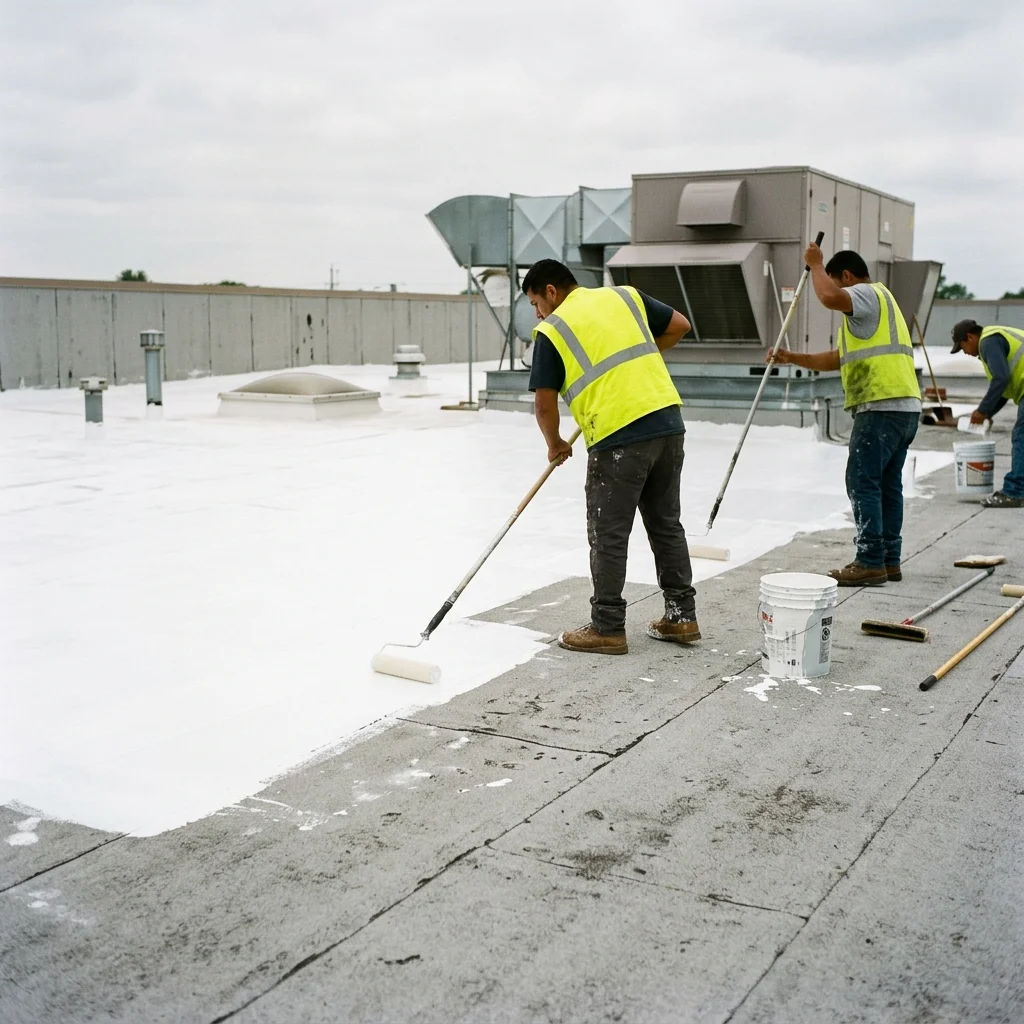
You reach for silicone when the roof ponds, when the UV load is brutal, or when you are restoring a sound but tired membrane instead of tearing it off. Silicone is the most expensive of the four coating chemistries by the gallon. Installed on a commercial low-slope restoration it runs about $3.50 to $7.00 per square foot, which lands close to polyurethane and well above acrylic. The premium buys one thing acrylic cannot give you: a cured film that sits in standing water without softening.
This page goes deep on commercial silicone for flat and low-slope roofs. It covers when silicone earns the price, the real published performance numbers, substrate and primer rules, climate fit, application targets, ASTM D6694, cool-roof compliance, cost, and the recoat constraint that ties an owner into the chemistry once the first coat goes down. For the four-chemistry overview and how silicone compares to acrylic, polyurethane, and SEBS rubber, start with the elastomeric roof coating guide.
Key point: A coating restores a sound roof. It does not rebuild a failing one. The substrate has to be structurally sound, the seams and flashings repaired, and the deck dry before any silicone goes down. Silicone tolerates ponding, but it cannot fix trapped moisture in wet insulation.
Is silicone the right call?
Before you spec silicone, answer one question: what is the controlling problem on this roof? The answer points you to the right chemistry, and silicone is not always it.
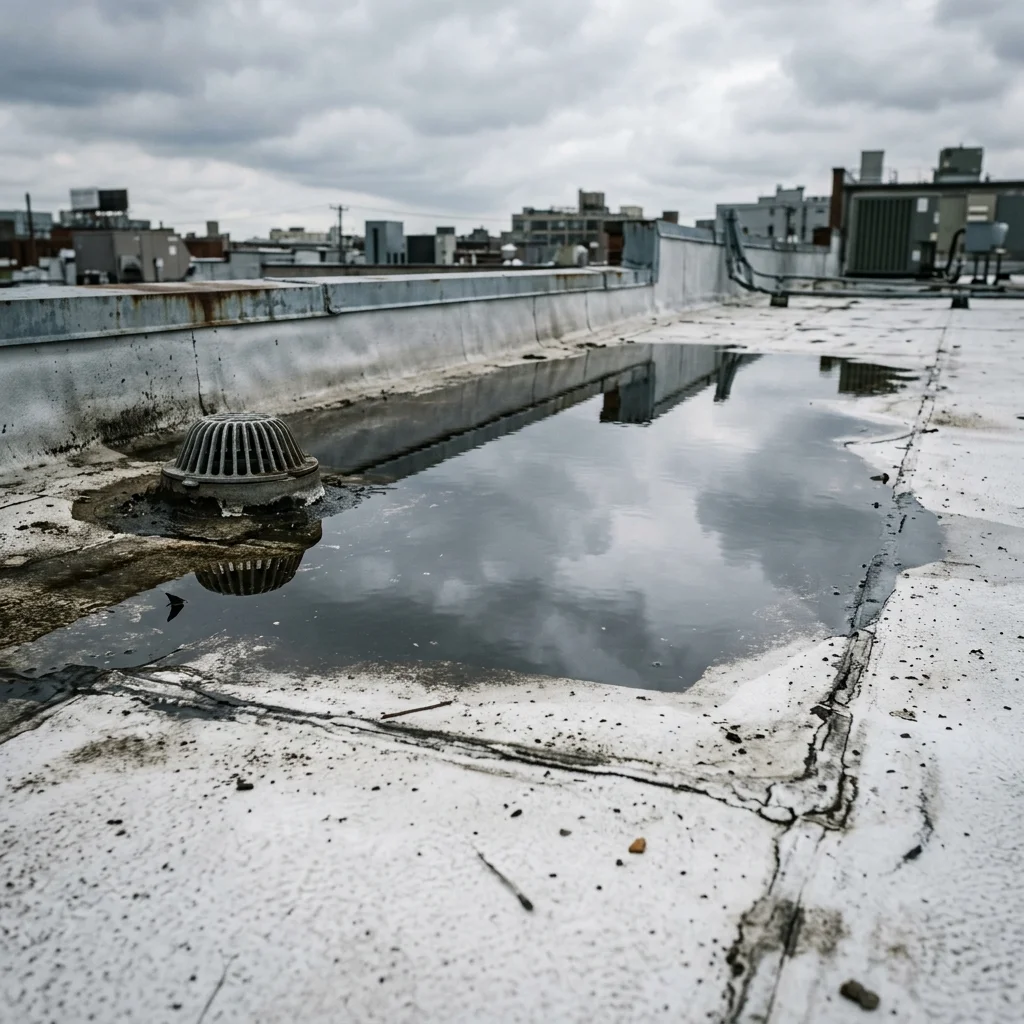
If ponding is the controlling problem, silicone is likely right. Water that sits more than 48 hours after rain, an owner who will not fix the drainage first, a low-slope roof that holds birdbaths every storm. This is what silicone is built for, and where acrylic product warranties commonly stop short.
If the roof drains well and the budget is tight, start with acrylic. A well-drained roof on a warehouse or school does not need the ponding premium. Acrylic at roughly $1.00 to $2.50 per square foot installed delivers 7 to 10 years of service life on a sound substrate, stays cleaner over time, and recoats with acrylic later without a fight. See the acrylic roof coating guide for that path.
Two other failure modes pull you away from silicone. If the roof sees regular foot traffic, dropped tools, or equipment dragging across it, polyurethane is the tougher film in puncture and abrasion. If dirt pickup is a hard constraint (rural ag, near an unpaved road, heavy industrial particulate), white acrylic holds its reflectance longer. Compare the two head to head in the silicone vs acrylic and silicone vs polyurethane comparisons.
Slope and drainage still come first. Silicone tolerates standing water better than any other coating, but that tolerance is not a substitute for positive drainage. Ponding shortens the life of any system, complicates inspection, and some warranties still expect drainage to be addressed. Coating a ponding roof with silicone is the right call when the drainage cannot be corrected, not a reason to skip slope and drainage in the first place.
How silicone works
Silicone roof coatings are single-component, moisture-curing elastomers built on a polysiloxane (Si-O-Si) backbone. Atmospheric humidity drives the crosslinking. The wet film pulls moisture out of the air and cures to a permanent Si-O-Si network that does not reverse once set. Cure rate scales with humidity and temperature, so the same product skins over fast in warm humid air and slow in cold dry air. One published example: Karnak 670HS cures in about 2 hours at 95°F and 90% relative humidity, versus roughly 8 hours at 50°F and 20% humidity.
That cured network is hydrophobic and holds its dimensions when submerged. That is the whole reason silicone tolerates ponding water. There are no C-C bonds in the backbone for UV to cleave either, which is why silicone does not chalk or backbone-degrade the way some chemistries do under heavy sun.
"100% silicone" vs "high-solids" vs "solvent-free"
These three terms get conflated in marketing copy, but they describe three different properties of the can. Knowing the difference keeps you from over-paying for a label that does not mean what you think it means.
- "100% silicone" describes the principal polymer phase. ASTM D6694 requires the principal polymer in the dispersion to be more than 95% silicone. That is the polymer fraction, not the whole can.
- "High-solids" is the total volume-solids percentage of the wet product, polymer plus fillers plus pigment plus adhesion promoter. The D6694 minimum is 57% volume solids; real products run far higher (GAF Unisil High Solids lists a 97% volume-solids test value; Gaco S20 lists 95%).
- "Solvent-free" is about whether a VOC carrier is present at all. A coating can be 100% silicone and still carry solvent. Gaco S20 is solvent-free at 37 g/L VOC; GAF Unisil HS lists under 50 g/L. Verify on the specific data sheet.
A product can be 100% silicone but not high-solids, high-solids but not 100% silicone, and either one without being solvent-free. Read all three values off the data sheet rather than trusting one phrase on the lid.
Performance numbers
The table below puts published values from four silicone coatings that report against ASTM D6694 next to the standard's minimum floors. Every product clears the floors by wide margins. Note that elongation is highly formulation-dependent (174% to 540% across this sample), so treat the manufacturer-specified value as the real number, not a single chemistry-wide figure.
| Property | Gaco S20 | Karnak 670HS | Enduris 3500 | KS-5100 | D6694 min |
|---|---|---|---|---|---|
| Tensile @ 73°F (psi) | 450 | 227 | 204 | 288 | 150 |
| Elongation @ 73°F (%) | 174-295 | 212 | 540 | 282 | 100 |
| Tear (lb/in) | 38.5 | 26 | - | 22 | 20 |
| Permeance @ 20 mil (perms) | 5.0 | - | - | 4.44 | per E96 |
| Solar reflectance, white (initial) | 0.88 | 0.87 | - | 0.856 | - |
| SRI (initial) | 111 | 110 | - | 107.9 | - |
Values are from each product's current published technical data sheet. Confirm against the specific product's data sheet before specifying, since data sheet revisions can change any number.
Cold-temperature performance is a quiet silicone advantage. Gaco S20 still shows 169% elongation at 0°F, where single-component acrylic stiffens. On UV, Gaco S20 retains 126% elongation after 5,000 hours of QUV (ASTM G154) exposure, well above the standard's accelerated-weathering retention floor. The backbone simply does not have the chemistry for sun to break down.
Substrate Compatibility
Substrate compatibility is system-specific, not chemistry-wide. The matrix below summarizes what manufacturer data sheets in the sample say. Specifying any actual job requires the chosen product's published substrate and primer list, plus the building's roofing-system manufacturer's approved-coating list. The examples are illustrative, not universal.
| Substrate | Generally specifiable? | Manufacturer-specific notes |
|---|---|---|
| Aged SPF | Yes | Cleaning typically sufficient (D6694's literal scope) |
| Aged BUR / smooth modified bitumen | Yes | Asphalt bleed-block primer commonly required, especially under white |
| Granulated cap sheet | Yes | Bleed-block per manufacturer; higher coverage (2.0 vs 1.5 gal/100 ft²) |
| EPDM (aged) | System-specific | Manufacturer epoxy primer required; verify on the product's data sheet |
| TPO / PVC (aged) | System-specific | Primer required after weathering; some products allow these, some do not |
| Galvanized / Galvalume metal | Yes | Epoxy primer required per the product's primer schedule |
| Concrete (cured) | Yes | Epoxy primer; some products require moisture below a set threshold |
| Uncured / fresh asphalt | No | Typically requires 30-day weathering before any primer |
| Existing silicone | Silicone only | Power wash plus manufacturer tie-coat or abrasion. See Recoat Compatibility. |
| Oily / contaminated | No | Must be cleaned to bare substrate first |
Caution: Asphalt bleed-through: over BUR and modified bitumen, plasticizers in the asphalt migrate up and stain white silicone if you skip the bleed-block primer. Some manufacturers will not warrant pigmented (non-white) silicone over asphalt at all, because the pigments do not fully block the bleed. The rule is system by system. Pull the bleed-block primer's data sheet for the product you are using.
The silicone field coating ends where the penetrations begin. For sealing the metal flashing, vent stacks, and curbs that interrupt the field, see the commercial roofing sealants guide and ASTM C920 for the joint-sealant spec.
Climate Fit
Where silicone is strongest
- Ponding water. The cured film is hydrophobic and dimensionally stable submerged, which is the headline reason buyers reach for silicone when ponding is the controlling problem.
- Southern US and high-UV climates. No chalk, no backbone degradation under heavy sun. Phoenix, central Texas, central Florida, Las Vegas, high-elevation Mountain West.
- Hurricane zones. Products in the sample carry Miami-Dade NOA and Florida Product Approval, with FM wind-uplift on system specs.
The honest weaknesses
- Dirt pickup. Solar reflectance drops measurably as the white film holds dirt: Gaco S20 from 0.88 initial to 0.63 aged; Karnak 670HS from 0.87 to 0.70 at 3 years. A pressure wash 6 to 12 months after install recovers most of the lost reflectance; ceramic granules at install are another option.
- Cold-weather application limits. Manufacturer substrate minimums cluster around 35°F to 50°F (most call 50°F). Below that, viscosity rises and results get unpredictable. W.R. Meadows KS-5100 requires the substrate to be at least 5°F above the dew point. Morning dew or frost kills adhesion.
- Slip when wet. Cured silicone is slick when damp. OSHA 1910.22 governs walking-working surfaces, so embed ceramic granules on HVAC and access walkway paths or specify a manufacturer walkway system.
Watch the weather window. GAF Unisil HS instructs not to apply if rain, dew, fog, heavy moisture, condensation, or freezing temperatures are in the 2-hour forecast. The flip side shows up in dry-but-humid air: W.R. Meadows notes high humidity with high temperature can skin KS-5100 over in the pail during application, and recommends a lid adapter with agitator. The shorthand is avoid surface moisture going in, and watch the pail in high humidity.
Application
Most silicone goes down in a single coat on smooth substrate, sometimes two over absorbent or repaired areas. The numbers below are typical across the sample. Coverage and target dry film thickness drive the warranty tier, so the inspection control on every silicone job is a wet-film gauge plus DFT verification.
| Parameter | Typical |
|---|---|
| Coverage (smooth) | 1.5 gal / 100 ft² wet, about 22 dry mil |
| Coverage (granulated / rough) | 2.0 gal / 100 ft² wet |
| Target DFT | 20 to 30 mil per warranty tier |
| Substrate temp | 35 to 120°F (most call 50°F minimum) |
| Above dew point | At least 5°F |
| Light foot traffic | 24 to 48 hours |
| Full cure | 7 days standard |
| Cleanup | Silicone solvent only (water will not work) |
Warranty tiers are product-specific
Different manufacturers tier their coating warranties at different DFT and coverage thresholds. There is no ASTM, NRCA, or RCMA standard mapping mils to years; the "20/25/30 mil to 10/15/20 year" shorthand from contractor blogs is a rough average, not a spec. Two concrete examples from current published data sheets show how the tiers actually run:
- GAF Unisil High Solids Silicone Roof Coating: 10-year tier at 1.5 gal/100 ft² (23 mils DFT); 15-year at 2.0 gal/100 ft² (31 mils); 20-year at 2.5 gal/100 ft² (39 mils).
- Gaco GacoFlex S20 Series: 10-year at 1.5 gal/100 ft² (22 mils DFT); 15-year at 2.0 gal/100 ft² (30 mils); 20-year at 2.5 gal/100 ft² (38 mils), with longer tiers available at higher DFT through the Gaco Western Qualified Applicator program. Gaco also markets a 50-year limited material warranty on the product itself, which is a material-replacement warranty, not the DFT-tiered system warranty (do not confuse the two when specifying).
Always verify against the actual product's current warranty schedule before specifying. Under-applying material to save gallons is the quiet way to miss a warranty threshold: a 20-year job specified at 22 mils but applied at 1.0 gal/100 ft² instead of 1.5 will not hit the required thickness.
Tip: for the full prep-and-apply walkthrough that applies across chemistries, see the step-by-step application guide. For crew PPE and fall protection on a slick silicone surface, see the roof coating safety kit guide.
ASTM D6694
ASTM D6694/D6694M-25 is the silicone-coating standard: liquid-applied silicone for spray polyurethane foam roofing, principal polymer more than 95% silicone. The minimum floors are:
- Tensile: minimum 150 psi (ASTM D412 / D2370)
- Elongation: minimum 100%
- Tear: minimum 20 lb/in, Die C (ASTM D624)
- Water-vapor permeance, tested per ASTM E96 (the standard sets a permeance limit; published silicone values in the sample run about 4 to 5 perms at 20 mils)
- Volume solids: minimum 57% (ASTM D2697)
- Plus accelerated-weathering elongation retention (QUV per ASTM G154), wet adhesion over SPF, and low-temperature flexibility
D6694's literal scope is spray polyurethane foam roofing, but in practice manufacturers test to it even when silicone goes over BUR, modified bitumen, single-ply, or metal, because it is the only silicone-coating standard there is. NRCA treats it as the de facto silicone spec.
If a silicone coating's published data sheet does not list D6694 conformance, treat it as not documented to meet the standard and ask the manufacturer whether the coating meets the requirements. "ASTM certified" is not a regulated label, and the absence of a listed claim is not by itself proof of non-conformance.
Cool Roof Compliance
White high-solids silicone in the sample clears the published cool-roof thresholds even after the dirt-pickup hit, but the reflectance loss is real, so the aged value is what counts. Code compliance is judged on the 3-year aged solar reflectance, thermal emittance, and SRI, not the day-one numbers.
CRRC (the reference for any project)
The Cool Roof Rating Council Rated Products Directory lists initial and 3-year-aged solar reflectance, thermal emittance, and SRI for thousands of products. Aged values come from 3-year outdoor weathering at approved test farms. Look for a CRRC listing when you need to document cool-roof compliance. For any project outside California, CRRC-rated values feed the local cool-roof code's reflectance and emittance tests.
California Title 24 (California only)
California Title 24, Part 6 (2025 cycle, effective January 1, 2026) sets prescriptive cool-roof values. For nonresidential low-slope roofs, new or re-roof, in all climate zones, the thresholds are aged solar reflectance 0.63, thermal emittance 0.75, and SRI 75. White high-solids silicone in the sample clears these even after the dirt hit (Gaco S20 aged solar reflectance lands at 0.63). Title 24 is California only. For non-California work, reference CRRC and your local cool-roof code instead. See the Title 24 cool roof compliance guide for the full thresholds.
Historical note: the EPA sunset the ENERGY STAR roof-products specification on June 1, 2022. Its old reflectance thresholds are no longer a current compliance pathway, so do not specify against them on a new project. Use CRRC and the applicable code.
Cost
Silicone is the most expensive of the four chemistries by material, and installed it lands close to polyurethane. Per gallon, high-solids silicone retail runs roughly 1.5 to 2 times acrylic. The high-solids formulation yields more dry film per gallon, which narrows the installed-cost gap, but the raw siloxane polymer still costs more than acrylic emulsion.
| Scope | Cost/sqft |
|---|---|
| Installed, commercial low-slope restoration | $3.50-$7.00 |
| Installed, broader commercial range | $1.50-$4.50 (simple) up to $6+ (complex) |
| Coat vs replace | $2-$4 coat vs $6-$8 full replacement |
Coastal labor markets and roofs that need real prep (wet insulation removal, drain replacement, seam reinforcement) push you to the high end. A straightforward restoration on a sound, well-drained membrane sits at the low end.
Recoat Compatibility
This is the section to read before the first coat goes down, because it changes the roof's whole lifecycle. Silicone goes over most substrates with the right primer. Almost nothing goes over cured silicone except more silicone.
Once it's silicone, it stays silicone. Acrylic and polyurethane are generally not specifiable over cured silicone. The cured film is too hydrophobic for non-silicone coatings to wet out reliably, and field-documented failures peel in sheets, often within the first thermal cycle. Plan on a same-chemistry recoat, or full mechanical removal if the owner wants to switch off silicone. There is no cheap chemistry switch out of silicone.
Recoating silicone with silicone
- Power wash (around 2,000 psi) to strip dirt and chalking debris. This step is non-optional.
- Spot-prime any wear-through back to the original substrate with the manufacturer-spec primer.
- Use the same product or a manufacturer-compatible silicone. Some manufacturers sell a silicone tie-coat for brand changes or heavily weathered existing silicone.
- Mechanical abrasion (sanding disc, walk-behind power scrub, close-range power wash) is the alternative to a tie-coat where the manufacturer allows it.
- Run a 24-hour adhesion test before the full system: a small cured patch you try to peel. A clean pull means re-prep before you commit.
If the owner wants off silicone
There are three paths, and only one of them is cheap:
- Stay on silicone, change brand only. Proper prep plus a tie-coat makes this routine.
- Full mechanical removal back to substrate. Expensive and slow, but it is the only path back to acrylic or polyurethane.
- Cover board plus new membrane. Effectively a re-roof in cost and scope.
Note that going onto silicone from an existing coating has its own rules. Some manufacturers publish silicone-over-acrylic bulletins with a tight recoat window (one example covers silicone over the same brand's acrylic within roughly 90 days of the acrylic going down). Outside the bulletin's scope you are into cleaning, an adhesion test, and often no warranty. Pull the existing coating's recoat guidance and the new product's bulletin before you commit.
Frequently Asked Questions
Why is silicone so much more expensive than acrylic?
Raw siloxane polymer costs more than acrylic emulsion. High-solids silicone yields more dry film per gallon, which helps, but per-gallon retail still runs roughly 1.5 to 2 times acrylic. You pay the premium for ponding tolerance and UV stability, not for waterproofing alone.
Can I switch from silicone to acrylic later?
Not without full mechanical removal or a cover-board re-roof. Acrylic will not reliably adhere to cured silicone. Once a roof is silicone, future recoats are silicone unless you strip it back to the substrate. Plan the lifecycle around that before the first coat.
Does silicone really handle ponding water that well?
The cured film is hydrophobic and dimensionally stable submerged, which is why it is the chemistry of choice when ponding is the controlling problem. Warranty coverage for ponding-water failure is product-specific, though. GAF requires a GAF silicone product to unlock it, Gaco's S20 warranty does not void coverage in ponding areas, and other manufacturers vary. Read the specific warranty document.
What's the dirt-pickup problem really like?
White silicone holds dirt, so solar reflectance drops from initial to aged (Gaco S20 from 0.88 to 0.63; Karnak 670HS from 0.87 to 0.70 at 3 years). Gaco's aged 0.63 still clears California Title 24 nonresidential low-slope. A pressure wash 6 to 12 months after install is the standard mitigation; ceramic granules at install are another option.
What's the warranty range?
Generally 10 to 20 years from major manufacturers, with longer tiers available at higher DFT through certified-applicator programs. The tier-to-DFT mapping is product-specific: GAF Unisil HS lists 23, 31, and 39 mils for 10, 15, and 20 years; Gaco S20 lists 22, 30, and 38 mils for the same tiers. Always check the specific product's current schedule.
Can I walk on the roof after it's coated?
With caution. Cured silicone is slick when damp or wet. For regular HVAC or PV service, embed ceramic granules on the walkway paths or use a manufacturer walkway system. OSHA 1910.22 governs walking-working surfaces.
How cold can I apply it?
Most data sheets call a 50°F substrate minimum, with some products going down to 35°F at reduced predictability. The substrate must be at least 5°F above the dew point and free of dew or frost. Cold dry air also slows the moisture cure.
Does silicone work over an asphalt roof?
Yes, with a bleed-block primer. New asphalt has to weather at least 30 days first. Some manufacturers only warrant white silicone over asphalt, because pigments do not fully block plasticizer bleed-through. Pull the bleed-block primer's data sheet for the product you are using.
What's ASTM D6694 and why does it matter?
ASTM D6694/D6694M-25 is the silicone-specific spec for SPF roofing. Conformance means meeting minimum tensile of 150 psi, elongation of 100%, tear of 20 lb/in (Die C), a water-vapor permeance limit tested per ASTM E96, plus accelerated-weathering retention, SPF wet adhesion, and low-temperature flexibility. If a product's data sheet does not list D6694 conformance, ask the manufacturer; absence of a listed claim is not by itself proof of non-conformance.
What's the difference between "100% silicone," "high-solids," and "solvent-free"?
Three different properties. "100% silicone" describes the principal polymer phase (ASTM D6694 requires more than 95% silicone in the polymer fraction, not the whole can). "High-solids" is the total volume-solids percentage of the wet product (the D6694 minimum is 57%; real products run far higher, like GAF Unisil HS at a 97% test value). "Solvent-free" is about whether a VOC carrier is present at all (Gaco S20 is solvent-free at 37 g/L VOC). A product can be one without being the others, so read all three off the data sheet.
How much material do I need?
Roughly 1.5 gallons per 100 square feet wet on smooth substrate, and about 2.0 gallons per 100 square feet on granulated, which yields around 22 dry mils. Actual coverage varies with surface profile, wind, and substrate absorbency. Confirm against the specific product's data sheet.
Roof Coating Products


Was this page helpful?
Your feedback helps us improve our technical resources.