
Acrylic Roof Coating
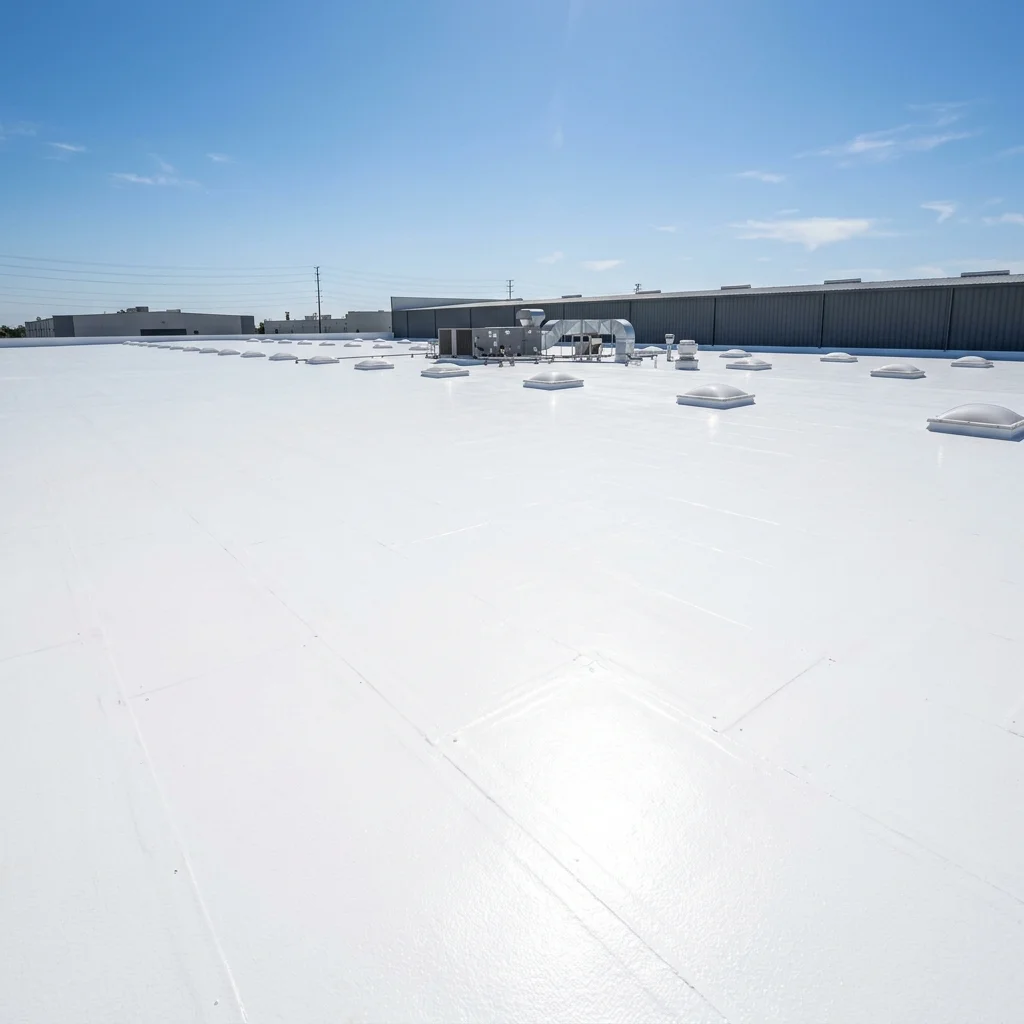
Overview
You reach for acrylic when the roof drains well, the budget is tight, and a white cool-roof finish is on the list. Acrylic is the least expensive of the coating chemistries by the gallon and installed. On a commercial low-slope restoration it runs about $0.65 to $1.75 per square foot installed, the cheapest of the four chemistries. It is a water-based product, so the crew works with no solvent fumes and cleans up with water. The one thing it cannot give you is the thing silicone is built for: a film that sits in standing water without softening.
This page goes deep on commercial acrylic for flat and low-slope roofs. It covers when acrylic earns the spec, the real published performance numbers against ASTM D6083, substrate and primer rules, climate fit, application targets, cool-roof compliance, cost, and the recoat path that makes acrylic easy to maintain over time. For the four-chemistry overview and how acrylic compares to silicone, polyurethane, and SEBS rubber, start with the elastomeric roof coating guide.
Key point: A coating restores a sound roof. It does not rebuild a failing one. The substrate has to be structurally sound, the seams and flashings repaired, and the deck dry before any acrylic goes down. Acrylic has one hard limit the others do not share: standing water softens the film over time, so a ponding roof is the wrong roof for acrylic.
Is acrylic the right call?
Before you spec acrylic, answer one question: does this roof drain? Acrylic is a strong, cheap, reflective coating on a roof with positive drainage. On a roof that ponds, it is the wrong product, and no amount of extra mils fixes that.
If the roof drains well and budget is the constraint, acrylic is likely right. A warehouse, school, or retail box with positive slope and no standing water after rain is the textbook acrylic job. White acrylic delivers a strong cool-roof finish at the lowest installed cost of the four chemistries, recoats with more acrylic later without a fight, and goes down with no solvent fumes while the building stays occupied.
If the roof ponds, go to silicone. Water that sits more than 48 hours after rain, an owner who will not fix the drainage first, a low-slope roof that holds birdbaths every storm. Acrylic is water-based, and standing water re-emulsifies the film over time. Acrylic product warranties commonly exclude or limit ponding coverage. See the silicone roof coating guide for that path.
Two other failure modes pull you away from acrylic. If the roof sees regular foot traffic, dropped tools, or equipment dragging across it, polyurethane is the tougher film in puncture and abrasion. If the project lands in cold-climate winter, the application window closes (acrylic needs warm, dry, frost-free weather to cure). Compare the chemistries head to head in the silicone vs acrylic and three-way acrylic vs silicone vs polyurethane comparisons. For the polyurethane path on traffic-heavy roofs, see the polyurethane roof coating guide.
Confirm slope and drainage before you specify acrylic. Acrylic does not belong on a roof that holds water. Verify the roof drains and clears within about 48 hours after rain. If it ponds and the drainage cannot be corrected, specify silicone for those areas or correct the slope first. Positive drainage is the precondition for an acrylic system, not an afterthought.
How acrylic works
Acrylic roof coatings are waterborne acrylic latex emulsions. Polymer particles sit dispersed in water along with pigment, fillers, and additives. As the water evaporates, the particles coalesce into a continuous elastomeric film. This is film formation by drying, not a chemical cure. Understanding that one fact explains every application rule that follows.
Drying means the water has to leave. In low-humidity air (think Phoenix) the surface can dry in under 2 hours; in high humidity (think Florida above 85% RH) it takes much longer. Drying is not the same as full strength. The polymers continue to fuse for a two- to four-week period after application, developing their final adhesion, moisture resistance, and dirt resistance. During that wet-and-drying window, rain, dew, fog, or a freeze destroys the film before it ever sets. Once the emulsion freezes in the pail, the product is ruined even after it thaws.
That water-based chemistry is also acrylic's defining limitation. Because the film forms by water leaving, standing water that returns can soften and re-emulsify it over time. That is why ponding is the dividing line between acrylic and silicone, and why the climate-fit section treats it as the honest centerpiece of this guide.
Performance numbers
The table below puts the ASTM D6083/D6083M-24 minimum floors next to the range commercial-grade acrylics commonly publish above them. The standard is a floor, not a ceiling. Most real products clear the tensile and elongation minimums by 2 to 3 times, so treat the specific product's published value as the real number rather than a single chemistry-wide figure.
| Property | D6083 minimum | Typical commercial product | Test method |
|---|---|---|---|
| Weight solids | 60% | 60% and up | n/a |
| Volume solids | 50% | 50% and up | n/a |
| Initial tensile @ 73°F (psi) | 200 | 250-500 | ASTM D2370 |
| Initial elongation @ 73°F (%) | 100 | 150-400+ | ASTM D2370 |
| Elongation after 1,000 hr weathering (%) | 100 | 100+ | ASTM D2370 |
| Dry peel adhesion (pli) | 4.0 | 4.0 and up | ASTM C794 / D903 |
| Wet peel adhesion, 1-week immersion (pli) | 2.0 | 2.0 and up | ASTM C794 / D903 |
| Permeance @ 20-mil film (perms) | 50 max | under 50 | ASTM D1653 |
| Solar reflectance, white (initial) | n/a | 0.83-0.88 | ASTM E903 / C1549 |
| Thermal emittance, white | n/a | 0.85-0.90 | ASTM C1371 / E408 |
D6083 minimums are from the published standard summary. The typical-product column is the landscape above the floor, not any one data sheet. Confirm every value against the specific product's current data sheet before specifying, since revisions can change any number.
Low-temperature flexibility splits by Type. D6083 sets two separate cold-flex paths. Type I, the original, passes a 1/2-inch mandrel bend at -26°C (-15°F). Type II adds an alternative path at -10°C (14°F), which lets the formulator trade some cold flexibility for gains in tensile, weathering, tear, and dirt-pickup resistance. There is no single generic D6083 cold-flex number. A data sheet that cites D6083 should name its Type, and for a cold-climate roof you want Type I.
One aging note that sets buyer expectations. White acrylic reflectance is high on day one (commonly 0.83 to 0.88) but drops as the surface holds dirt: 3-year aged values land around 0.65 to 0.78, with the biggest loss in hot-humid climates and less in hot-dry ones. Acrylics age from the outside in, with chalking as the surface aging mode rather than film cracking on a properly applied film. Type II formulations target improved dirt-pickup resistance for that reason.
Substrate Compatibility
Substrate compatibility is system-specific, not chemistry-wide. The matrix below summarizes what acrylic data sheets and practitioner guidance commonly say. Specifying any actual job requires the chosen product's published substrate and primer list, plus the building's roofing-system manufacturer's approved-coating list. The examples are illustrative, not universal.
| Substrate | Generally specifiable? | Manufacturer-specific notes |
|---|---|---|
| SPF foam (sloped) | Yes | Coating is the UV layer; common DFT minimum 20 mils, up to 40 per warranty |
| Smooth BUR | Yes | Bleed-blocker / base coat; age 90 days post-install before coating |
| Granulated mod-bit / mineral cap | Yes | Bleed-blocker recommended; surface roughness aids adhesion |
| Gravel BUR | No | Loose aggregate prevents adhesion |
| Galvanized / Galvalume metal | Yes | Rust-inhibitive primer if rusted; weathering improves Galvalume adhesion |
| Painted / Kynar metal | Generally no | Factory fluoropolymer finishes fail adhesion |
| Concrete / masonry | Yes | Masonry primer if damp or chalky; adheres well to cured concrete |
| EPDM (cured) | System-specific | Etching or bonding primer required; verify on the product's data sheet |
| TPO / PVC (weathered) | System-specific | Some products publish a primer + acrylic restoration path; some exclude these explicitly. Product by product. |
| Coal-tar pitch | No | Excluded on data sheets that address it |
| Existing silicone | Generally not specifiable | Cured silicone's low surface energy peels acrylic. See Recoat Compatibility. |
| Existing acrylic | Yes | Clean and recoat; the standard maintenance path |
TPO and PVC are a product-by-product call, not a category rule. A small number of manufacturers publish a tested TPO-primer plus acrylic system for problematic single-ply restoration, and a few list weathered single-ply as an acceptable substrate in their own path. Others say plainly that their acrylic is not for use on TPO. Use only a manufacturer's tested, warrantied system for the specific product, and do not extrapolate a TPO-compatible claim from one brand to another. For new work without a tested system available, default to a membrane-compatible restoration chemistry or rebuild.
The acrylic field coating ends where the penetrations begin. For sealing the metal flashing, vent stacks, and curbs that interrupt the field, see the commercial roofing sealants guide.
Climate Fit
Where acrylic is strongest
- Well-drained roofs in warm-dry climates. Positive slope plus a long, dry application season is acrylic country: spring through early fall across most of the US.
- Cool-roof targets. White acrylic reflects a large share of solar heat on day one and is a strong cool-roof performer when the product holds its 3-year aged reflectance in the CRRC directory for the target climate.
- Occupied buildings. Water-based means no solvent fumes, so the building stays in use during application.
- Hurricane and high-wind zones. A monolithic seamless acrylic film has no mechanically fastened lap seams to lift, which is the failure mode single-ply suffers under wind uplift. FEMA storm-damage research groups liquid-applied systems among the better performers on low-slope roofs.
The honest weaknesses
- Ponding water. This is acrylic's defining limitation. Standing water beyond roughly 48 hours softens and re-emulsifies the film over time, and acrylic product warranties commonly exclude or limit ponding coverage. Several published data sheets state plainly that the product is not for surfaces prone to ponding water. If the roof ponds, fix drainage first or specify silicone.
- Cold-weather application. The practical floor is 50°F ambient and rising, with no rain, dew, fog, or freezing in the forecast for 24 to 48 hours after application. Apply on a warm afternoon with a cold overnight forecast and the wet film freezes before it coalesces, then chalks, cracks, or delaminates on the first heating cycle.
- Humidity. High humidity stretches drying time substantially, and many manufacturers limit application above 85% relative humidity or below the dew point.
- Dirt pickup and chalking. White acrylic loses reflectance as it holds dirt and chalks at the surface over years. A maintenance recoat restores it, and Type II formulations resist it better.
Watch the weather window. A water-based film is fragile until it dries. Stored product must stay above 30°F; once it freezes, the emulsion is destroyed and the pail is scrap. On the roof, the shorthand is: 50°F and rising, no moisture in the 24-to-48-hour forecast, and no application late in the day when the overnight low will dip toward freezing. Once the film fully cures over the two- to four-week window, it tolerates freeze-thaw normally; the risk is only during the wet-and-drying window.
Application
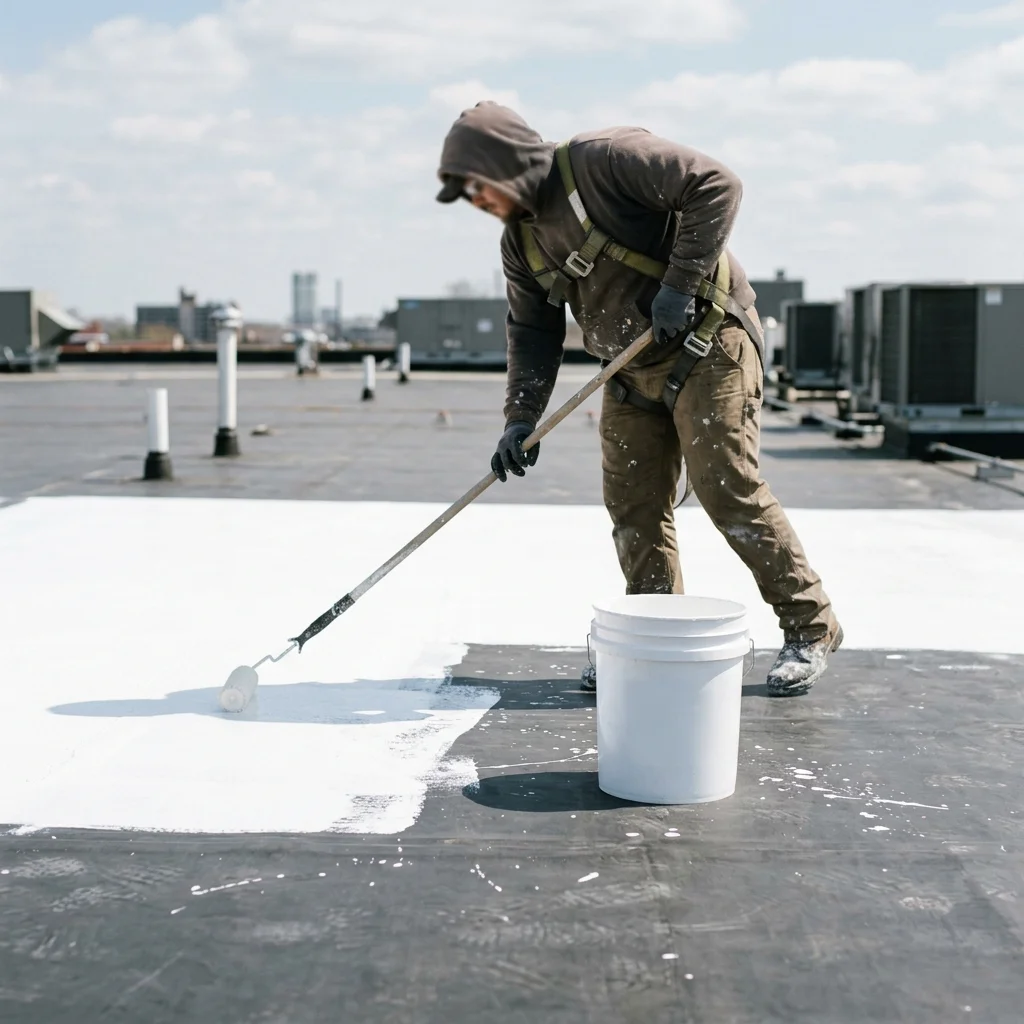
Most commercial acrylic goes down in two coats, a base and a topcoat, with fabric reinforcement embedded at seams, penetrations, transitions, and drains. Coverage and target dry film thickness drive the warranty tier, so the inspection control on every acrylic job is a wet-mil gauge during application backed by DFT verification. The numbers below are typical commercial targets.
| Parameter | Typical |
|---|---|
| Two-coat coverage | ~1.5 gal / 100 ft² base + 1.5 gal / 100 ft² topcoat |
| Two-coat film | 40-45 mil wet, about 22-25 mil dry |
| RCMA typical DFT range | 15-30 mil dry |
| Ambient temp | 50°F minimum and rising |
| Recoat between coats | Typically next-day; humidity extends it |
| Full cure (polymer fusion) | 2-4 weeks |
| Equipment | Brush, roller, or airless spray (1,800 psi pump minimum) |
| Cleanup | Water |
Estimate material with: gallons = (roof square feet / 100) × (gallons per 100 square feet per coat) × number of coats. Buy 10 to 15% extra for waste and detail work. Surface prep is universal: remove loose coating, debris, and dirt, then power wash (800 to 1,500 psi is typical). Asphaltic substrates age 90 days minimum before coating. On an unknown existing coating, run a 1-square-foot test patch, let it cure 24 hours, and attempt a peel; a clean release means it is incompatible.
Warranty tiers are product-specific
Manufacturers tier their no-dollar-limit (NDL) warranties at different DFT thresholds. There is no ASTM, NRCA, or RCMA standard mapping mils to years. One published high-tensile acrylic specification ties the tiers to DFT like this:
- 10-year NDL: 35 mils DFT minimum
- 15-year NDL: 40 mils DFT minimum
- 20-year NDL: 45 mils DFT minimum
Always verify against the actual product's current warranty schedule before specifying. Under-applying material to save gallons is the quiet way to miss a threshold: two thin passes that yield 12 mils against a 22-to-25-mil spec can cut service life in half.
Tip: for the full prep-and-apply walkthrough that applies across chemistries, see the step-by-step application guide. For crew PPE and fall protection, see the roof coating safety kit guide.
ASTM D6083
ASTM D6083/D6083M-24 is the acrylic-coating standard: liquid-applied, water-dispersed acrylic latex elastomeric protective roof coatings, applied by brush, squeegee, roller, or spray. The standard sets minimum requirements but does not provide application guidance. The core floors are:
- Weight solids: minimum 60%; volume solids: minimum 50%
- Initial tensile: minimum 200 psi at 23°C (ASTM D2370)
- Initial elongation at break: minimum 100% at 23°C (ASTM D2370)
- Permeance: maximum 50 perms on a 20-mil film (ASTM D1653)
- Dry peel adhesion 4.0 pli, wet peel adhesion 2.0 pli after 1-week immersion (ASTM C794 / D903)
- Plus tear (ASTM D624), water swelling (ASTM D471), and fungi resistance (ASTM G21)
Type I vs Type II
D6083 splits low-temperature flexibility into two Types, and the difference matters on a cold-climate bid. Type I is the original path: a 1/2-inch mandrel bend at -26°C (-15°F) per ASTM D522. Type II adds an alternative low-temperature path at -10°C (14°F). Loosening the cold-flex requirement lets a Type II formulator target gains in tensile strength, weatherability, tear resistance, dirt-pickup resistance, and reflectivity. Type I remains the cold-climate path. Specifying "must meet D6083" without naming the Type lets a Type II product into a cold-climate job where Type I would be the right call.
One label to keep straight: ASTM D6694/D6694M-25 is the silicone-coating standard and does not apply to acrylic. The two get confused constantly. If a product's data sheet does not list D6083 conformance and name its Type, treat it as not documented to the acrylic standard and ask the manufacturer.
Cool Roof Compliance
White acrylic is a strong cool-roof performer, which is one of the main reasons to spec it. Code compliance is judged on the 3-year aged solar reflectance, thermal emittance, and SRI, not the day-one numbers, and white acrylic does lose reflectance as it weathers. The aged value in the rated directory is what counts.
CRRC (the reference for any project)
The Cool Roof Rating Council Rated Products Directory lists initial and 3-year-aged solar reflectance, thermal emittance, and SRI for thousands of products by product and color. Aged values come from accelerated and outdoor weathering. Look up the specific acrylic product and color you plan to spec; hot-humid climates can pull aged reflectance lower than the dry-climate value. For any project outside California, CRRC-rated values feed the local cool-roof code's reflectance and emittance tests (many jurisdictions reference IECC or ASHRAE 90.1 criteria).
California Title 24 (California only)
California Title 24, Part 6 (2025 cycle, effective January 1, 2026) sets prescriptive cool-roof values. For nonresidential low-slope roofs in all climate zones, the thresholds are 3-year aged solar reflectance 0.63, thermal emittance 0.75, or SRI 75. White acrylic typically meets these when the specific product holds aged reflectance at or above 0.63 in CRRC testing for the target climate. Hot-humid climates are the variable that can pull aged reflectance below 0.63 for some formulations, so verify by product and color. Title 24 is California only. For non-California work, reference CRRC and your local cool-roof code instead. See the Title 24 cool roof compliance guide for the full thresholds, and the Los Angeles County roof coating guide for a California-specific walkthrough.
Historical note: the EPA sunset the ENERGY STAR roof-products specification on June 1, 2022. Its old reflectance thresholds are no longer a current compliance pathway, so do not specify against them on a new project. Use CRRC and the applicable code.
Cost
Acrylic is the low-cost chemistry. Installed, it runs the cheapest of the four, which is a large part of why a well-drained budget roof lands on acrylic. The figures below come from contractor-aggregator pricing for 2025 to 2026, so treat them as a planning band rather than a firm bid, and cross-check against a commercial-roofing estimator for your market.
| Scope | Cost/sqft |
|---|---|
| Installed (material + labor) | $0.65-$1.75 |
| Material only | under ~$1.00 |
| Labor only (varies with size, slope, height) | $0.50-$3.00 |
On material, a typical 22-to-25-mil two-coat system uses about 3 gallons per 100 square feet, and a 35-mil 10-year NDL system about 4 to 4.5 gallons per 100 square feet. Commercial-grade acrylic runs roughly $20 to $40 per gallon at distributor pricing, with premium high-tensile and Type II products higher. Roofs that need real prep (asphalt aging, drainage work, seam reinforcement) and coastal labor markets push you toward the top of the installed band.
Recoat Compatibility
Easy recoat is one of acrylic's quiet advantages over silicone. Acrylic recoats over cured acrylic without a fight, which keeps an owner's future maintenance simple. The one path that does not work is acrylic over cured silicone.
Recoating acrylic with acrylic
- Clean the surface. Power wash to strip dirt and chalking debris back to a sound film.
- Repair first. Patch cracks or alligatoring and reinforce seams, penetrations, and drains with fabric where needed.
- Recoat. Apply base plus topcoat, or topcoat only, depending on the condition of the existing acrylic.
- Maintain on schedule. Plan a maintenance recoat before warranty expiration; recoating every several years is the standard way to keep reflectance up.
Acrylic over cured silicone is generally not specifiable. Cured silicone has very low surface energy, so a field-applied acrylic does not wet out and commonly delaminates, with field failures peeling in sheets. Only proceed inside a manufacturer's tested, warrantied acrylic-over-their-own-silicone system. Absent that, the default paths on an existing silicone roof are silicone-on-silicone with the silicone manufacturer's abrasion or tie-coat primer spec, or full removal. When the existing coating is unknown, run a 1-square-foot adhesion test patch and let it cure 24 hours before committing: a clean release means incompatible, while a cohesive failure (the film tears but stays bonded) means compatible.
Where acrylic recoats well, and where it does not
With the appropriate manufacturer-specified primer where required, acrylic recoats over SPF, smooth BUR, granulated mod-bit, galvanized metal, concrete, masonry, EPDM, and existing acrylic. It is generally not specifiable over cured silicone, factory Kynar or fluoropolymer finishes, coal-tar pitch, oily or contaminated surfaces, or a wet substrate. Going the other direction, some manufacturers publish a silicone-over-acrylic bulletin with a tight recoat window (one example covers silicone over the same brand's acrylic within roughly 90 days of the acrylic going down); older, failed acrylic is a different scenario and not covered. Pull the existing coating's recoat guidance and the new product's bulletin before you commit.
Frequently Asked Questions
Can I apply acrylic over my old silicone roof?
Generally no. Cured silicone has very low surface energy, and field-applied acrylic over it commonly delaminates. Only proceed inside a manufacturer's tested, warrantied acrylic-over-their-own-silicone system. The default paths on an existing silicone roof are silicone-on-silicone with the silicone manufacturer's abrasion or tie-coat primer spec, or full removal.
Will acrylic hold up if my roof has ponding water?
Not where ponding lasts longer than about 48 hours. Acrylic is water-based, so standing water softens and re-emulsifies the film over time. Ponding-water coverage in acrylic warranties varies by manufacturer; some exclude ponding entirely, and some cover limited ponding under specific systems. Read the specific product warranty document. The safer call is to fix drainage first or specify silicone for areas with documented long-duration ponding.
What ASTM standard should an acrylic roof coating meet?
ASTM D6083/D6083M-24, the Standard Specification for Liquid-Applied Acrylic Coating Used in Roofing. It sets minimums for tensile (200 psi), elongation (100%), permeance, adhesion, and low-temperature flexibility, and it distinguishes Type I (-26°C cold-flex) from Type II (-10°C cold-flex). If a data sheet does not cite D6083 and name its Type, treat it as not documented to the acrylic standard.
How cold is too cold to apply acrylic?
The practical minimum is 50°F ambient and rising, with no rain, dew, fog, or freezing in the forecast for 24 to 48 hours after application. Below that, the wet film freezes before it coalesces and fails on the first heating cycle. Store product above 30°F; once it freezes in the pail, it is ruined.
How thick should the coating be?
Most commercial acrylic systems target 22 to 30 mils dry in two coats. Longer warranties want more film. One high-tensile specification calls 35 mils for a 10-year NDL, 40 mils for 15 years, and 45 mils for 20 years. Below about 20 mils, service life drops sharply.
Will acrylic work on my TPO roof?
It depends on the specific manufacturer's tested system. Most acrylic manufacturers do not list TPO as an approved substrate, and some exclude it explicitly. A small number publish a tested TPO-primer plus acrylic path for problematic single-ply restoration. Use only that manufacturer's tested system, and do not extrapolate a TPO-compatible claim from one brand to another. Without a tested system available, default to a membrane-compatible chemistry or rebuild.
What service life should I plan for?
Plan on 10 to 15 years for a properly applied two-coat system at 22 to 30 mils dry in a non-ponding climate with annual maintenance; some sources cite up to 20 years at 30 mils. NRCA-aligned guidance recommends a recoat every five to seven years to keep reflectivity up. Budget a maintenance recoat before warranty expiration.
Will the coating qualify for California Title 24?
White acrylic typically meets the 2025 Title 24 Part 6 nonresidential low-slope thresholds (3-year aged solar reflectance 0.63, thermal emittance 0.75 or SRI 75, effective January 1, 2026) when the specific product holds aged reflectance in CRRC testing. Verify by product and color in the CRRC Rated Products Directory. Hot-humid climates can pull aged reflectance below 0.63 for some formulations. Title 24 is California only; outside California, refer to the local cool-roof code plus the CRRC database.
What about ENERGY STAR certification?
The ENERGY STAR roof-products specification was sunset on June 1, 2022. There is no current ENERGY STAR certification for new roof products. Use CRRC ratings and the applicable building code (Title 24 in California, IECC or ASHRAE 90.1 elsewhere) as the compliance reference.
Do I need a primer?
It depends on the substrate. Concrete, masonry, weathered SPF, and existing acrylic usually do not need one. Galvanized metal (especially rusted), EPDM, granulated mod-bit, smooth BUR, and TPO require substrate-specific primers. Skipping primer on metal or EPDM is one of the most common failure causes.
Acrylic vs silicone, which is better?
Different jobs. Acrylic costs less, reflects well when new, and is easier to work with. Silicone tolerates the ponding water that destroys acrylic. Positive drainage plus a cool-roof finish at lower cost points to acrylic; documented ponding points to silicone. See the dedicated silicone vs acrylic comparison in this cluster.
Can I recoat my existing acrylic with more acrylic?
Yes, that is the standard maintenance recoat. Clean the surface, repair cracks or alligatoring, reinforce seams and penetrations with fabric where needed, and apply base plus topcoat or topcoat only per condition. Easy recoat is one of acrylic's advantages over silicone, which limits future recoat options.
Roof Coating Products


Was this page helpful?
Your feedback helps us improve our technical resources.