
Polyurethane Roof Coating
Last updated: May 31, 2026
Overview
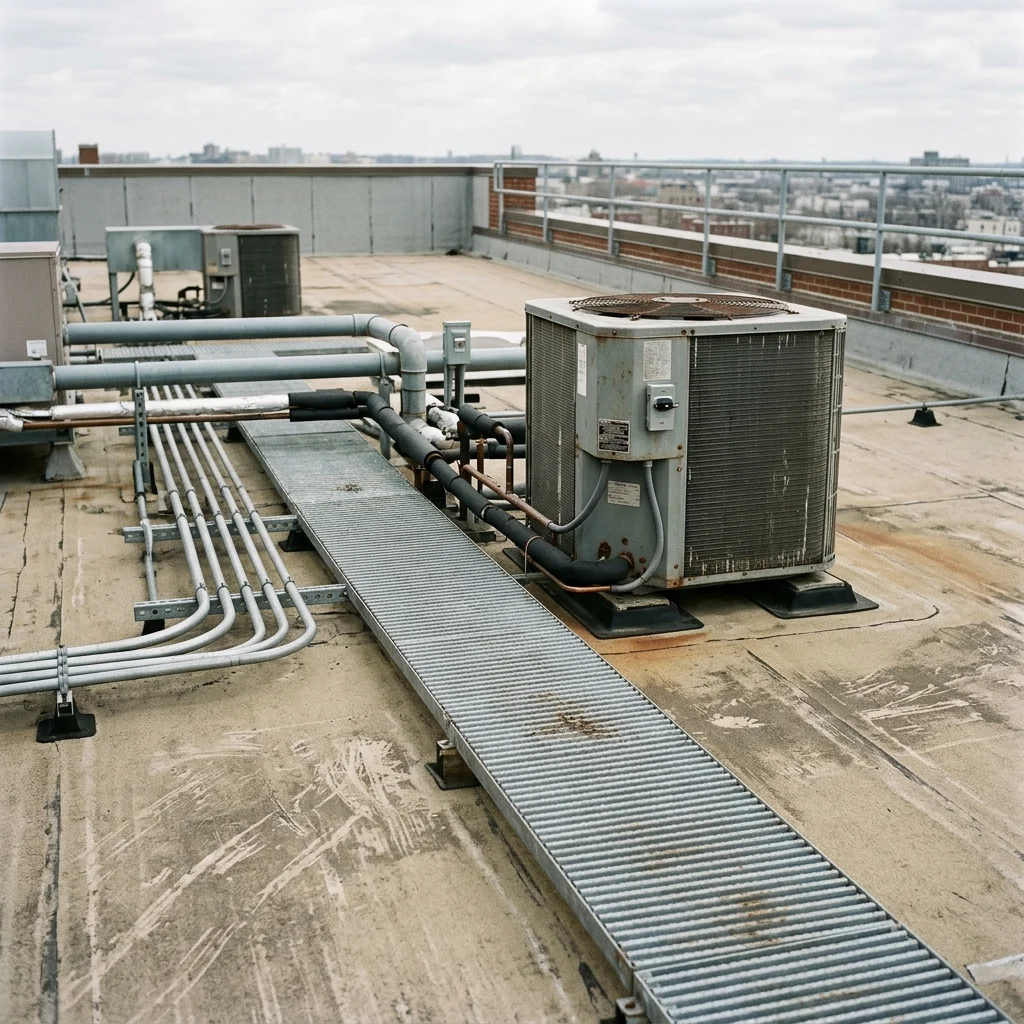
You reach for polyurethane when the roof takes a beating. Regular foot traffic from HVAC and telecom techs, dropped tools, equipment dragged across the field, solar service paths. Polyurethane is the toughest of the four coating chemistries in abrasion and puncture. It outpulls acrylic on tensile and tear, and it beats silicone on tear and abrasion. That toughness is the whole reason to spec it, and it is what separates polyurethane from a pure restoration coating.
There is a catch buried in the search term. A buyer typing "polyurethane roof coating" sometimes actually needs a walking-deck system. Same resin family, but a different product class with different standards, fire posture, and cost. This page draws that line clearly. It covers when polyurethane's toughness earns the price, the aromatic-base plus aliphatic-topcoat architecture, real performance ranges, substrate and primer rules, climate fit, application discipline, ASTM D6947, the walking-deck and ICC-ES AC39 crossover, cost, and the recoat constraint. For the four-chemistry overview and how polyurethane stacks against acrylic, silicone, and SEBS rubber, start with the elastomeric roof coating guide.
Key point: a coating restores a sound roof. It does not rebuild a failing one. The substrate has to be structurally sound, the seams and flashings repaired, and the deck dry before any polyurethane goes down. Polyurethane is tough, but it cannot fix trapped moisture in wet insulation, and substrate moisture above the data sheet threshold is one of the fastest ways to blister a urethane film.
Is polyurethane the right call?
Before you spec polyurethane, answer one question: what is the controlling problem on this roof? The answer points you to the right chemistry, and polyurethane is not always it.
If traffic, abrasion, or occupied space below is the controlling problem, polyurethane is likely right. Roofs with HVAC, telecom, and PV service paths. Decks where tools and equipment get dragged. Substrates with moderate cracking that need strong crack-bridging. This is what polyurethane's tensile and tear numbers buy you.
If ponding is the controlling problem, look at silicone first. Water that sits more than 48 hours after rain favors silicone, which holds its dimensions submerged. Polyurethane handles brief ponding but is more vulnerable to slow hydrolysis under continuous wet contact. See the silicone roof coating guide.
If the roof drains well, the budget is tight, and cool-roof reflectance is the goal, start with acrylic. Polyurethane costs more than acrylic, and it is a weaker cool-roof story. A well-drained warehouse or school roof does not need the toughness premium. See the acrylic roof coating guide.
Compare polyurethane head to head against the other two chemistries in the silicone vs polyurethane and three-way comparison guides. If the real problem is a multifamily balcony, a parking podium, or a deck over occupied space, you are not shopping for a roof coating at all. Jump to the walking decks and AC39 section below.
Drainage drives longevity and warranty. Polyurethane handles occasional ponding better than acrylic, but standing water still shortens service life and can affect warranty terms. Confirm positive slope and functioning drains as part of the assessment, regardless of how tough the film is.
How polyurethane works
Polyurethane elastomers form when an isocyanate group reacts with a polyol, building a 3-D crosslinked film. Two cure architectures show up on roofs. Single-component (1K) moisture-cure uses an isocyanate-terminated prepolymer that reacts with ambient water vapor, so it likes moderate humidity (a practical band of roughly 40% to 60% relative humidity). Two-component (2K) meters a resin and an isocyanate at the point of application and mixes them, with a pot life around 20 to 45 minutes at 77 degrees F. Read the product data sheet to know which one you are buying, because the cure rules differ.
Do not confuse the neighbors. Spray polyurethane foam (SPF) is a foam substrate, not a coating. Polyurethane coating sits on top of it. Polyurea is a different chemistry (isocyanate plus amine) that cures in seconds and needs plural-component spray gear. Adjacent, but a separate product.
Aromatic base plus aliphatic topcoat
This is the most consequential distinction in polyurethane, and the one most often gotten wrong. The choice between aromatic and aliphatic is about UV stability, not strength.
- Aromatic polyurethane uses aromatic isocyanates. The benzene ring absorbs UV and photo-oxidizes, so the film yellows and chalks within months of sun exposure. Mechanical strength holds, but appearance and reflectance degrade fast. It costs less and belongs as a basecoat under an aliphatic topcoat, or in a spot the cured film never sees daylight.
- Aliphatic polyurethane uses aliphatic isocyanates with no aromatic ring. It resists photo-oxidation and holds color and gloss across the service life. It costs more and belongs as the exposed topcoat or a single exposed coat.
- The field-standard commercial restoration system is an aromatic basecoat at roughly 20 to 25 mils plus an aliphatic topcoat at 10 to 15 mils dry film thickness.
Aromatic exposed to direct sun is a near-guaranteed appearance failure. Expect yellowing and chalking inside the first 12 to 24 months. Aromatic-only is acceptable only when the cured film never sees sunlight. Anywhere it does, the aliphatic topcoat is not optional.
Recoat windows
The recoat window between coats runs roughly 10 to 24 hours, but treat the product data sheet as the source of truth. Recoat too soon and trapped solvent gasses out as blisters. Recoat too late and you lose the intercoat bond, which shows up as delamination later. Walk-on cure is around 24 hours, and full chemical cure takes about 7 days at 77 degrees F and 50% relative humidity.
Performance numbers
The table below shows realistic published ranges for polyurethane roof films next to the test methods that report them. Elongation and tear are highly formulation-dependent, so treat the value on the chosen product's data sheet as the real number, not a single chemistry-wide figure. The standout columns versus the rest of the cluster are tensile, tear, and abrasion, where polyurethane leads.
| Property | Typical range | Test method |
|---|---|---|
| Tensile | 1,500-3,000 psi aromatic; 2,500+ psi high-solids | ASTM D412 |
| Elongation at break | 150-600% | ASTM D412 |
| Hardness, Shore A | 60-90 (most field roof coatings 70-85) | ASTM D2240 |
| Tear, Die C | 200-500+ pli; high-end near 1,000 pli | ASTM D624 |
| Water vapor permeance | Formulation-dependent; common target under 10 perms | ASTM E96 |
| Min application temp | 40°F standard; 20°F specialty low-temp | Per data sheet |
Values are realistic ranges across polyurethane roof films, not a single product's published numbers. Confirm against the specific product's current data sheet before specifying, since data sheet revisions can change any number.
Where polyurethane gives ground is chronic ponding. The urethane film is more vulnerable to slow hydrolysis under continuous wet contact than silicone is, so a roof that ponds for days every storm is a silicone job, not a polyurethane one. Brief, draining ponding is within range for many polyurethane systems, but the warranty coverage on standing water is product-specific. Read it before you spec.
Substrate Compatibility
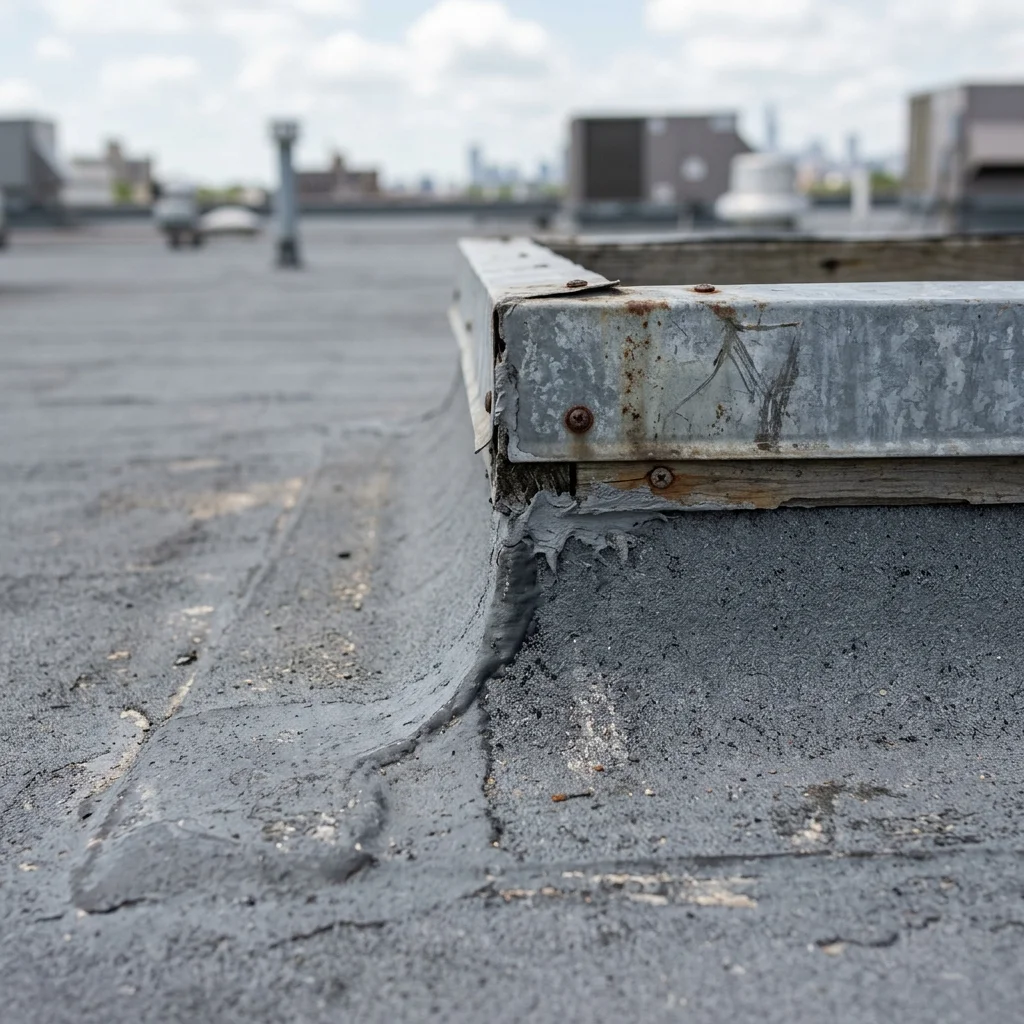
Polyurethane bonds to a broad set of substrates relative to acrylic and silicone, but every pairing is system-specific, not category-wide. The matrix below is illustrative. Specifying any actual job requires the chosen product's published substrate and primer list, plus the building's roofing-system manufacturer's approved-coating list.
| Substrate | Generally specifiable? | Manufacturer-specific notes |
|---|---|---|
| SPF (spray polyurethane foam) | Yes | Canonical D6947 use case for 1K moisture-cure |
| Concrete (cured) | Yes | Primer typically required; substrate moisture below the data sheet threshold (commonly under 12%) |
| Metal | Yes | Rust-inhibitive primer; flash rust between prep and prime is the common error |
| Mod-bit / BUR | System-specific | Possible with a bleed-blocking primer when the data sheet lists it |
| Single-ply (EPDM, TPO, PVC) | System-specific | Some lines publish a tested path, others exclude single-ply entirely. Verify against the product data sheet and ESR |
| Plywood | Walking-deck context | Plywood applications are almost always walking-deck systems evaluated under AC39, not roof-only polyurethane |
| Cured silicone | Generally no | Use a manufacturer-approved tested tie-coat if published; otherwise remove or recoat with silicone |
Two prep errors cause most failures. Skipping the bleed-blocking primer on mod-bit lets asphaltic oils bleed up and block the bond. Skipping the rust-inhibitive primer on metal, or letting flash rust form in the gap between prep and prime, lifts the coating. And concrete moisture above the data sheet threshold drives vapor up through the film as blisters and delamination. When the roof is plywood, you are almost certainly looking at a walking-deck system, not a roof-only coating.
The polyurethane field coating ends where the penetrations begin. For sealing the metal flashing, vent stacks, and curbs that interrupt the field, see the commercial roofing sealants guide.
Climate Fit
Where polyurethane is strongest
- Abrasion and traffic. The tough urethane film takes foot traffic, dragged equipment, and PV service better than acrylic or silicone, which is the headline reason buyers reach for it.
- Freeze-thaw climates. Cured polyurethane elastomers retain flexibility well below freezing, so they handle thermal cycling without cracking.
- Moderate cracking and movement. Strong crack-bridging makes polyurethane a fit for substrates that move, including mod-bit recoats that need high tensile strength rather than pure cool-roof restoration.
- Mild chemical exposure. Certain polyurethane formulations resist fuels, oils, and incidental spillage better than acrylic or silicone. Confirm the specific resistance on the data sheet.
The honest weaknesses
- Chronic ponding. Polyurethane handles brief draining ponding but is more vulnerable to slow hydrolysis under continuous wet contact than silicone. A roof that ponds for days is a silicone job. Warranty coverage on ponding is product-specific.
- UV on an aromatic film. Aromatic polyurethane yellows and chalks within a season of direct sun. Exposed systems require an aliphatic topcoat, full stop.
- Cold application limits. Typical minimum is a 40 degrees F substrate and rising, with specialty low-temp products down to 20 degrees F. Below the rated minimum, the cure stalls.
- Humidity extremes during application. The 1K moisture-cure benefits from moderate humidity, but excess substrate moisture or condensation drives blistering and pinholing. Watch the dew point and the substrate moisture reading.
Watch the moisture going in. Substrate moisture above the data sheet threshold and condensation on the deck are the two fastest ways to blister a urethane film. On a 1K moisture-cure product the air humidity helps the cure, but liquid water trapped under or in the substrate works against you. Check the substrate moisture reading and stay clear of the dew point before the first coat.
Application
Most commercial polyurethane roof systems go down as a two-coat build: an aromatic basecoat under an aliphatic topcoat. A primer is typically required, and it is product-specific. The numbers below are typical across the field, but the product data sheet is the source of truth per SKU. The inspection control on every job is a wet-film gauge plus dry-film-thickness verification, because the warranty tier rides on hitting the target thickness.
| Parameter | Typical |
|---|---|
| Two-coat system DFT | 20-25 mil aromatic base + 10-15 mil aliphatic top = 30-40 mil total |
| Single-coat aliphatic DFT | 15-20 mil |
| Application rate | About 1.5 gal / 100 ft² wet, roughly 15-18 mil DFT per coat |
| 2K pot life | 20-45 min at 77°F |
| Recoat window | 10-24 hr (per data sheet) |
| Walk-on cure | About 24 hr |
| Full chemical cure | 7 days at 77°F / 50% RH |
| Substrate temp | 40°F minimum and rising (specialty to 20°F) |
Recoat window discipline
The recoat window is where crews get burned. Coat the next layer too soon and trapped solvent gasses out as blisters. Apply too much film in a single pass and you get the same gassing blisters. Wait too long past the window and the intercoat bond fails, showing up as delamination down the road. Hit the published window, and build the thickness in the specified number of passes rather than one heavy coat.
Warranty tiers are product-specific
Manufacturers tier coating warranties at different thickness thresholds, and the "thicker film, longer term" rule of thumb (roughly 20 mils for 10 years, 25 for 15, 30 for 20) is a rough average, not an ASTM or RCMA spec. Actual terms are product-specific. Roof-only polyurethane warranties commonly run 10 to 25 years and are often thickness-tied. Some lines exclude ponding outright, others tolerate it within stated limits. No-dollar-limit coverage is available on some commercial systems through authorized-applicator programs. Read the schedule and the exclusions before specifying, and never under-apply material to save gallons, because that is the quiet way to miss a warranty threshold.
Tip: for the full prep-and-apply walkthrough that applies across chemistries, see the step-by-step application guide. For crew PPE, respirators around isocyanates, and fall protection, see the roof coating safety kit guide.
ASTM D6947
ASTM D6947/D6947M-16(2023) is the polyurethane roof-coating standard, but its scope is narrow and easy to overstate. It covers single-component, moisture-cured polyurethane applied over spray polyurethane foam (SPF). That is it. The test battery includes viscosity, solids, initial and aged tensile and elongation, permeance, water absorption, adhesion, fungi resistance, tear, and low-temperature flexibility. The standard explicitly does not provide guidance on application.
D6947 does not govern all roof polyurethane. It does not cover 2K polyurethane, and it does not cover roof-only polyurethane over non-SPF substrates like mod-bit, single-ply, concrete, or metal. Those systems sit under their product data sheets, which reference test methods like D412, D624, D2240, and E96 rather than D6947. Do not read a D6947 listing as proof a 2K or non-SPF system meets it. Walking-deck and traffic-bearing systems are governed by entirely different standards, covered in the next section.
If a polyurethane roof coating over SPF does not list D6947 conformance on its data sheet, treat it as not documented to the standard and ask the manufacturer. "ASTM certified" is not a regulated label, and the absence of a listed claim is not by itself proof of non-conformance.
Walking Decks & AC39
Here is the crossover that trips up buyers. A bare polyurethane roof coating is a coating. A walking deck is an assembly. Same resin family, different spec, different standards, different fire posture, and different cost. If the real project is a multifamily balcony, a parking podium, or a deck over occupied space, you need the assembly, not the roof coating.
Roof-only vs walking-deck polyurethane
- Roof-only polyurethane. 1K moisture-cured over SPF lands under ASTM D6947; 2K and non-SPF roof PU sit under product data sheets. Purpose is waterproofing plus UV protection over a low-slope membrane or SPF. Total DFT around 30 to 40 mils, smooth surface, pedestrian load incidental only.
- Walking-deck or traffic-bearing system. An assembly with primer, basecoat, an aggregate broadcast for slip resistance, an intermediate or topcoat, and often an aliphatic or polyaspartic sealer. Total DFT roughly 33 to 45 mils for pedestrian traffic, 60 to 100 mils for vehicular. Governed by ASTM C957/C957M-25 (integral wearing surface, pedestrian or vehicular, no hydrostatic head) or ASTM C836/C836M-18(2022) (separate wearing course over a membrane subject to hydrostatic head, such as plazas and parking).
ICC-ES AC39 and the fire-rating nuance
When the building official requires it, walking-deck assemblies are evaluated under ICC-ES AC39, the acceptance criteria for walking decks. A product on its own is not "approved." The assembly gets an evaluation report (ESR), and the ESR scope plus the local code define what the assembly can be used for.
Fire rating is more nuanced than a single test call. ASTM E84 (surface burning) is one of the AC39 fire tests, but it is not a roof-covering classification. When the walking deck is also a roof covering over occupied space, the Class A, B, or C classification comes from ASTM E108 or UL 790, not E84. And an E108 or UL 790 Class A listing does not automatically satisfy CBC Chapter 7A or IBC Section 1505 ember exposure in a wildland-urban-interface zone, which is a different test entirely. Confirm which test the building official requires before selecting an ESR-listed assembly. The Class A vs Class B fire rating guide walks through which test applies when.
California balconies: do not say "SB-721 approved." A bare polyurethane roof coating is not the right spec for an SB-721 or SB-326 balcony inspection repair. The correct framing is that an AC39-evaluated walking-deck assembly can support a code-compliant repair when the assembly's ESR scope and the local building official's fire-rating requirement (often Class A over occupied space per ASTM E108 or UL 790, plus any Chapter 7A or wildland-urban-interface ember path) fit the project. The assembly, not the resin, is what the inspector accepts.
Walking-deck cost is segmented by project type
There is no single walking-deck price. The cost depends entirely on the scope, and a common mistake is to quote the membrane-only line from a new commercial build against a balcony repair. The bands below match our walking-deck cost by project type guide.
| Project type | Cost/sqft |
|---|---|
| SB-721 / SB-326 balcony repair (scope-laddered) | $36-$200 |
| Commercial podium / plaza full replacement | $25-$40 |
| Parking structure replacement | $35-$50 |
| New commercial podium, waterproofing layer only | $4-$10 |
The often-quoted "$7 to $10 per square foot" figure is the waterproofing-membrane line on a new commercial podium build, not balcony repair or parking-deck replacement. Walking-deck warranties commonly run 5 to 10 years on the wearing surface and are product-specific. Keep this segmented walking-deck cost separate from the roof-only coating cost in the next section, which is lower.
Cost
For a roof-only polyurethane coating, material runs roughly $1.25 to $2.50 per square foot for a two-coat aromatic-plus-aliphatic build, with 2025 trade pricing closer to the $1.50 to $2.50 end. Installed, a roof-only polyurethane restoration lands in the low single digits per square foot, comparable to silicone and above acrylic.
| Scope | Cost/sqft |
|---|---|
| Material, two-coat aromatic + aliphatic | $1.25-$2.50 |
| Installed, roof-only restoration | $1.50-$4.70 ($2-$4 commercial midpoint) |
| Walking-deck assembly | Segmented by project type (see Walking Decks & AC39 above) |
Reading a quote: if someone quotes a "polyurethane roof coating" at $25 or more per square foot, the architect has written a walking-deck replacement or an SB-721 balcony repair, not a roof coating. The price tells you which product class you are actually buying. A true roof-only coating sits in the low single digits per square foot installed.
Recoat Compatibility
Recoat compatibility is product-system-specific, and it is the largest single source of elastomeric coating failure. Defer to the manufacturer's approved-recoat list rather than a category rule. The summary below is the starting point, not the spec.
Recoating over cured polyurethane
- More polyurethane from the same line, within the recoat window, generally yes.
- Aliphatic over aromatic, yes. This is the canonical two-coat system.
- Aggregate-broadcast walking-deck topcoats, yes, when they are part of an ESR-listed assembly.
- Silicone over polyurethane is possible with prep and an amine-silane primer, but confirm it against the silicone manufacturer’s approved list first.
- Acrylic over cured polyurethane is generally not specifiable without a manufacturer-approved tested system.
Polyurethane over an existing coating
- Over most substrates with a manufacturer-matched primer, generally yes (see Substrate Compatibility above).
- Over cured silicone, generally not specifiable. Use a manufacturer-approved tested tie-coat if one is published; otherwise remove the silicone or stay on silicone.
Caution: The recoat decision outlives the first coat. Whatever chemistry goes down first sets the rules for every future recoat. Acrylic over cured polyurethane and any non-silicone over cured silicone are the two pairings that bite crews, because they look like they should bond and then peel within a thermal cycle. Run a small cured-patch adhesion test before committing to any cross-chemistry recoat, and pull both the existing coating's recoat guidance and the new product's bulletin first.
Frequently Asked Questions
Is a polyurethane roof coating the same as a deck coating?
Same resin family, different system. A roof-only coating waterproofs a low-slope membrane or SPF and takes only incidental foot traffic. A walking-deck system is an assembly with an aggregate broadcast for slip resistance, evaluated under ICC-ES AC39, and built for pedestrian or vehicular traffic. If the project is a balcony, podium, or parking deck, you need the assembly, not the roof coating.
Will an aliphatic topcoat last longer in the sun?
Yes. Aromatic polyurethane has benzene rings that absorb UV and photo-oxidize, so it yellows and chalks within months of sun exposure. Aliphatic polyurethane has no aromatic ring and holds color and gloss across the service life. The field-standard system pairs an aromatic basecoat with an aliphatic topcoat.
Can I use aromatic polyurethane and skip the aliphatic topcoat?
Only if the cured film never sees direct sunlight. On an exposed roof, aromatic-only yellows and chalks inside 12 to 24 months and you are repainting within a year. Anywhere the film sees daylight, the aliphatic topcoat is required.
What ASTM standard governs polyurethane roof coatings?
ASTM D6947/D6947M-16(2023) covers single-component, moisture-cured polyurethane over spray polyurethane foam only. It does not govern 2K polyurethane or roof-only polyurethane over non-SPF substrates like mod-bit, single-ply, concrete, or metal. Those systems sit under their product data sheets, which reference methods like D412, D624, D2240, and E96.
Is polyurethane better than silicone for ponding water?
Generally no. Silicone outperforms polyurethane under chronic ponding because it holds its dimensions submerged. Polyurethane handles brief, draining ponding but is more vulnerable to slow hydrolysis under continuous wet contact. Warranty coverage on standing water is product-specific, so read it before specifying.
How long does polyurethane take to cure?
Walk-on cure is around 24 hours, the recoat window runs roughly 10 to 24 hours, and full chemical cure takes about 7 days at 77 degrees F and 50% relative humidity. Two-component products cure faster but have a short pot life of 20 to 45 minutes at 77 degrees F. Confirm against the product data sheet.
Do I need to prime concrete before polyurethane?
Almost always. A manufacturer-matched primer is typically required, and the substrate moisture has to be below the data sheet threshold (commonly under 12%). Moisture above the threshold drives vapor up through the film as blisters and delamination. Check the moisture reading before priming.
Can I put polyurethane over an existing silicone roof?
Generally not specifiable. Cured silicone is too hydrophobic for polyurethane to wet out reliably. Use a manufacturer-approved tested tie-coat if one is published; otherwise remove the silicone or recoat with silicone. Run a small cured-patch adhesion test before committing.
What is the warranty range?
Product-specific. Roof-only polyurethane commonly runs 10 to 25 years and is often thickness-tied (the rough rule of thumb is 20 mils for 10 years, 25 for 15, 30 for 20). Walking-deck wearing surfaces commonly run 5 to 10 years. Some lines exclude ponding, others tolerate it within limits, so read the exclusions before specifying.
Is polyurethane approved for California SB-721 balconies?
A bare polyurethane roof coating is not the right spec. An AC39-evaluated walking-deck assembly can support a code-compliant SB-721 or SB-326 repair when the assembly's ESR scope and the local building official's fire-rating requirement (often Class A over occupied space per ASTM E108 or UL 790, plus any Chapter 7A ember path) fit the project. The assembly is what the inspector accepts, not the resin alone.
What is the minimum application temperature?
Typically a 40 degrees F substrate and rising, with specialty low-temp products rated down to 20 degrees F. Below the rated minimum the cure stalls. Watch the dew point and the substrate moisture reading too, because condensation blisters a urethane film.
Does polyurethane meet California Title 24 cool-roof requirements?
It can, but only with a CRRC-rated white aliphatic topcoat. Aromatic-exposed polyurethane chalks out of compliance past the aging test, and polyurethane is a weaker cool-roof story than acrylic or silicone overall. California Title 24, Part 6 (2025 cycle, effective January 1, 2026) sets nonresidential low-slope thresholds of aged solar reflectance 0.63, thermal emittance 0.75, or SRI 75. Title 24 is California only. Outside California, reference the local cool-roof code plus the CRRC Rated Products Directory.
Roof Coating Products


Was this page helpful?
Your feedback helps us improve our technical resources.