
CO2 Fire Extinguisher Inspection, Testing & Service Life
How to read the dates marked on the cylinder, why a CO2 unit is hydrostatically tested every 5 years instead of 12, and whether a CO2 fire extinguisher ever really expires
Last updated: July 8, 2026
Overview
You found a date on your CO2 fire extinguisher and want to know one thing: is it still good, or is it overdue? CO2 units carry several dates, and the one that governs whether the extinguisher stays in service is the requalification (hydrostatic test) date on the cylinder, not the paper tag and not the year it was made.
CO2 is the odd one out among portable extinguishers. It has no pressure gauge, it is tested on a shorter cycle than the familiar red ABC dry-chemical unit, and it does not have a fixed calendar expiration. This guide covers how to read the markings, the inspection and testing schedule, and what actually retires a CO2 cylinder.
Scope. This guide summarizes federal OSHA (29 CFR 1910.157), US DOT cylinder requalification (49 CFR Part 180), and NFPA 10. Your state or local fire code and authority having jurisdiction (AHJ) can add requirements, and NFPA 10 section numbers change between editions. Confirm specifics with your fire marshal or a licensed fire-equipment service company.
Reading the Dates on the Cylinder
A CO2 extinguisher is a high-pressure gas cylinder, so it is marked to US DOT rules like any other compressed-gas cylinder (typically a DOT-3A, 3AA, or 3AL specification). The exact format and location of the markings depend on the cylinder specification, but you will generally find:
- The DOT specification and service pressure (for example DOT-3AA followed by a pressure in psi).
- An original manufacture / first-test date, which tells you the cylinder’s age.
- A requalification date for each hydrostatic test the cylinder has passed since — this is the one that governs.
Read the most recent requalification date. It is marked as a month and a year, with a four-character Requalifier Identification Number (RIN) in a square pattern between them (49 CFR 180.213(d)) — for example 09 [RIN] 21 reads as September 2021. For a CO2 extinguisher, the next test is due five years later, so a September 2021 mark means the unit is due in September 2026.
Two cautions. A five-pointed star or other symbol after the date is a special DOT designation for an extended test interval — it does not apply to a pure CO2 extinguisher, which stays on the 5-year cycle regardless. And if you cannot find or cannot read a legible requalification date, treat the unit as due and have it inspected rather than guessing.
Do not confuse the DOT dates marked on the cylinder with the paper service tag a technician attaches at the annual maintenance check. Both matter: the cylinder marks set the 5-year hydrostatic clock, and the tag shows the last professional service.
Why CO2 Is Different
Three things set a CO2 extinguisher apart from the dry-chemical unit most people picture, and all three change how you judge whether it is in service.
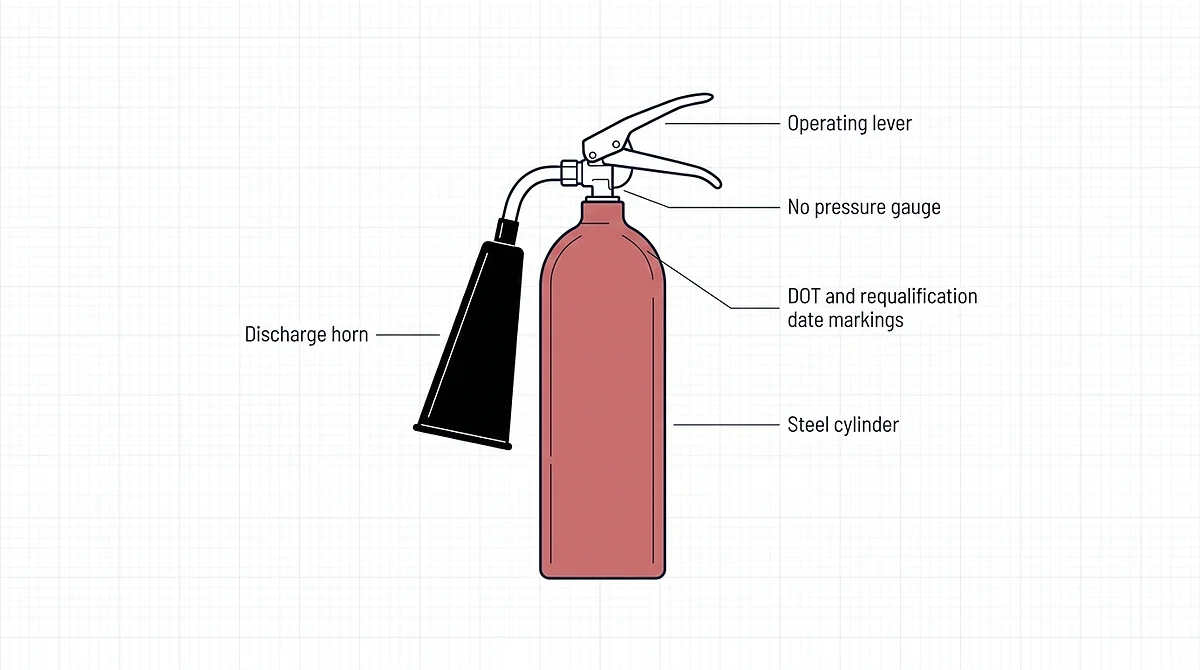
No pressure gauge
CO2 is stored as a liquid under its own vapor pressure, so a standard dial gauge cannot give a meaningful reading — that is why CO2 units do not have one. You cannot tell by looking whether the extinguisher is charged. Charge is verified by weight rather than a gauge reading: weight and fullness are checked during inspection and annual maintenance by qualified service personnel, subject to NFPA 10 and local AHJ requirements.
Self-expelling, not stored-pressure
CO2 discharges under its own pressure, so it is a self-expelling extinguisher, not a stored-pressure one. This matters because OSHA's line that "stored pressure extinguishers do not require an internal examination" does not exempt CO2 — a CO2 unit still gets its full inspection, annual maintenance, and 5-year hydrostatic test.
Tested every 5 years, not 12
This is the crux of the "date" question. A CO2 cylinder is hydrostatically tested every 5 years, at 5/3 of its stamped service pressure — half the interval of a typical dry-chemical unit. Owners used to a 12-year dry-chem cycle are often surprised their CO2 unit came due sooner.
| Agent | Hydrostatic test interval |
|---|---|
| Carbon dioxide (CO2) | 5 years |
| Water, foam, wet chemical | 5 years |
| Dry chemical (mild-steel / aluminum shell) | 12 years |
| Halon 1211 / 1301 | 12 years |
Source: OSHA 29 CFR 1910.157 Table L-1 and NFPA 10. Intervals for dry chemical depend on shell and construction type; confirm the exact interval for your unit against its markings and the adopted code.
The Service Schedule
A CO2 extinguisher moves through a fixed set of intervals. Some steps are the owner's job; the rest require qualified service personnel (a service company licensed or registered as your state and AHJ require, and a DOT-registered requalifier for the hydrostatic test).
| Interval | What happens | Who |
|---|---|---|
| Monthly | Visual inspection: present, accessible, unobstructed; seal / tamper indicator intact; horn and hose sound with no cracks; no dents or corrosion. With no gauge to read, the monthly check confirms the unit is in place and undamaged — its charge is confirmed by weight at service. | Owner / employer |
| Annual | Maintenance check: thorough exam plus weight / charge verification and hose and horn condition. | Qualified service personnel |
| 5 years | Hydrostatic (requalification) test at 5/3 of stamped service pressure, with the internal examination performed at the same time. | DOT-registered requalifier |
| After any use | Recharge. Under NFPA 10 a rechargeable extinguisher is recharged after any discharge — even a partial one — or when inspection or service indicates. | Qualified service personnel |
Two points people miss. First, monthly is the minimum visual interval under OSHA — a 2006 OSHA interpretation letter confirmed you cannot stretch it to quarterly. Second, the 6-year internal examination that applies to stored-pressure units on a 12-year hydrostatic cycle (dry chemical and similar) is not a separate step for CO2: a CO2 unit's internal exam happens with its 5-year test.
Hose assemblies. CO2 hose assemblies get a conductivity check under NFPA 10, and OSHA separately requires hose assemblies fitted with a shut-off nozzle to be hydrostatically tested (at 1,250 psi). This is part of professional service, not something to attempt yourself.
Do CO2 Fire Extinguishers Expire?
Short answer: a rechargeable CO2 extinguisher has no fixed calendar "expiration." As long as it passes its monthly inspections, annual maintenance, and 5-year hydrostatic test, it stays in service. Age alone does not retire it — condition does.
The "12-year rule" you may have read about applies to non-rechargeable, disposable extinguishers, which are removed from service 12 years from their date of manufacture. Rechargeable CO2 units are not covered by that blanket limit.
What actually retires a CO2 cylinder is failing requalification. During the 5-year hydrostatic test a DOT-registered requalifier condemns any cylinder that fails the condition criteria — examples include excessive permanent expansion under test, a leak through the cylinder wall, cracking serious enough to weaken it, or fire and heat damage. These are determinations made with test equipment during professional service, not a checklist an owner self-applies. Some cylinders also carry a specified service life or DOT special-permit limits, which the requalifier applies.
The practical rule. Do not scrap a CO2 extinguisher just because it looks old — and do not trust one that is past due for its 5-year test. When in doubt, the requalification date on the cylinder and a licensed service company are the answer, not the manufacture year.
What Employers Must Keep on File
If the extinguisher protects a workplace, OSHA makes the employer responsible for its inspection, maintenance, and testing. Two records tie directly to the dates on the unit:
- Annual maintenance record — record the annual maintenance date and keep it for one year after the last entry or the life of the shell, whichever is less (29 CFR 1910.157(e)(3)).
- Hydrostatic test certification — a record with the date of the test, the signature of the person who performed it, and the serial number or other identifier of the extinguisher (29 CFR 1910.157(f)(16)); keep it until the next test or the unit’s removal from service.
Both must be available to OSHA on request. These are the federal minimums — your state or local AHJ, and NFPA 10, may require additional documentation such as a service company's tag or a state license or registration number.
Replacing units that failed testing, or outfitting a site?
Volume pricing on US-made CO2 extinguishers — handheld and wheeled — with spec sheets for your fire marshal or insurer. We typically reply within one business day; lead times are confirmed per order.
or call 714-248-6555 · email partners@usmadesupply.com
Frequently Asked Questions
How do I know when my CO2 fire extinguisher needs to be tested?
Read the most recent requalification date marked on the cylinder — a month and year with a four-character RIN between them. Add five years: that is when the next hydrostatic test is due. If you cannot find or read a legible date, treat the unit as due and have it inspected.
Do CO2 fire extinguishers expire?
A rechargeable CO2 extinguisher has no fixed calendar expiration. It stays in service as long as it passes its monthly inspections, annual maintenance, and 5-year hydrostatic test. The 12-year removal rule applies to non-rechargeable, disposable extinguishers, not rechargeable CO2 units. What retires a CO2 cylinder is failing its requalification test, not its age.
Why doesn't my CO2 extinguisher have a pressure gauge?
CO2 is stored as a liquid under its own vapor pressure, so a dial gauge cannot read it meaningfully. Charge is verified by weight instead — checked during inspection and annual maintenance by qualified service personnel.
How often does a CO2 extinguisher need a hydrostatic test?
Every 5 years, at 5/3 of the service pressure stamped on the cylinder. That is half the interval of a typical mild-steel dry-chemical unit, which is tested every 12 years.
Can I inspect a CO2 extinguisher myself?
You can and should do the monthly visual inspection — accessibility, seals, horn and hose condition, no obvious damage. Because a CO2 unit has no gauge, that visual check confirms it is present and undamaged but not that it is fully charged; charge is confirmed by weight during the annual maintenance check and the 5-year hydrostatic test, which must be done by qualified service personnel.
CO2 Extinguishers
When a cylinder fails its 5-year test or you are outfitting a space, CO2 handhelds cover electrical rooms, labs, and electronics, and wheeled units extend the same residue-free, non-conductive coverage to larger energized-equipment hazards.
CO2 Fire Extinguishers
Non-conductive, residue-free protection for Class B and energized electrical hazards, in handheld and wheeled sizes.


Before you order. CO2 extinguishers are specialty, pressurized equipment. Many ship directly from the manufacturer, so lead times can run longer than a stock item — occasionally two weeks or more — and as compressed-gas (hazmat) items they cannot be returned once shipped. Please review our shipping and returns policies before ordering.
Inspection Record Tags
This page covers what to check and how often. The record of it has to stay on the cylinder. These are write-on plastic cards with the checklist and a date table printed on them, sold 10 to a pack, and they hold up in the electrical rooms and labs where CO2 units usually hang.

Was this page helpful?
Your feedback helps us improve our technical resources.

Recommended in this guide
Buckeye 10 lb CO2 Fire Extinguisher