
Acrylic vs Silicone vs Polyurethane Roof Coating
Last updated: May 31, 2026
Overview
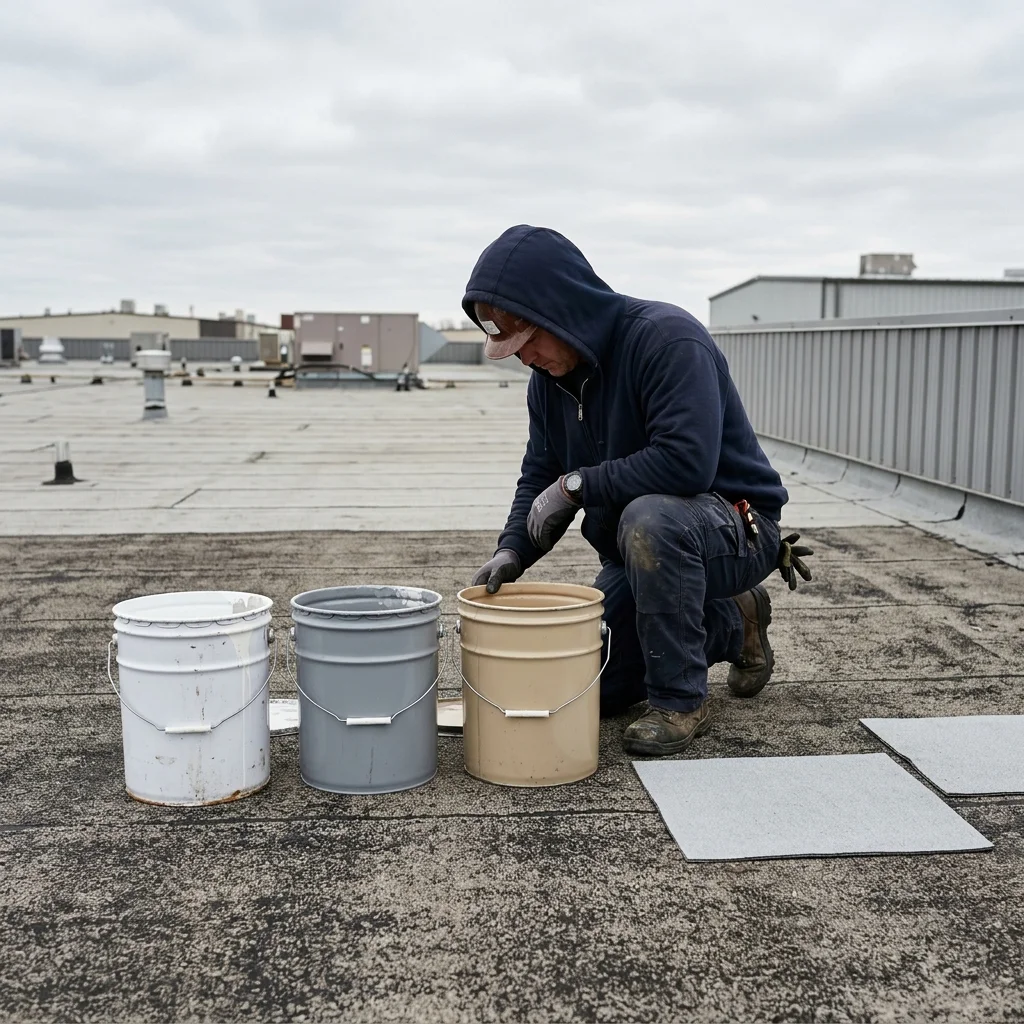
Three elastomeric chemistries cover most commercial low-slope restoration work: acrylic, silicone, and polyurethane. The right call is not about which one is best in the abstract. It is about which failure mode controls your roof. Ponding water points to silicone. A tight budget on a well-drained roof points to acrylic. Foot traffic, equipment, or an occupied walking deck points to polyurethane. Get the controlling problem right and the chemistry chooses itself.
This page is the decision matrix. It gives you a quick verdict by situation, a three-column head-to-head table, buyer scenarios that each name one winner, a cost comparison, and the recoat-compatibility rules that lock a roof into a chemistry once the first coat goes down. For the full four-chemistry primer, including SEBS rubber, start with the elastomeric roof coating guide.
Key point: a coating restores a sound roof. It does not rebuild a failing one. The deck has to be structurally sound, the seams and flashings repaired, and trapped moisture removed before any of these three chemistries goes down. Start every spec with the roofing-system manufacturer's approved-coating list, because compatibility and warranty are product-system-specific, not chemistry-wide.
Start with slope and drainage, then pick the chemistry. Positive drainage is independent of which coating wins: confirm the roof sheds water, or correct what you can, before choosing. Ponding that cannot be fixed pushes the call toward silicone; a well-drained roof opens up acrylic and polyurethane on cost and traffic.
Quick Verdict
Three short reads. Find the line that matches your roof and jump to that chemistry's deep-dive guide.
Pick acrylic if the roof drains well, the budget is tight, and you want a white reflective film that stays cleaner over time. Acrylic is the cheapest of the three by the gallon, recoats over acrylic without a fight, and holds reflectance better than silicone because it does not pick up dirt as fast. Acrylic softens under standing water, so most acrylic product warranties stop short on ponded areas. Read the acrylic roof coating guide.
Pick silicone if the roof ponds, the UV load is brutal, or both. The cured film is hydrophobic and dimensionally stable submerged, so it sits in standing water without softening. The polysiloxane backbone does not chalk under heavy sun. The cost runs close to polyurethane, and dirt pickup drops reflectance over time, but for a ponding flat roof it is the chemistry that does not fail. Read the silicone roof coating guide.
Pick polyurethane if the roof sees foot traffic, equipment, cart loads, or doubles as a walking deck over occupied space. Polyurethane is the toughest film of the three in tear and abrasion. ASTM D6947 sets its tensile floor at 1,500 psi, against 150 psi for silicone and 200 psi for acrylic. For walking decks, an ICC-ES AC39 evaluated assembly is the path to a code-compliant wearing surface. Read the polyurethane roof coating guide.
Head-to-Head
The table puts the three chemistries side by side on the variables that decide most commercial low-slope jobs. ASTM minimum tensile and elongation come from each chemistry's primary standard. Cost and warranty are typical 2026 commercial ranges, not guarantees. Verify any number against the specific product's data sheet before you spec.
| Property | Acrylic | Silicone | Polyurethane |
|---|---|---|---|
| Primary ASTM | D6083/D6083M-24 | D6694/D6694M-25 | D6947/D6947M-16(2023) |
| ASTM min tensile | 200 psi | 150 psi | 1,500 psi |
| ASTM min elongation | 100% | 100% | 75% |
| Installed cost/sqft | $1.50 to $3.50 | $2.00 to $5.00 | $2.50 to $5.00 |
| Ponding water | Poor; most warranties exclude ponded areas | Typically good; verify the product TDS | Moderate; handles under 48 hours, not confirmed long-term |
| Traffic and abrasion | Low | Low; slippery when wet | High; the traffic chemistry |
| UV and chalk | Very good; some chalking after long exposure | Outstanding; no chalk | Aliphatic outstanding; aromatic yellows and chalks |
| Recoatability | Acrylic over cured acrylic | Silicone over cured silicone only | Polyurethane over cured polyurethane |
| Cool roof | White, high initial SR; CRRC-listed products available | White, CRRC-listed products available; dirt drops aged SR | Aliphatic white only; verify on the CRRC directory |
| Typical warranty | 10 to 20 years | 15 to 20 years (some 50-year limited material) | 10 to 20 years |
ASTM minimums per D6083 (acrylic), D6694 (silicone), and D6947 (polyurethane). Cost and warranty ranges are typical commercial low-slope figures; confirm against the product data sheet and warranty schedule before specifying.
Buyer Scenarios
Five common jobs. Each one names a single winner and routes you to that chemistry's deep-dive guide. The reason a chemistry is wrong matters as much as the reason the winner is right, so each scenario states both.
Ponding-prone flat roof, 15-to-20-year target
A low-slope modified-bitumen roof with a corner that holds water more than 48 hours after rain, and an owner who will not regrade the drainage first. Winner: silicone. The cured film sits in standing water without softening, which is the one thing acrylic cannot do. Acrylic is wrong here because most acrylic product warranties exclude ponded areas and the film softens under standing water. Polyurethane is the middle of the road on ponding, rated for short ponding but not confirmed long-term standing water. Verify the silicone product's TDS does not exclude ponding rather than assuming the chemistry covers it. See the silicone roof coating guide.
Budget cool-roof warehouse with good drainage
A large white single-ply or BUR warehouse roof that drains within a day, no ponding, under a $2 per square foot installed budget, and an owner who wants the reflective cool-roof benefit. Winner: acrylic. It is the cheapest compliant chemistry, carries the highest initial solar reflectance, and the broadest CRRC-listed inventory. Silicone also works but adds the ponding premium you do not need on a well-drained roof. Polyurethane costs more without a benefit when there is no traffic. See the acrylic roof coating guide.
High-traffic roof with rooftop equipment
A roof with regular HVAC service routes, equipment dragged across it, or cart loads. Winner: polyurethane. It is the toughest film of the three in tear and abrasion, with a 1,500 psi ASTM tensile floor against 150 to 200 psi for the others. Silicone is wrong because it is slippery when wet and tears more easily than polyurethane. Acrylic is not a traffic chemistry. If the field coating has to be silicone or acrylic for another reason, designate walk paths and use a manufacturer walkway system. See the polyurethane roof coating guide.
Walking deck over occupied space
A roof deck people walk on, over offices or living space below, needing a durable wearing surface. Winner: polyurethane. A two-coat polyurethane system meeting ICC-ES AC39 for walking decks gives you a code-recognized wearing surface when the evaluation report and local code fit, with an aromatic base coat and an aliphatic topcoat for UV stability. Silicone is wrong because it is slick underfoot. Acrylic does not carry the wear rating. See the polyurethane roof coating guide.
Hot-climate roof outside California, no traffic, no ponding
A flat warehouse roof in Phoenix or another hot, high-UV market outside California, good drainage, owner wants a reflective cool roof. Winner: acrylic or silicone, by budget. Both hold up under heavy UV and both have CRRC-listed white products. Outside California there is no Title 24 requirement, so document compliance against the local cool-roof code using CRRC-rated values. Acrylic wins on cost when drainage is good; silicone wins if there is any ponding. Polyurethane is overkill without traffic. Compare the two directly in the silicone vs acrylic comparison.
Cost Comparison
Acrylic is the cheapest of the three by material and installed. Silicone and polyurethane land in the same higher band. The installed numbers below assume a full system on a commercial low-slope roof: prep, primer where the product requires it, two coats or one heavy coat to the target dry film thickness, and fabric at seams.
| Chemistry | Material $/sqft | Installed $/sqft | Service life at spec DFT |
|---|---|---|---|
| Acrylic | $0.75 to $1.25 | $1.50 to $3.50 | 10 to 20 years |
| Silicone | $1.50 to $2.00 | $2.00 to $5.00 | 15 to 20 years |
| Polyurethane | $1.25 to $2.00 | $2.50 to $5.00 | 10 to 20 years |
Lowest installed cost does not always mean lowest cost per year. At a 15-to-20-year horizon, silicone often beats acrylic on cost-per-year because acrylic at the 10-year dry film thickness typically needs a recoat near year 10, while silicone at the same warranty target tends to hold the full window. Quote the warranty tier the owner actually needs, then back-calculate gallons per square to the required thickness.
Watch the VOC limit if you are in California. Water-based acrylic comfortably clears the SCAQMD Rule 1113 limits of 50 g/L for roof coatings and 100 g/L for aluminum roof coatings. High-solids silicone often complies but not always: the GacoRoof product page lists VOC around 250 g/L, which exceeds both of those limits. Solvent-borne polyurethane can also exceed. VOC compliance and ponding-water performance are independent product attributes, so verify the specific product's data sheet lists the right VOC for your air district instead of assuming the chemistry complies.
Recoat Compatibility
Read this before the first coat goes down, because it shapes the roof's whole lifecycle. The single rule that drives most recoat planning: nothing non-silicone reliably goes over cured silicone. Once a roof is silicone, future recoats are silicone unless the owner pays to strip it back to substrate. Defer to the existing coating manufacturer's approved-coating list for any real job; the matrix is direction, not a universal rule.
| Existing cured coating | Acrylic over it | Silicone over it | Polyurethane over it |
|---|---|---|---|
| Cured acrylic | Generally specifiable, with prep | Manufacturer-tested systems only | Manufacturer-tested systems only |
| Cured silicone | Not generally specifiable | Generally specifiable, silicone to silicone with primer | Not generally specifiable |
| Cured polyurethane | Not generally specifiable | Manufacturer-tested systems only | Generally specifiable, same chemistry preferred |
Once it's silicone, it stays silicone. Acrylic over cured silicone is the most common recoat failure in the industry; it peels in sheets, often within the first heating-cooling cycle, because the cured film is too hydrophobic for acrylic to wet out reliably. Polyurethane over cured silicone is also not generally specifiable. The standard paths off silicone are a same-chemistry silicone recoat, full mechanical removal back to substrate, or a cover board plus new membrane.
Going onto silicone from fresh acrylic has one narrow exception. A manufacturer bulletin may permit silicone over the same brand's acrylic within roughly 90 days of the acrylic application, for a drainage problem found right after coating. That is a tight, fresh-acrylic window, not a path for recoating old or failed acrylic. Outside that window, treat silicone over aged acrylic as not generally specifiable and pull both the existing coating's recoat guidance and the new product's bulletin before you commit.
For the prep-and-apply walkthrough that applies across chemistries, see the step-by-step application guide.
Asphalt and SEBS
Two other roof-coating chemistries sit outside this three-way set. They solve different problems and rarely compete head-to-head with acrylic, silicone, or polyurethane on the same job.
Aluminum-fibered asphalt is the budget short-life option, around $0.50 to $1.50 per square foot with a 3-to-10-year hold, native to BUR. It is not in this comparison. See the asphalt roof coating guide.
SEBS rubber is the call for chemical-splash exposure and metal panel movement, not the general low-slope decision covered here. The elastomeric roof coating guide covers where it fits.
Frequently Asked Questions
Which roof coating is best, acrylic, silicone, or polyurethane?
There is no single best. The controlling problem on your roof picks the chemistry. Ponding water points to silicone. A tight budget on a well-drained roof points to acrylic. Foot traffic, equipment, or a walking deck points to polyurethane. Match the chemistry to the failure mode that matters most on your specific roof.
What coating is best for a roof that ponds water?
Silicone. The cured film is hydrophobic and dimensionally stable submerged, so it sits in standing water without softening. Acrylic softens under standing water and most acrylic warranties exclude ponded areas. Polyurethane handles short ponding under 48 hours but is not the call for confirmed long-term standing water. Verify the specific silicone product's data sheet does not exclude ponding.
Which roof coating is cheapest?
Acrylic. It runs about $1.50 to $3.50 per square foot installed on a commercial low-slope roof, against $2.00 to $5.00 for silicone and $2.50 to $5.00 for polyurethane. On a well-drained roof with no traffic, acrylic is the cost-efficient pick. At a 15-to-20-year horizon, silicone can win on cost per year because acrylic often needs a recoat around year 10.
Which coating is toughest for foot traffic and equipment?
Polyurethane. Its ASTM D6947 tensile floor is 1,500 psi, against 150 psi for silicone under D6694 and 200 psi for acrylic under D6083. It has the highest tear and abrasion resistance of the three. For a walking deck over occupied space, an ICC-ES AC39 evaluated assembly gives you a code-recognized wearing surface when the evaluation report and local code fit.
Can I put polyurethane or acrylic over an existing silicone roof?
Generally no. Neither acrylic nor polyurethane reliably adheres to cured silicone, and acrylic over silicone is the most common recoat failure in the industry. Once a roof is silicone, future recoats are silicone unless you strip it back to substrate. Plan the lifecycle around that before the first coat goes down.
Does any of these meet California Title 24 cool-roof rules?
Yes, with a CRRC-listed white product that meets the threshold. The Title 24 2025 cycle, effective January 1, 2026, sets aged solar reflectance 0.63, thermal emittance 0.75, or SRI 75 for nonresidential low-slope roofs. White acrylic and white silicone both have compliant CRRC-listed products; aliphatic white polyurethane can meet it on specific products. Title 24 is California only. For other states, use CRRC values against your local cool-roof code.
Is ENERGY STAR still a roof-coating compliance path?
No. The EPA sunset the ENERGY STAR roof-products specification on June 1, 2022. Do not specify against its old reflectance thresholds on a new project. Use a CRRC-listed product and the applicable cool-roof code instead.
What ASTM standards cover these three coatings?
Acrylic is covered by ASTM D6083/D6083M-24, silicone by D6694/D6694M-25, and single-component moisture-cured polyurethane over spray foam by D6947/D6947M-16(2023). Walking-deck polyurethane assemblies are evaluated under ICC-ES AC39. If a product's data sheet does not list conformance to its standard, ask the manufacturer.
How cold can I apply each of these?
Acrylic typically calls a 50 degrees F minimum and rising, dry weather. Silicone moisture-cures and most data sheets allow application down to roughly 35 to 50 degrees F, tolerating higher humidity. Polyurethane wants a stable dry window and precise mixing on two-component systems. In cold or high-humidity conditions, silicone is usually the most forgiving. Always confirm the product's data sheet.
Roof Coating Products


Was this page helpful?
Your feedback helps us improve our technical resources.