
NFPA 76: Fire Protection of Telecommunications Facilities
The NFPA standard for the buildings and equipment areas that carry public telecom service: what the 2024 edition covers, how it treats remote and unstaffed sites, and how it differs from NFPA 75
Last updated: July 3, 2026
What NFPA 76 Is
NFPA 76, the Standard for the Fire Protection of Telecommunications Facilities, is the NFPA standard that governs fire protection for the buildings and equipment areas that carry public telecommunications service. It covers central offices, signal-processing equipment rooms, cable entrance facilities, power areas, and the remote shelters and huts that support wireless networks. The current edition is the 2024 edition, which took effect December 21, 2023 and supersedes all previous editions.
The standard is written and maintained by the NFPA Technical Committee on Telecommunications, whose scope is fire protection for telecommunication networks. The project dates to April 1996, when it was created in response to fire-protection challenges identified by the FCC-sponsored Network Reliability Council. NFPA 76 was first published in 2002 as a recommended practice and was converted to a standard with the 2005 edition, followed by the 2009, 2012, 2016, 2020, and 2024 editions.
Operator-facing version: for which extinguisher goes in each equipment area, the remote-site service cycle, and how to buy for a whole network, see our communication tower site and equipment shelter buyer's guide. One point to keep straight up front: NFPA 76 is a facility standard. It governs a facility's fire-protection design, so no single fire extinguisher, cabinet, or component "complies with NFPA 76" on its own.
Scope: What NFPA 76 Covers
NFPA 76 provides requirements for the fire protection of telecommunications facilities, including landline, cable, wireless, and satellite services such as telephone and voice, voice over internet protocol (VoIP), internet, data, and video transmission that are rendered to the public. That phrase, rendered to the public, is the scope boundary. The standard is not intended to apply to a private telecommunications facility, such as a room a business uses to deliver telecom to its own employees.
Within a covered facility, NFPA 76 addresses the specific equipment areas a telecommunications service provider occupies:
- Signal-processing equipment areas
- Cable entrance facility areas
- Power areas
- Main distribution frame areas
- Standby engine areas
- Technical support, administrative, and building services and support areas
Private, non-utility does not mean out of scope: the standard still reaches businesses that provide telecom services to the public, including large medical facilities, universities, large corporate networks, military bases, and private prisons. For applying the Life Safety Code (NFPA 101) and NFPA 5000, telecom facilities are classified as special-purpose industrial occupancies.
Remote and unstaffed sites
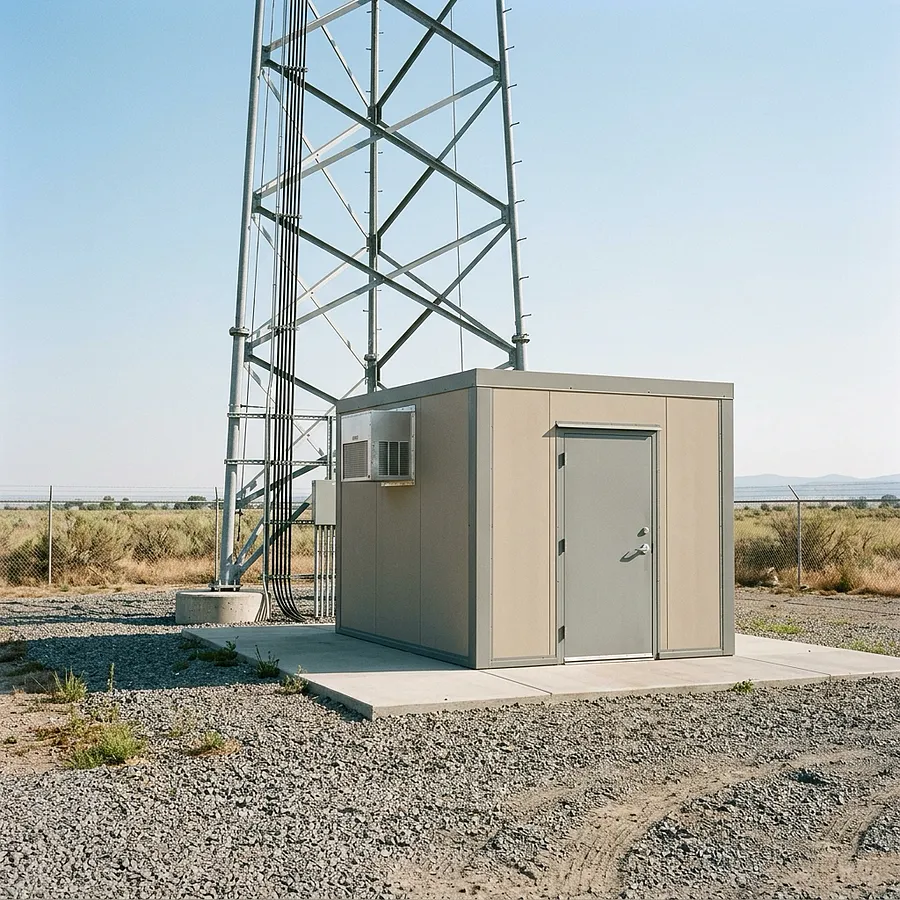
Wireless equipment shelters and cell sites are in scope, but they are handled by a dedicated chapter for small structures that are normally unoccupied and house telecommunications equipment: on-grade walk-in cabinets, on-grade huts, cell huts, and controlled environmental vaults (CEVs). NFPA 76 defines a cell hut as a small structure or enclosure that is normally unoccupied, is dedicated to housing cellular or wireless telecommunications equipment, and is associated with a nearby radio tower or antenna.
Do not assume NFPA 76 mandates extinguishers in an unstaffed hut. For these small unoccupied structures, the standard says the general chapters do not apply, that portable fire extinguishers are not required, and, new in the 2024 edition, that fire detection systems are not required. An unstaffed cell shelter is within scope, but NFPA 76 exempts it from the extinguisher and detection mandates that apply to a staffed central office. Any extinguisher you place there is a carrier, insurer, or prudence decision, not an NFPA 76 requirement.
Purpose: Life Safety, Equipment, and Service Continuity
What makes NFPA 76 different from a general building fire code is its third objective. The standard states that its provisions provide a minimum level of fire protection, a minimum level of life safety for occupants, and protection of the telecommunications equipment and service continuity. Its stated application is a reasonable level of protection from loss of life, property, and service continuity from fire.
- Life safety. Protect the people who work in and evacuate from the facility, the same objective any fire code carries.
- Equipment protection. Limit fire, heat, smoke, and corrosion damage to the continuously energized telecom equipment that a general code would not specifically address.
- Service continuity. Keep the network running. NFPA 76 treats continuity as a first-class design objective and provides for it through redundant or replacement-based approaches.
Service continuity is why this standard exists. Its risk analysis weighs the importance of keeping telecom service up in support of public safety through emergency communications such as 911, national defense communications, video transmission of critical medical operations, and other vital data. Its performance objectives split into life safety objectives and network objectives, the latter limiting a worst-credible design fire from causing an unacceptable network failure.
Detection and Suppression Concepts
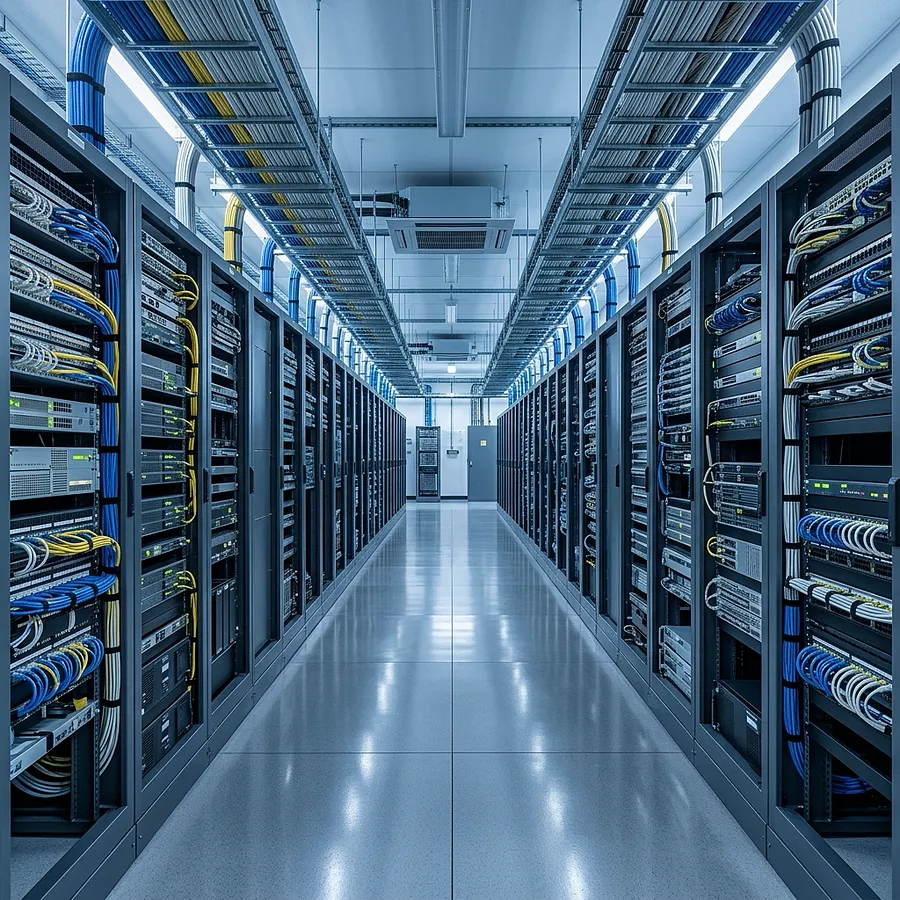
NFPA 76 lets a designer meet its objectives through a performance-based approach, a prescriptive-based approach, or a redundant or replacement-based approach, used selectively by hazard area or in combination. Two ideas run through all of them: catch a fire in telecom equipment far earlier than a conventional smoke alarm would, and suppress it with agents that do not destroy the surviving equipment.
Early detection is the standard's signature. It defines very early warning fire detection (VEWFD), which detects low-energy fires before conditions threaten telecom service, and early warning fire detection (EWFD), which detects fires before high-heat conditions threaten life or cause significant service damage. These systems use spot-type smoke detectors or air-sampling (aspirating) detection. A signal-processing equipment area larger than 2,500 square feet calls for VEWFD; an area of 2,500 square feet or less calls for EWFD. The fire alarm, detection, and notification equipment is installed, tested, and maintained under NFPA 72.
For automatic suppression, NFPA 76 does not design the systems itself. It points to the relevant installation standard for whichever system a facility uses:
| Suppression system | Designed and installed to |
|---|---|
| Automatic sprinklers | NFPA 13 (tested and maintained under NFPA 25) |
| Clean agent (gaseous) | NFPA 2001, with cross-zoned detection to minimize false discharge |
| Water mist | NFPA 750 (tested and maintained under NFPA 25) |
| Halon 1301 | NFPA 12A |
| Hybrid (water and inert gas) | NFPA 770 (added in the 2024 edition) |
Clean agent suppression is common in telecom equipment rooms because it protects the equipment without water or residue. For how those systems are designed and where they fit, see our NFPA 2001 clean agent standard page.
Portable Extinguishers Under NFPA 76
For portable fire extinguishers, NFPA 76 defers to NFPA 10 (2022 edition): the selection, placement, and maintenance of portable extinguishers follow NFPA 10. Where extinguishers are provided, NFPA 76 calls for units listed for use on energized telecommunications equipment, that is, units carrying a Class C rating. Equipment areas each take a unit suited to their hazard, so a standby engine area, for example, takes a unit suited to both energized equipment and the liquid or gaseous fuel present.
NFPA 76 bars dry chemical near telecom equipment. The standard prohibits dry chemical and corrosive-liquid portable extinguishers in signal-processing equipment areas, main distribution frame areas, and power areas. An annex to the standard explains why: the residue from these agents contaminates the equipment and damages terminals and connectors, and that damage can be catastrophic. The practical consequence is that the extinguishers that belong in telecom equipment areas are the residue-free, Class C-listed agents.
That points to carbon dioxide (CO2) and clean agent (such as Halotron) handhelds, both non-conductive and residue-free. A clean agent is often preferred over CO2 in a small enclosed shelter, where a large CO2 discharge raises an oxygen-displacement concern for anyone inside. For how the agents compare for sensitive electronics, see our fire extinguisher for sensitive electronics guide.
How to talk about the hardware. A portable extinguisher does not "comply with NFPA 76." It can be listed for use on energized electrical and telecommunications equipment (Class C) and selected, placed, and maintained under NFPA 10. Those are the claims that belong on the unit; NFPA 76 is the facility standard the unit helps a site satisfy.
NFPA 76 vs. NFPA 75
NFPA 76 and NFPA 75 are routinely confused because both protect rooms full of powered electronics. The dividing line is public network versus private IT. NFPA 75 is the Standard for the Fire Protection of Information Technology Equipment, covering enterprise IT rooms and data centers. NFPA 76 covers public-network telecom equipment, and it limits itself to services rendered to the public while excluding private telecom facilities.
| NFPA 75 | NFPA 76 | |
|---|---|---|
| Full name | Fire Protection of Information Technology Equipment | Fire Protection of Telecommunications Facilities |
| Covers | Private and enterprise IT rooms and data centers | Central offices, cable entrance rooms, carrier hotels, remote sites |
| Dividing line | Private IT equipment | Telecom service rendered to the public |
A colocation site that runs both enterprise IT and public-telecom operations can fall under both standards. In Department of Defense facilities, the Unified Facilities Criteria (UFC 3-600-01) directs that telecommunication areas comply with NFPA 76 in lieu of NFPA 75. For the data-center side and its firestop detail, see our NFPA 75 firestop compliance guide.
Who Requires NFPA 76
NFPA itself neither adopts nor enforces its standards. NFPA 76 is a standard, not a model building code, so it carries legal force only where an authority having jurisdiction adopts it or another adopted code references it. Its adoption into state law is limited: the 2024 edition has been adopted into the state codes of Delaware and Georgia. Confirm the adopted edition with your local fire marshal rather than assuming the latest one applies where you are.
In practice, most of the pressure to build to NFPA 76 comes from outside the building-code channel. The Department of Defense references NFPA 76 for military telecom areas through UFC 3-600-01. And NFPA 76 references Telcordia GR-63-CORE, the Network Equipment-Building System (NEBS) physical-protection requirements, which is how carrier equipment specifications, NEBS, and insurer requirements drive telecom fire protection alongside any local adoption.
The realistic read: NFPA 76 is enforceable where it is adopted (a limited set of jurisdictions, plus DoD facilities through the UFC) and is otherwise applied through contract, carrier standards such as NEBS and GR-63, and insurer requirements. It is not broadly adopted into law nationwide.
Extinguishers for Telecom Equipment Areas
Because dry chemical is barred from signal-processing, main distribution frame, and power areas, the handhelds that belong in telecom equipment areas are the residue-free, Class C-listed agents. These CO2 and Halotron clean-agent units are related to NFPA 76 facilities. They are selected, placed, and maintained under NFPA 10, not certified to NFPA 76.
CO2 handhelds for equipment and power areas
Non-conductive, residue-free Class B:C carbon dioxide, related to NFPA 76 telecom equipment areas.


Halotron clean agent for shelters and console spaces
Residue-free halocarbon clean agent that avoids the oxygen-displacement concern of CO2 in a small enclosed shelter, related to NFPA 76 telecom facilities.

2.5 lb
UL 2-B:C
Manufacturer: Buckeye
Buckeye 2.5 lb Halotron Clean Agent Fire Extinguisher
$275.00

5 lb
UL 5-B:C
Manufacturer: Buckeye
Buckeye 5 lb Halotron Clean Agent Fire Extinguisher
$515.00

11 lb
UL 1-A:10-B:C
Manufacturer: Buckeye
Buckeye 11 lb Halotron Clean Agent Fire Extinguisher
$1,109.00
Outfitting a central office, shelter, or tower site?
Volume pricing on CO2 and Halotron clean-agent handhelds for telecom equipment areas, with spec sheets for your fire marshal, carrier, or insurer. Quotes back within one business day.
or call 714-248-6555 · email partners@usmadesupply.com
Frequently Asked Questions
What does NFPA 76 cover?
NFPA 76 is the Standard for the Fire Protection of Telecommunications Facilities. It provides fire-protection requirements for the buildings and equipment areas that carry public telecom service, including landline, cable, wireless, and satellite service, from central offices and signal-processing rooms to cable entrance facilities, power areas, and remote equipment shelters. It applies to service rendered to the public and is not intended for private telecom facilities.
What is the current edition of NFPA 76?
The current edition is the 2024 edition, which took effect December 21, 2023 and supersedes all previous editions. NFPA 76 was first published in 2002 as a recommended practice and became a standard with the 2005 edition.
Does NFPA 76 require fire extinguishers in an unstaffed cell site or hut?
No. NFPA 76 treats small structures that are normally unoccupied, such as cell huts, on-grade huts, walk-in cabinets, and controlled environmental vaults, under a dedicated chapter that says portable fire extinguishers are not required, and, new in the 2024 edition, that fire detection systems are not required either. The shelter is in scope, but any extinguisher placed there is a carrier, insurer, or prudence decision, not an NFPA 76 mandate.
Which fire extinguishers does NFPA 76 allow near telecom equipment?
NFPA 76 prohibits dry chemical and corrosive-liquid portable extinguishers in signal-processing equipment areas, main distribution frame areas, and power areas, because the residue contaminates equipment and can cause catastrophic damage. It defers to NFPA 10 for selection, placement, and maintenance and calls for units listed for use on energized telecommunications equipment (Class C). In practice that means residue-free, non-conductive CO2 and clean agent such as Halotron.
What is the difference between NFPA 75 and NFPA 76?
NFPA 75 covers information technology equipment, meaning enterprise IT rooms and data centers. NFPA 76 covers public-network telecommunications facilities such as central offices, cable entrance rooms, and carrier hotels. The dividing line is private IT versus telecom service rendered to the public; a colocation site running both can fall under both standards.
Is NFPA 76 required by law?
Only where it is adopted. NFPA neither adopts nor enforces its standards, so NFPA 76 carries legal force where an authority having jurisdiction adopts it, such as Delaware and Georgia for the 2024 edition, or where an adopted code references it. In Department of Defense facilities it applies through UFC 3-600-01. Elsewhere it is driven by contract, carrier standards such as NEBS and GR-63, and insurer requirements. Confirm the adopted edition with your local fire marshal.
Was this page helpful?
Your feedback helps us improve our technical resources.