
NFPA 303: Fire Protection for Marinas & Boatyards
The standard that governs fire extinguishers on the dock itself: what it covers, how it differs from NFPA 307 and the Coast Guard's vessel rules, and where the units go
Last updated: June 27, 2026
Overview
NFPA 303, the Fire Protection Standard for Marinas and Boatyards, is the standard that governs fire protection for the dock itself, the facility, as opposed to the boats tied up to it. It applies to marinas, boatyards, yacht clubs, boat condominiums, and condominium or multi-family docking facilities, along with the piers, docks, and floats serving vessels not exceeding 300 gross tons.
NFPA 303 is enforced through the locally adopted fire code, such as the International Fire Code (Chapter 36, Marinas), and your authority having jurisdiction, usually the fire marshal, has the final say on what a given facility needs. The portable fire extinguisher requirements are the part most operators are looking for, and they are covered below.
Operator-facing version: for which extinguisher goes in each dock zone, the salt-air service cycle, and how to buy for a whole facility, see our marina and dock fire extinguisher buyer's guide. One scope boundary worth stating up front: NFPA 303 is not intended to apply to a private single-family residential dock, although a local code still might.
Scope: NFPA 303 vs. NFPA 307 vs. the Coast Guard
Three different regimes touch marine fire protection, and they are routinely confused. Keeping them separate is the first step to reading any marina requirement correctly.
| Standard / rule | Applies to | Responsible party |
|---|---|---|
| NFPA 303 | Marinas, boatyards, yacht clubs, docks serving vessels up to 300 gross tons | Facility operator |
| NFPA 307 | Cargo-handling marine terminals, piers, and wharves | Terminal operator |
| USCG 46 / 33 CFR | The vessel itself (commercial / recreational) | Boat owner |
NFPA 307 covers cargo-handling marine terminals, piers, and wharves and does not apply to marinas and boatyards, which remain under NFPA 303. On the vessel side, the U.S. Coast Guard sets what each boat carries by its size and type — vessels under 46 CFR by type (uninspected vessels under §25.30-20) and recreational boats under 33 CFR Part 175 — by extinguisher rating and number. Those are the boat owner's responsibility, separate from the dock.
Portable Extinguisher Placement
The placement rules for marina extinguishers draw from a few sources, and it helps to keep them straight:
- At the pier/land intersection. NFPA 303 calls for an extinguisher where a pier meets land when that pier exceeds 25 feet in length. A pier of 25 feet or less does not, on its own, trigger the requirement.
- 75-foot maximum travel distance. NFPA 303 calls for enough extinguishers that no point on a pier or dock is more than 75 feet of travel from one — the same distance NFPA 10 uses for general (Class A) coverage. Higher-hazard areas such as the fuel dock use shorter Class B distances.
- At each required standpipe hose connection. Where the fire code requires standpipe hose connections, an extinguisher is required at each one (IFC §3604.4); the rating and exact placement follow the adopted code and the authority having jurisdiction.
The count is layout-based. NFPA 303 does not prescribe a number of extinguishers per slip. The count follows from the layout and the placement rules above — the 75-foot travel distance, the standpipe locations, and the fuel dock. The authority having jurisdiction sets the final count and placement.
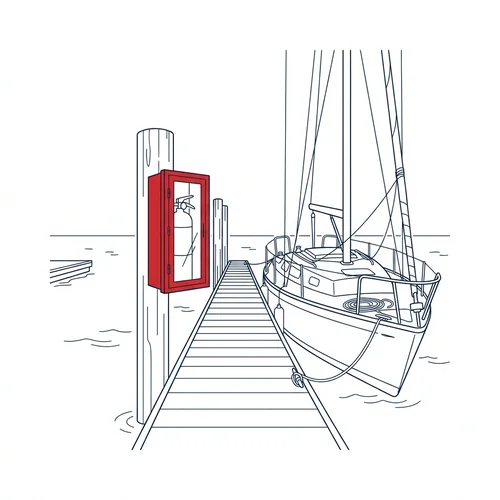
On an open dock, the extinguisher needs a weatherproof cabinet to survive sun, spray, and washdown while staying visible and reachable from the walkway.
See the marina cabinet + extinguisher pairing →
Fuel-Dispensing and Extra-Hazard Areas
A fuel dock is an extra-hazard area and needs Class B extinguishing capacity. Class B fires use shorter travel distances than the 75-foot general distance — NFPA 10 places extra-hazard Class B units at 40-B within 30 feet or 80-B within 50 feet — so the fuel dock takes higher-rated units set closer to the dispensing area, with extra-hazard units on each side of the fuel-dispensing area. Purple K is the primary choice for the fastest knockdown and carries the high Class B rating the hazard needs; CO2 is a clean, residue-free supplement near fuel-system electronics, but its lower rating makes it a backup rather than the primary extra-hazard unit. The adopted code and the authority having jurisdiction set the final rating and placement. For how the agents compare and how the Class B rating is sized, see the Class B fire extinguisher guide.
Inspection, Maintenance, and Testing
Marina extinguishers are maintained on the same schedule as any other portable unit, set by NFPA 10:
| Interval | Requirement |
|---|---|
| Monthly | Visual inspection: pressure gauge in the green where fitted (CO2 units have none), seal intact, no damage or corrosion |
| Annually | Professional maintenance by a certified technician, with a service tag |
| Every 6 years | Internal examination of rechargeable stored-pressure extinguishers |
| Every 5 years | Hydrostatic test for CO2, water, and AFFF units |
| Every 12 years | Hydrostatic test for dry-chemical units; disposable units retired |
Any extinguisher that has been discharged is recharged before it returns to service. Non-rechargeable (disposable) units are removed from service 12 years after their date of manufacture.
The Marine Environment
Salt air, UV, and moisture accelerate corrosion of extinguisher cylinders, valves, and seals compared with an indoor installation. That does not create a separate hydrotest or retirement interval, but a corrosive atmosphere can warrant inspection more frequent than the monthly minimum, and it means closer scrutiny at each service and a higher chance of a unit being condemned for corrosion before its hydrotest date.
NFPA 303 requires protection from the environment. Dock extinguishers must be protected from environmental exposure so they stay operable; NFPA 303 does not mandate one specific method, so a cabinet, a cover, or another approved means can satisfy it. In an exposed marine location a weatherproof cabinet or cover is the common way to meet it and slow corrosion. See the mounting and placement requirements for the rules on cabinets, height, and clearance.
Related Products
ABC dry chemical for general dock areas
Multipurpose A:B:C handhelds on a wall hook for gangways, slip posts, and walkways. Made in USA by Buckeye.

5 lb
UL 3-A:40-B:C
Manufacturer: Buckeye
Buckeye ABC Dry Chemical Fire Extinguisher w/ Wall Hook – 5 lb.
$56.00
4+ for $51 each

10 lb
UL 4-A:60-B:C
Manufacturer: Buckeye
Buckeye 10 lb Short ABC Fire Extinguisher, Wall Hook, UL Listed 4-A:60-B:C, Part 11310
$128.00

20 lb
UL 10-A:120-B:C
Manufacturer: Buckeye
Buckeye ABC Dry Chemical Fire Extinguisher w/ Wall Hook – 20 lb.
$155.00
Purple K for the fuel dock
The fastest-knockdown Class B dry chemical for gasoline and diesel fires, handheld and wheeled.

2.5 lb
UL 10-B:C
Manufacturer: Buckeye
Buckeye 2.5 lb Purple K BC Fire Extinguisher, Vehicle Bracket, UL Listed 10-B:C, Part 13515
$69.00

5 lb
UL 10-B:C
Manufacturer: Buckeye
Buckeye 5 lb Purple K BC Fire Extinguisher, Wall Mount or Vehicle Bracket
$102.00

10 lb
UL 80-B:C
Manufacturer: Buckeye
Buckeye 10 lb Purple K Fire Extinguisher 80-B:C
$165.00
Wheeled units for platforms and fuel terminals
High-capacity 50 lb Purple K, ABC, and CO2 on a cart for extra-hazard areas. Made in USA by Buckeye.

50 lb
UL 10-A:160-B:C
Manufacturer: Buckeye
Buckeye 50 lb ABC Wheeled Fire Extinguisher 10-A:160-B:C
$1,995.00

65 lb
UL 4-A:60-B:C
Manufacturer: Buckeye
Buckeye 65 lb Halotron Wheeled Fire Extinguisher
$8,917.00

125 lb
UL 320-B:C
Manufacturer: Buckeye
Buckeye 125 lb Purple K Wheeled Fire Extinguisher 320-B:C
$3,154.00
Bringing a marina up to NFPA 303?
Volume pricing on Buckeye ABC, Purple K, CO2, and wheeled extinguishers for the dock, with spec sheets for your fire marshal or insurer. Quotes back within one business day.
or call 714-248-6555 · email partners@usmadesupply.com
Frequently Asked Questions
What does NFPA 303 cover?
NFPA 303 is the Fire Protection Standard for Marinas and Boatyards. It applies to marinas, boatyards, yacht clubs, boat condominiums, and condominium or multi-family docking facilities, plus the piers, docks, and floats serving vessels up to 300 gross tons. It governs the dock facility, not the boats.
Does NFPA 303 apply to a private residential dock?
NFPA 303 is not intended to apply to a private single-family residential dock. A community, commercial, or multi-family docking facility is covered, and a local code may still impose requirements on a private dock, so the local fire marshal is the authority to confirm with.
What is the difference between NFPA 303 and NFPA 307?
NFPA 303 covers marinas and boatyards. NFPA 307 covers cargo-handling marine terminals, piers, and wharves and does not apply to marinas and boatyards, which remain under NFPA 303.
How many fire extinguishers does a marina need?
It is layout-based, not a fixed count per slip. The number follows from the 75-foot maximum travel distance, the locations of any required standpipe hose connections, and the fuel dock. The authority having jurisdiction sets the final count and placement.
What about the extinguishers on the boats?
Those are covered separately by U.S. Coast Guard rules and are the boat owner's responsibility: 46 CFR 25.30-20 for uninspected vessels (other vessel types under their own subchapters) and 33 CFR Part 175 for recreational boats. They are independent of the marina's NFPA 303 obligations for the dock.
Was this page helpful?
Your feedback helps us improve our technical resources.