
Fire Extinguishers for Marinas & Docks: A Buyer's Guide
What the marina, not the boat, is responsible for: which extinguishers each dock zone needs under NFPA 303, how the service and replacement cycle works in a salt-air environment, and how to outfit a whole facility at once
Overview
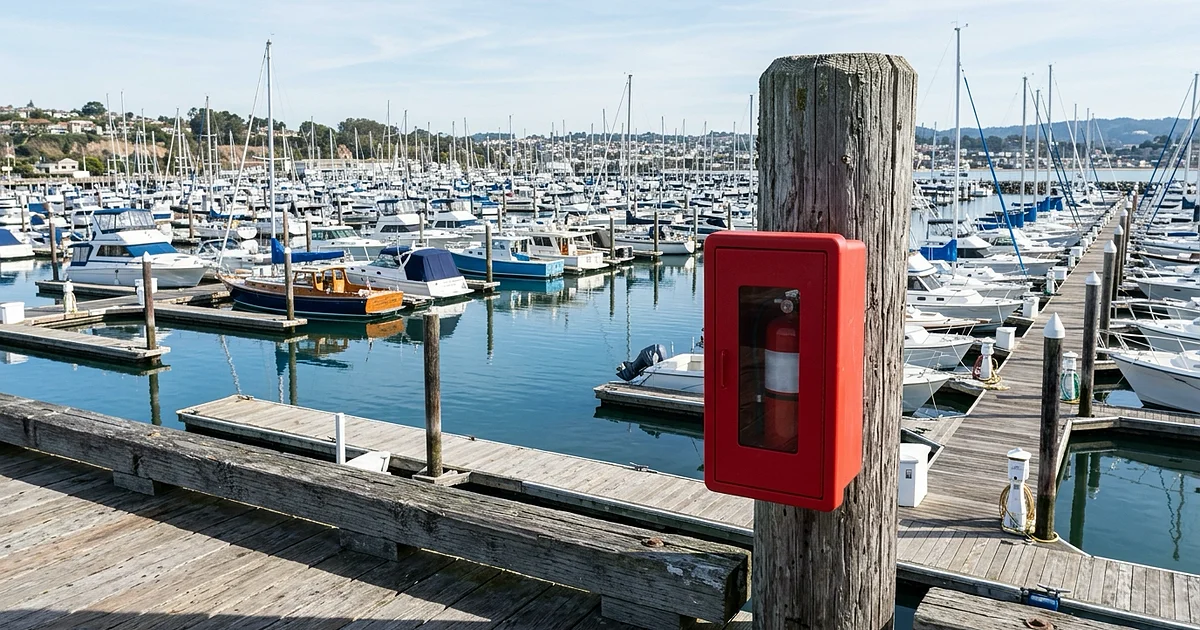
If you run a marina, boatyard, yacht club, or a homeowner-association dock, the fire extinguishers along the piers are your responsibility, not the boat owners'. The dock is a fire-protected facility in its own right, and the question this guide answers is a practical one: which extinguishers each part of the dock needs, how many and where, how the inspection and replacement cycle works once salt air is in the picture, and how to buy for a whole facility at once.
The most common mistake is treating the dock and the boats as one compliance problem. They are two separate rule sets with two separate owners, so we start there, then walk the dock zone by zone and finish with the service calendar and the bulk-buying conversation.
The one-paragraph version: the marina facility is covered by NFPA 303 and the locally adopted fire code; each boat is covered separately by U.S. Coast Guard rules. Put an ABC dry-chemical unit along the general piers, a high-rated Class B unit such as Purple K at the fuel dock (with CO2 as a clean supplement near fuel-system electronics), and wheeled units where a large platform or fuel area needs more reach. Then keep them serviced on the NFPA 10 schedule, and expect salt air to mean closer inspection scrutiny over time.
Facility vs. Vessel: Two Separate Rule Sets
Marine fire protection splits cleanly into the dock and the boat, and they are governed by different authorities. Keeping them straight is the difference between a compliant facility and a surprise at inspection.
| What | Who is responsible | Governing rules |
|---|---|---|
| The dock / marina facility | Marina or facility operator | NFPA 303 and the locally adopted fire code (for example IFC Ch. 36) |
| The boat / vessel | Boat owner | U.S. Coast Guard rules (46 CFR for uninspected and commercial vessels, 33 CFR for recreational) |
On the vessel side, the Coast Guard sets what each boat carries by its size and type — vessels under 46 CFR by type (uninspected vessels under §25.30-20) and recreational boats under 33 CFR Part 175 — specified by extinguisher rating and number. Those are the boat owner's obligation.
One detail on the vessel side catches people out, including boatyard staff who answer the question all day. Since April 20, 2022 the Coast Guard reads recreational carriage off the UL classification, not the old Marine Type sizes. A unit UL Classified 5-B:C or 10-B:C or greater meets carriage requirements on any recreational vessel regardless of the hull's age, while extinguishers rated Marine Type USCG Type B:C Size I or Size II are only acceptable on boats built model year 2017 or earlier. One 20-B can stand in for two required 5-B units, and a disposable extinguisher has to come out of service at the end of the twelfth year from its date stamp. The practical upshot is that the label most people still look for is the narrower of the two paths.
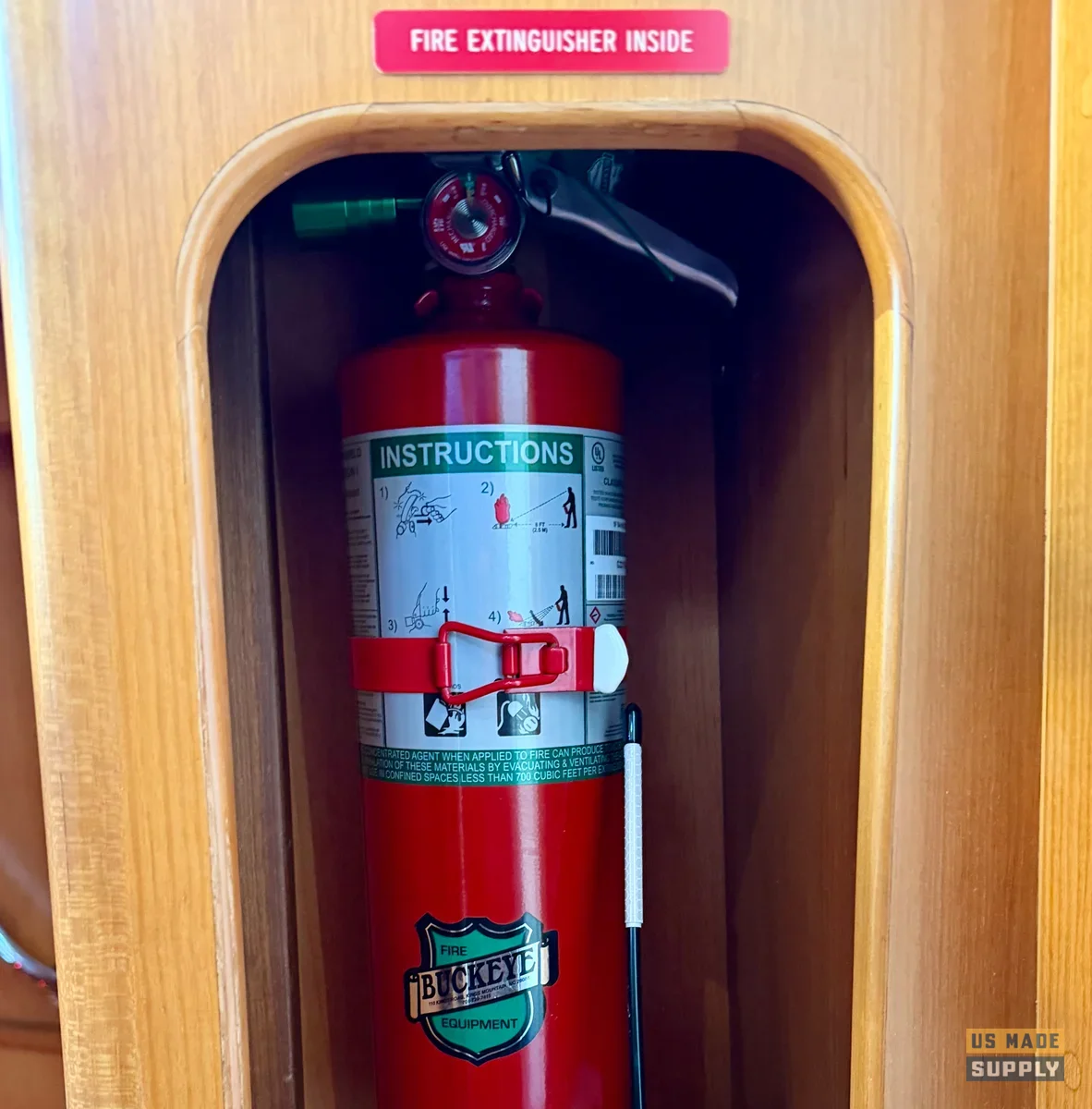
The vessel side of the line: a 5 lb Halotron clean-agent unit in a dedicated cabin locker aboard a customer's boat. Clean agent is a common pick below deck because it leaves no residue on navigation electronics. This unit is UL Classified 5-B:C.
Marine Type approval can carry a hardware condition. Buckeye's 11 lb and 15.5 lb Halotron units are Coast Guard approved for Type B:C, Size I and Size II respectively, only when ordered with the Model 810 mounting bracket (P/N 700228), which ships separately. The bracket is part of the approval, not an accessory. The smaller 2.5 lb and 5 lb units carry no Marine Type approval at all — on a recreational vessel they qualify on their UL classification instead.
Clean-agent units for cabins, helms, and engine spaces
Halotron leaves no residue on navigation electronics, wiring, or engine controls. Made in the USA.

2.5 lb
UL 2-B:C
Manufacturer: Buckeye
Buckeye 2.5 lb Halotron Clean Agent Fire Extinguisher
$275.00

5 lb
UL 5-B:C
Manufacturer: Buckeye
Buckeye 5 lb Halotron Clean Agent Fire Extinguisher
$515.00

11 lb
UL 1-A:10-B:C
Manufacturer: Buckeye
Buckeye 11 lb Halotron Clean Agent Fire Extinguisher
$1,109.00
This guide is about the facility, so everything below is the dock side.
Do not conflate the two. A dock is not compliant just because the boats tied to it carry their own extinguishers, and a marina's pier extinguishers do not satisfy any boat's Coast Guard requirement. One more boundary: NFPA 303 is not intended to apply to a private single-family residential dock, although a local code still might. The fire extinguishers you saw lining a community or commercial marina are the facility's, placed under NFPA 303.
What NFPA 303 Requires on the Dock
NFPA 303, the Fire Protection Standard for Marinas and Boatyards, applies to marinas, boatyards, yacht clubs, boat condominiums, and condominium or multi-family docking facilities, along with the piers, docks, and floats that serve vessels not exceeding 300 gross tons. The portable-extinguisher rules that follow come from a few different places, and it helps to keep their sources straight:
- An extinguisher at the pier/land intersection. NFPA 303 calls for an extinguisher where a pier meets land when that pier runs more than 25 feet; a pier of 25 feet or less does not, on its own, trigger the requirement.
- A 75-foot maximum travel distance. NFPA 303 calls for enough extinguishers that no point on the dock is more than 75 feet of travel from one — the same distance NFPA 10 uses for general (Class A) coverage. Higher-hazard spots like the fuel dock use shorter distances, covered below.
- A unit at each required standpipe hose connection. Where the fire code requires standpipe hose connections, an extinguisher is required at each one (IFC §3604.4); the rating and exact placement follow the adopted code and your authority having jurisdiction.
How many do you actually need? NFPA 303 does not set a fixed count per slip; the number follows from the layout and its placement rules — the 75-foot travel distance, any standpipe locations, and the fuel dock. Your authority having jurisdiction, usually the local fire marshal, adopts the fire code and has the final say on the count and placement.
One standard that does not apply here: NFPA 307 covers cargo-handling marine terminals, piers, and wharves, not marinas and boatyards. Recreational and small-craft facilities stay under NFPA 303.
Matching the Extinguisher to the Dock Zone
NFPA 303 sets where extinguishers go and the minimum ratings; which agent you put in each spot is a selection decision. The recommendations below are ours, based on what each dock zone is most likely to burn. For the chemistry behind them, the Class B and Class K guides go deeper.
General piers and walkways: ABC dry chemical
For the routine dock run, the gangway, slip posts, and walkways, a multipurpose ABC dry-chemical unit is the workhorse. It covers ordinary combustibles, the flammable liquids you find around boats, and energized electrical, which is the mix a general dock location is most likely to see. A 5 or 10 lb unit on a wall hook is the common choice.
ABC dry-chemical units for general dock and pier areas
Multipurpose A:B:C handhelds on a wall hook for gangways, slip posts, and walkways. Made in the USA.

5 lb
UL 3-A:40-B:C
Manufacturer: Buckeye
Buckeye ABC Dry Chemical Fire Extinguisher w/ Wall Hook – 5 lb.
$56.00
4+ for $51 each

10 lb
UL 4-A:60-B:C
Manufacturer: Buckeye
Buckeye 10 lb Short ABC Fire Extinguisher, Wall Hook, UL Listed 4-A:60-B:C, Part 11310
$128.00

20 lb
UL 10-A:120-B:C
Manufacturer: Buckeye
Buckeye ABC Dry Chemical Fire Extinguisher w/ Wall Hook – 20 lb.
$155.00
Fuel dock and fueling areas: Class B
Fuel dispensing is an extra-hazard area. Class B (flammable-liquid) fires use shorter travel distances than the 75-foot general distance — NFPA 10 places extra-hazard Class B units at 40-B within 30 feet or 80-B within 50 feet — so the fuel dock wants higher-rated units, set closer to the dispensing area than the rest of the dock, and NFPA 303 calls for extra-hazard units on each side of the fuel-dispensing area. Purple K is the fastest-knocking dry chemical for a gasoline or diesel fire and carries the high Class B rating the hazard needs (80-B:C handheld, 160-B:C wheeled). CO2 is a clean, residue-free supplement where fuel-system electronics or pumps are in play, but its lower Class B rating (10–20-B:C) makes it a backup to the primary unit, not the primary extra-hazard unit. Neither contains PFAS, and your authority having jurisdiction sets the final rating and placement.
Purple K for fuel docks and fueling stations
The fastest-knockdown Class B dry chemical, in handheld and wheeled formats. Made in the USA.

2.5 lb
UL 10-B:C
Manufacturer: Buckeye
Buckeye 2.5 lb Purple K BC Fire Extinguisher, Vehicle Bracket, UL Listed 10-B:C, Part 13515
$69.00

5 lb
UL 10-B:C
Manufacturer: Buckeye
Buckeye 5 lb Purple K BC Fire Extinguisher, Wall Mount or Vehicle Bracket
$102.00

10 lb
UL 80-B:C
Manufacturer: Buckeye
Buckeye 10 lb Purple K Fire Extinguisher 80-B:C
$165.00
CO2 where fuel-system electronics are in the mix
Residue-free, non-conductive Class B:C protection for pumps, controls, and electrical near the fuel dock.

Large platforms and fuel terminals: wheeled units
Where a fueling platform, work float, or larger fuel area needs more agent and more reach than a handheld delivers, a 50 lb wheeled unit is the step up. They carry the high Class B ratings a fuel hazard wants and roll to the fire instead of being carried. The Purple K and ABC wheeled units carry the high Class B ratings; the CO2 wheeled is a residue-free supplement for electronics-sensitive areas.
50 lb wheeled units for platforms and fuel terminals
High-capacity Purple K, ABC, and CO2 on a cart, for the high-hazard areas a handheld can't cover. Made in the USA.

50 lb
UL 10-A:160-B:C
Manufacturer: Buckeye
Buckeye 50 lb ABC Wheeled Fire Extinguisher 10-A:160-B:C
$1,995.00

65 lb
UL 4-A:60-B:C
Manufacturer: Buckeye
Buckeye 65 lb Halotron Wheeled Fire Extinguisher
$8,917.00

125 lb
UL 320-B:C
Manufacturer: Buckeye
Buckeye 125 lb Purple K Wheeled Fire Extinguisher 320-B:C
$3,154.00
If the clubhouse has a commercial kitchen: a galley or clubhouse fryer line is a Class K hazard, not Class B, and needs a wet-chemical unit that cools and seals hot cooking oil. That is a separate fixture from the dock units; see the Class K fire extinguisher guide.
Salt Air and Corrosion
A marina is a harder environment on an extinguisher than an indoor building. Salt air, UV, and constant moisture accelerate corrosion of the cylinder, the valve, and the seals. Pitting shows up on shells, and pull pins and brass valve bodies can seize. None of that creates a separate hydrotest or retirement interval; what it changes is how carefully each unit gets looked at, how often one fails that look, and — where the marine atmosphere is corrosive enough — how often you inspect beyond the monthly minimum.
NFPA 303 does require protection from the environment. Dock extinguishers must be protected from environmental exposure so they stay operable; what NFPA 303 does not do is mandate one specific method. A cabinet, a cover, or another approved means can satisfy it, and in an exposed marine setting a weatherproof cabinet or cover is the common way to meet it and to slow corrosion. Your fire marshal has the final word on a given location. See the mounting and placement requirements for the rules on cabinets, height, and clearance, and the fire extinguisher cabinet selection guide to choose a weatherproof model for the dock.
The Service and Replacement Cycle
Dock extinguishers are a recurring line item, not a one-time purchase. NFPA 10 sets the maintenance calendar, and a marina that budgets for it avoids both the compliance gap and the scramble of an unplanned replacement run. The intervals:
| Interval | What happens |
|---|---|
| Monthly | Visual inspection: pressure gauge in the green where fitted (CO2 units have none), seal intact, no physical damage or corrosion |
| Annually | Professional maintenance by a certified technician, with an updated service tag |
| Every 6 years | Internal examination of rechargeable stored-pressure extinguishers |
| Every 5 years | Hydrostatic test for CO2, water, and AFFF units |
| Every 12 years | Hydrostatic test for dry-chemical units |
| At 12 years | Non-rechargeable (disposable) extinguishers are removed from service |
On top of the calendar, any extinguisher that has been used, even a short burst, must be recharged before it goes back on the dock. Between recharges, corrosion that gets condemned at the annual service, and the scheduled hydrotest and retirement dates, the practical planning takes is simple: a marina re-buys extinguishers on a rolling basis, and salt air tends to pull some of that demand forward.
For the full inspection and maintenance detail, see our NFPA 10 reference.
Electric Boats and Lithium Batteries
Electric boats and large lithium-ion battery banks are showing up at more docks, and a lithium-ion battery fire behaves differently from a fuel or electrical fire: it can reignite, runs very hot, and is hard to fully extinguish with a portable unit. It is an emerging planning question for facility operators rather than a current NFPA 303 portable-extinguisher mandate, but it is worth getting ahead of as electric craft become common.
For how lithium-ion fire protection is developing — including NFPA 855, which covers stationary energy-storage systems and is the closest dedicated standard (it covers stationary energy-storage systems, not the propulsion batteries aboard boats) — see our NFPA 855 lithium-ion battery fire protection guide.
Outfitting a Whole Facility
A marina rarely buys a single extinguisher; outfitting or standardizing a facility is a multi-unit order. Bringing a dock up to code, standardizing units across the piers, the fuel dock, and the boatyard, or covering several docks or properties on one order is where buying in volume pays off, both on price and on having one consistent, serviceable lineup. Wheeled and multi-unit orders ship by freight, and we confirm delivered pricing in the quote rather than guessing it at checkout.
Outfitting or re-extinguishering a marina?
Volume pricing on ABC, Purple K, CO2, and wheeled extinguishers for piers, fuel docks, and boatyards, with spec sheets for your fire marshal or insurer. Quotes back within one business day.
or call 714-248-6555 · email partners@usmadesupply.com
Frequently Asked Questions
Are docks required to have fire extinguishers?
Marinas, boatyards, yacht clubs, and multi-family or condominium docking facilities are, under NFPA 303 and the locally adopted fire code. NFPA 303 is not intended to apply to a private single-family residential dock, though a local code still might. The extinguisher cabinets you see lining a community or commercial marina are the dock's own, placed to meet that facility requirement.
How far apart do marina extinguishers have to be?
NFPA 303 calls for enough extinguishers that no point on the dock is more than 75 feet of travel from one, plus an extinguisher where a pier longer than 25 feet meets land. Higher-hazard areas like the fuel dock are placed closer. The exact count and locations are set by the layout and approved by your local fire marshal.
Is the marina responsible for the extinguishers on the boats?
No. Extinguishers aboard each vessel are the boat owner's responsibility under U.S. Coast Guard rules (46 CFR for uninspected and commercial vessels, 33 CFR for recreational boats). The marina is responsible for the dock and facility extinguishers under NFPA 303. The two do not substitute for each other.
What kind of fire extinguisher does a fuel dock need?
A Class B unit, because fuel dispensing is an extra-hazard area. Purple K gives the fastest knockdown on a gasoline or diesel fire and carries the high Class B rating the hazard needs; CO2 is a clean, residue-free supplement where fuel-system electronics are involved. Fuel areas use shorter Class B travel distances than the rest of the dock, so the unit goes close to the dispensing area; a 50 lb wheeled unit covers a larger fueling platform.
How often do marina extinguishers need to be serviced or replaced?
On the NFPA 10 schedule: a monthly visual check, annual professional maintenance by a certified technician, a 6-year internal exam for rechargeable stored-pressure units, and a hydrostatic test every 5 years for CO2, water, and AFFF or every 12 years for dry chemical. Non-rechargeable units are retired at 12 years, and any unit that has been used is recharged before it goes back out.
Does salt air mean replacing them more often?
Salt air accelerates corrosion of cylinders, valves, and seals, so expect closer scrutiny at the annual service and budget for the occasional unit being condemned early. It does not, by itself, shorten the standard NFPA 10 schedule; there is no separate, shorter replacement interval defined by coastal location, though a corrosive marine atmosphere can warrant more frequent inspection than the monthly minimum.
Do marina extinguishers need weatherproof cabinets?
NFPA 303 does require dock extinguishers to be protected from the environment, but it does not mandate one specific method — a cabinet, a cover, or another approved means can satisfy it. In an exposed marine setting a weatherproof cabinet or cover is the common way to meet it and slow corrosion. Your fire marshal has the final say for a given location.
What is the difference between NFPA 303 and NFPA 307?
NFPA 303 covers marinas, boatyards, yacht clubs, and docks serving vessels up to 300 gross tons. NFPA 307 covers cargo-handling marine terminals, piers, and wharves and does not apply to marinas and boatyards, which remain under NFPA 303.
Dockside & Fuel-Dock Extinguishers in Stock

Manufacturer: Buckeye
10 lb
UL 10-B:C
Buckeye 10 lb CO2 Fire Extinguisher
$264.00
Manufacturer: Buckeye
10 lb
UL 80-B:C
Buckeye 10 lb Purple K Fire Extinguisher 80-B:C
$165.00
Manufacturer: Buckeye
10 lb
UL 4-A:60-B:C
Buckeye 10 lb Short ABC Fire Extinguisher, Wall Hook, UL Listed 4-A:60-B:C, Part 11310
$128.00

Manufacturer: Buckeye
10 lb
UL 40-B:C
Buckeye 10 lb Standard BC Fire Extinguisher, Wall Hook, UL Listed 40-B:C, Part 11840
$109.00
Manufacturer: Buckeye
11 lb
UL 10-B:C
Buckeye 11 lb Halotron Clean Agent Fire Extinguisher
$1,109.00
$1,205.00
Manufacturer: Buckeye
125 lb
UL 320-B:C
Buckeye 125 lb Purple K Wheeled Fire Extinguisher 320-B:C
$3,154.00

Manufacturer: Buckeye
15 lb
UL 10-B:C
Buckeye 15 lb CO2 Fire Extinguisher
$307.00

Manufacturer: Buckeye
15.5 lb
UL 2-A:10-B:C
Buckeye 15.5 lb Halotron Clean Agent Fire Extinguisher
$1,513.00
$1,625.00
Was this page helpful?
Your feedback helps us improve our technical resources.

Recommended in this guide
Buckeye 10 lb Purple K Fire Extinguisher 80-B:C