
Fire Extinguishers for Wastewater Treatment Plants
Digester gas, plant chemicals, and the electrical rooms that run it all give a treatment plant three fire problems most facilities never see. Which codes govern the extinguishers, how NFPA 820's hazardous-area rules change the picture, and what each process area needs
Overview
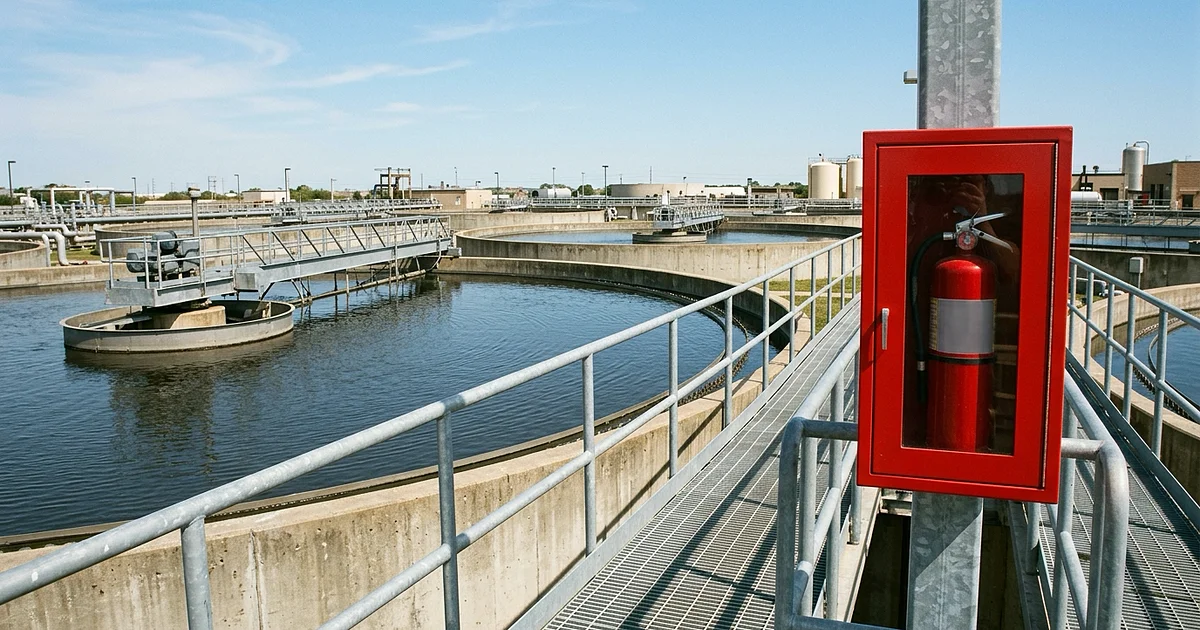
A wastewater treatment plant concentrates fire and explosion hazards most facilities never deal with: digester gas that is mostly methane, hydrogen sulfide collecting in enclosed spaces, a chemical inventory that changes with the process, and pump galleries and control rooms full of energized equipment. The extinguishers themselves are the easy part. What trips up operators is knowing which spaces are classified hazardous locations, which rules stack on top of each other, and who actually enforces them at a municipal plant.
This guide is written for plant operators, city public works and utility staff, and contract O&M firms. We start with the three layers of code that put extinguishers in a plant, translate NFPA 820's hazardous-area classification into plain English, walk each process area, then cover the H2S and confined-space overlay, chemical storage, cabinets for a corrosive environment, the service calendar, and the Buy America procurement angle for federally funded upgrades.
The one-paragraph version: NFPA 820 (2024) decides which spaces at a plant are hazardous locations and which fire-protection measures each process area needs; the adopted fire code and NFPA 10 set extinguisher placement; OSHA 1910.157 governs access, service, and training. Put ABC dry chemical through the general facility, CO2 or clean agent in electrical and control rooms, protect outdoor and corrosion-exposed units with cabinets, pair the fire program with continuous H2S monitoring, and keep everything on the NFPA 10 service cycle. Your authority having jurisdiction has the final say on count, ratings, and placement.
Which Codes Apply
Three layers put portable extinguishers in a treatment plant: OSHA 29 CFR 1910.157 for worker access and the service cycle, the adopted fire code (IFC Section 906, which points to NFPA 10 for selection and placement), and NFPA 820, which decides which fire-protection measures each wastewater process area needs.
| Layer | What it covers | Where to go deeper |
|---|---|---|
| OSHA 29 CFR 1910.157 | Extinguishers provided for employee use: mounted, located, and identified so they are readily accessible; kept fully charged; travel distance of 75 ft or less for Class A hazards and 50 ft or less for Class B, measured along the walking path; monthly and annual checks; training at assignment and at least annually | OSHA 1910.157 |
| IFC Section 906 + NFPA 10 | The adopted fire code requires portable extinguishers in the occupancy groups plant process and utility buildings fall under, selected, installed, inspected, and maintained per NFPA 10 (current edition 2026) | NFPA 10 |
| NFPA 820 (2024) | The wastewater-specific standard: hazard classification of specific locations and processes, ventilation tied to that classification, and which fire-protection measures — alarms, combustible-gas detection, hydrants, suppression, and portable extinguishers — each space needs | NFPA 820 |
NFPA 820, the Standard for Fire Protection in Wastewater Treatment and Collection Facilities, is the anchor. It sets minimum requirements to prevent fires and explosions across sewage treatment plants, pump stations, and collection systems. The 2024 edition added reference material for process hazard analysis, new tables clarifying classified areas and ventilation, and new requirements for risk assessments, fire inspections, system testing, and fire brigade operations. It is enforced where the local jurisdiction adopts it, and it is routinely applied by design engineers, insurers, and fire marshals as the recognized standard of care for wastewater facilities either way.
The municipal-OSHA nuance: federal OSHA does not cover state and local government employees — which includes most municipal plant staff. Public-sector workers have OSH Act protections only in states with OSHA-approved State Plans: 22 plans cover both private and state/local government workers, and 7 more cover state and local government workers only. Whether OSHA rules legally bind your plant depends on your state's plan — but nearly every utility adopts 1910.157 and 1910.146 as its safety baseline anyway, and private contract operators are always covered.
Hazardous Area Classification in Plain English
The flammable-gas hazard at a treatment plant is a Class I hazard — flammable gases and vapors — under Article 500 of the National Electrical Code (NFPA 70). The gases of concern are methane and hydrogen sulfide, and classified wastewater spaces are typically Group D. Division 1 means the gas is expected to be present under normal operating conditions; Division 2 means it shows up only under abnormal conditions, such as a rupture or equipment failure.
The two standards split the work: NFPA 820 assigns the classification — which spaces are Class I Division 1, Division 2, or unclassified, given the process and the ventilation provided — and the NEC then governs what electrical equipment is allowed there. Ventilation is the lever. The same space can carry a different classification depending on the air changes per hour it maintains: an enclosed, unventilated headworks space is typically Class I, Division 1, Group D, while continuous ventilation at 12 air changes per hour can reduce it to Division 2. Physical separation of hazardous from non-hazardous areas is an allowed control alongside ventilation.
In practice: spaces like headworks, screening rooms, wet wells, sludge-handling areas, and digester gas piping galleries are typically treated as Class I, Division 1 or Division 2, Group D hazardous locations — the exact designation depends on the process and the ventilation rate the facility maintains. Labs, control rooms, and electrical rooms are generally kept unclassified by separation and ventilation. The classification study itself is consulting-engineer work; for how classified areas are documented and what the NEC framework means for equipment, see the NFPA 497 reference.
Why digester gas drives all of this: digester gas is typically 50–70% methane — the same fuel as natural gas — along with carbon dioxide, hydrogen sulfide, and water vapor. Methane becomes ignitable at just 5% concentration in air, and it is lighter than air, so it collects at ceilings and high points of enclosed spaces. That is why NFPA 820 treats digester complexes and gas-handling areas as Class I hazardous locations.
Do not let the ventilation quietly fail. If a space is rated Division 2 or unclassified because of continuous ventilation, that classification depends on the fans actually running. The 2024 edition of NFPA 820 revised its ventilation-monitoring and quarterly testing requirements for exactly this reason — treat ventilation as fire-protection equipment, not just HVAC.
Extinguishers by Process Area
The code sets where extinguishers go and the minimum ratings; which agent you put in each spot is a selection decision. The recommendations below are ours, based on what each part of a plant is most likely to burn — they are guidance, not code text, and your AHJ sets the final count and placement.
| Process area | Primary fire hazard | Extinguisher approach |
|---|---|---|
| Headworks & wet wells | Methane and H2S accumulating in enclosed, often classified spaces | ABC dry chemical at entrances and in the adjacent unclassified areas; gas detection and ventilation carry the atmosphere hazard |
| Digester & gas handling | Digester gas piping, compressors, and gas-train equipment | ABC dry chemical placed per the adopted code around the complex; which fixed measures apply is an NFPA 820 design question |
| Pump galleries | Pumps, motors, lubricants, and energized electrical | CO2 or clean agent for the electrical side; ABC for the general gallery |
| Electrical & control rooms (MCC, VFD, SCADA) | Energized equipment and sensitive electronics | CO2 or clean agent — non-conductive and residue-free, so a discharge does not take out the switchgear it protects |
| Laboratories | Reagents, small flammable-liquid inventory, benchtop electrical | CO2 or clean agent at the bench; ABC nearby for the room |
| Chemical storage & delivery | Varies by plant — disinfection chemicals, coagulants, polymers, and any flammable-liquid inventory | ABC where a Class B hazard exists; spill control and containment alongside (see the chemical section below) |
Multipurpose ABC dry chemical is the workhorse for the general facility — it covers ordinary combustibles, flammable liquids, and energized electrical, which is the mix most plant locations see. Remember the OSHA travel-distance frame when laying units out: 75 feet or less to a Class A hazard, 50 feet or less to a Class B hazard, measured along the path someone actually walks, not through walls.
Electrical rooms, MCCs, and pump galleries: CO2 and clean agent
A dry-chemical discharge in an MCC or SCADA room means corrosive powder across every energized cabinet in it. CO2 has long been the standard choice for electrical hazards, and clean agents suit sensitive or occupied electronics spaces — both are non-conductive and leave nothing to clean up. Note that CO2 portables carry a B:C rating only, so they supplement rather than replace the ABC units covering the surrounding areas.
CO2 and clean-agent units for electrical and pump rooms
Non-conductive, residue-free protection for MCCs, VFDs, SCADA panels, and pump-gallery electrical. Made in the USA options.


Do not treat a portable as gas-atmosphere protection. A hand extinguisher is for a small, incipient, reachable fire. A flammable atmosphere in a wet well or digester gallery is a ventilation, gas-detection, and evacuation problem — no portable extinguisher count substitutes for the engineered measures NFPA 820 assigns to those spaces.
H2S and Confined Spaces
Hydrogen sulfide sits alongside the fire program because it is both toxic and flammable — its lower explosive limit is 4% in air. OSHA's general-industry limit is a 20 ppm ceiling with a 50 ppm maximum peak for up to 10 minutes, NIOSH recommends a 10 ppm ceiling, and 100 ppm is immediately dangerous to life and health. The rotten-egg odor is not a safeguard: per NIOSH, the sense of smell becomes rapidly fatigued and cannot be relied upon to warn of the continuous presence of H2S. Wastewater exposure is also dominated by sharp peaks — a spike can far exceed ceiling values even when the average looks fine.
The operating rule: H2S kills the sense of smell before it kills the worker — continuous gas monitoring, not odor, is the only reliable warning at a treatment plant. A personal single-gas monitor such as the MSA ALTAIR H2S single-gas detector belongs on every operator working headworks, wet wells, and collection systems. Our H2S gas detection guide covers monitor selection, alarm setpoints, and calibration.
The confined-space overlay is OSHA 29 CFR 1910.146, permit-required confined spaces — and its Appendix E is specifically about sewer system entry. OSHA singles sewers out because the space usually cannot be isolated, the atmosphere can suddenly and unpredictably become lethally hazardous, and entries are frequent. The parts that touch a plant's daily routine:
- Test in a mandatory order: oxygen first, then combustible gases and vapors, then toxic gases and vapors. The hazardous-atmosphere thresholds that matter at a plant: flammable gas above 10% of its lower flammable limit, and oxygen below 19.5%.
- An attendant stays outside. At least one attendant must be stationed outside the permit space for the duration of entry operations.
- Continuous monitoring for sewer-type entries. Where a continuous system like a sewer cannot be isolated, pre-entry testing to the extent feasible plus continuous atmospheric monitoring during the entry is required.
The full permit-space program — permits, rescue, training, reclassification — is covered on our OSHA 1910.146 reference.
Chemical Storage and Spill Response
Chemical inventory varies plant to plant — disinfection chemicals, coagulants, polymers, and lab reagents are the usual mix — so the storage rules that apply depend on what you actually keep on site. If your plant stores flammable or combustible liquids (solvents, fuels for standby equipment, certain lab stock), storage falls under NFPA 30 and belongs in listed flammable-storage cabinets and safety cans — our flammable storage cabinet selection guide covers sizing and placement.
On the spill side, plants with substantial oil storage — standby generators, fuel tanks, lubricants — may have SPCC obligations under EPA's 40 CFR 112, and every chemical delivery pad and drum-storage area wants a stocked spill kit within reach. For berms, pallets, and drum containment, see the secondary containment selection guide.
Spill Kits for Chemical Deliveries & Process Areas

Manufacturer: Brady SPC
Brady SPC 30 Gallon Universal Spill Kit
$317.00

Manufacturer: Brady SPC
Brady SPC ALLWIK Universal Portable Spill Kit 6.5 Gallon Bucket
$69.00

Manufacturer: Brady SPC
Brady SPC Drum Spill Kit 20 Gallon Universal
$322.00

Manufacturer: Brady SPC
Brady SPC Drum Spill Kit Universal 41 gal Absorbency
$569.00

Manufacturer: Brady SPC
Brady SPC Universal Spill Kit 15 gal
$104.00

Manufacturer: Spilfyter
Spilfyter Oil Only 20 Gallon Overpack Spill Kit
$247.00
Cabinets for a Corrosive Environment
A treatment plant is a hard place to keep an extinguisher serviceable. H2S-laden, humid air works on cylinders, valves, and gauges; outdoor units add UV and weather on top. OSHA requires extinguishers to be mounted, located, and identified so they are readily accessible, and kept fully charged and operable — a corroded unit at the annual service is a failed unit. Cabinets and covers are the practical answer for outdoor stations, process areas, and washdown zones: they keep units visible and reachable while shielding them from the environment.
How to choose between surface-mount, recessed, and outdoor-rated cabinets — and the mounting-height rules that go with them — is covered in the cabinet selection guide and the mounting and placement requirements.
Extinguisher Cabinets for Outdoor & Process Areas

Manufacturer: JL Industries
Cato Chief Plastic Fire Extinguisher Cabinet 10 lb
$47.00

Manufacturer: JL Industries
Cato Chief Plastic Fire Extinguisher Cabinet 20 lb
$89.00

Manufacturer: JL Industries
Cato Chief Plastic Fire Extinguisher Cabinet 5 lb
$42.00

Manufacturer: JL Industries
Cato Island Chief MRI Safe Plastic Fire Extinguisher Cabinet 10 lb
$49.00

Manufacturer: JL Industries
Cato Island Chief MRI Safe Plastic Fire Extinguisher Cabinet 5 lb
$44.00

Manufacturer: JL Industries
Cato Warrior Plastic Outdoor Fire Extinguisher Cabinet 10 lb Red 95151
$44.00

Manufacturer: JL Industries
Cato Warrior Plastic Outdoor Fire Extinguisher Cabinet 5 lb Red 95551
$39.00

Manufacturer: JL Industries
JL Industries Academy Aluminum Recessed Locking Fire Extinguisher Cabinet 10 lb 1025W10
$243.00
$335.00
First Aid and Eyewash
OSHA 29 CFR 1910.151 covers medical services and first aid, and its paragraph (c) requires suitable facilities for quick drenching or flushing of the eyes and body where the eyes or body may be exposed to injurious corrosive materials. Whether that clause is triggered depends on your plant's chemical handling — chlorine-based disinfectants, ferric coagulants, and lab reagents are the common corrosive exposures — and ANSI Z358.1 is the design standard eyewash and drench equipment is built to. First-aid supplies follow the ANSI/ISEA Z308.1 baseline.
Eyewash Stations in Stock

Manufacturer: First Aid Only
First Aid Only Eyewash Station Single 32 oz. Screw Cap Bottle
$27.00

Manufacturer: First Aid Only
First Aid Only Eyewash Stations, Two 32 oz. Screw Cap Bottle
$74.00

Manufacturer: Justrite
Justrite 16 Gallon Portable Self-Contained Hughes Eyewash Station, Gravity-Fed - 16GFEW
$454.00

Manufacturer: First Aid Only
First Aid Only Eyewash Station, Double 16 oz. Screw Cap Bottle
$39.00
The NFPA 10 Service Cycle
Plant extinguishers are a recurring line item, not a one-time purchase. OSHA 1910.157 and NFPA 10 set the maintenance calendar, and a plant that budgets for it avoids both the compliance gap and the scramble of an unplanned replacement run:
| Interval | What happens |
|---|---|
| Monthly | Visual inspection: pressure gauge in the green where fitted (CO2 units have none), seal intact, no physical damage or corrosion |
| Annually | Professional maintenance by a certified technician, with an updated service tag; OSHA also requires extinguisher training at assignment and at least annually |
| Every 6 years | Internal examination of rechargeable stored-pressure dry chemical extinguishers |
| Every 5 years | Hydrostatic test for CO2, water, and AFFF units |
| Every 12 years | Hydrostatic test for dry-chemical units |
| At 12 years | Non-rechargeable (disposable) extinguishers are removed from service |
Any extinguisher that has been used, even briefly, must be recharged before it goes back into service, and maintenance records are retained. A treatment plant's corrosive, humid environment means closer scrutiny at the annual service and the occasional unit condemned early — budget for a rolling replacement. The full inspection and maintenance detail is on our NFPA 10 reference.
Buy America and Municipal Procurement
If your plant upgrade is SRF- or IIJA-funded, Build America, Buy America domestic-content rules apply to the project. BABA, part of the Infrastructure Investment and Jobs Act signed in November 2021, requires federally assisted infrastructure projects to use iron, steel, manufactured products, and construction materials produced in the United States. Water infrastructure was already under American Iron and Steel (AIS) requirements for Clean Water and Drinking Water SRF projects; BABA expands on AIS, and a project is subject to one or the other, not both. EPA waivers exist for small projects (total cost under $250,000) and de minimis items (covered products under 5% of project cost).
Whether a given piece of safety equipment is covered on a given project is a project-level determination — but specifying US-made equipment keeps procurement simple either way: no waiver paperwork, no origin questions. The full picture is in our Buy America compliance guide, with deeper references on BABA and American Iron and Steel.
Outfitting a Whole Plant
A treatment plant rarely buys one extinguisher. Bringing a plant up to code, standardizing units across process buildings and lift stations, or covering a whole collection system on one order is a multi-unit purchase — and municipal procurement usually wants a written quote with spec sheets before a PO moves. That is where buying in volume pays off, both on price and on consistency, and we confirm delivered pricing in the quote rather than guessing it at checkout.
Outfitting or re-equipping a treatment plant?
Volume pricing on ABC, CO2, and clean-agent extinguishers, cabinets, eyewash stations, and spill kits for plants, lift stations, and collection systems, with spec sheets for your fire marshal, engineer, or procurement office. Quotes back within one business day.
or call 714-248-6555 · email partners@usmadesupply.com
Frequently Asked Questions
What fire code applies to a wastewater treatment plant?
NFPA 820, the Standard for Fire Protection in Wastewater Treatment and Collection Facilities (current edition 2024), sets the fire- and explosion-prevention requirements for treatment plants, pump stations, and collection systems, including the hazard classification of specific locations and processes. It applies alongside the locally adopted fire code — the International Fire Code requires portable extinguishers selected and placed per NFPA 10 — and OSHA 29 CFR 1910.157 governs extinguishers provided for employee use. Your authority having jurisdiction has the final say on count, ratings, and placement.
What is a Class I Division 1 area at a treatment plant?
A location where flammable gas — at a treatment plant, methane and hydrogen sulfide — is expected to be present under normal operating conditions. Division 2 means the gas appears only under abnormal conditions. NFPA 820 assigns the classification based on the process and the ventilation rate, and NFPA 70 (the NEC) then governs what electrical equipment is allowed there. The same space can be Division 1, Division 2, or unclassified depending on ventilation: an enclosed, unventilated headworks space is typically Class I, Division 1, Group D, while continuous ventilation at 12 air changes per hour can reduce it to Division 2.
Does OSHA apply to municipal wastewater plant operators?
Federal OSHA does not cover state and local government employees, which includes most municipal plant staff. Public-sector workers have OSH Act protections in states with OSHA-approved State Plans: 22 plans cover both private and state/local government workers, and 7 more cover state and local government workers only. Private contract O&M operators are always covered. In practice, nearly every utility adopts 1910.157 and 1910.146 as its safety baseline regardless of coverage.
What extinguisher should go in an electrical or SCADA room?
CO2 and clean-agent extinguishers are the common engineering choice around MCCs, VFDs, SCADA panels, and control-room electronics: they are non-conductive and leave no residue, where a dry-chemical discharge means cleanup across every energized cabinet in the room. That is selection guidance rather than a code mandate — the adopted code sets minimum ratings and travel distances, and your AHJ has the final say. Note that CO2 portables carry a B:C rating only.
Why can't you rely on smell to detect H2S?
Hydrogen sulfide has a strong rotten-egg odor at low concentrations, but per NIOSH the sense of smell becomes rapidly fatigued and cannot be relied upon to warn of its continuous presence. OSHA's general-industry limit is a 20 ppm ceiling with a 50 ppm maximum peak for up to 10 minutes, NIOSH recommends a 10 ppm ceiling, and 100 ppm is immediately dangerous to life and health. Continuous gas monitoring, not odor, is the only reliable warning at a treatment plant.
How often do plant extinguishers need service?
On the standard OSHA 1910.157 / NFPA 10 cycle: a monthly visual inspection, annual maintenance by a certified technician, and hydrostatic testing at intervals that vary by extinguisher type (5 to 12 years). Any used extinguisher is recharged before going back into service, and employees expected to use extinguishers need training at assignment and at least annually. A plant's corrosive, humid environment tends to condemn some units early, so budget for a rolling replacement.
Do Buy America rules require US-made fire extinguishers?
Not as a blanket rule. Build America, Buy America domestic-content requirements apply to federally assisted infrastructure projects — including SRF-funded water and wastewater work — and whether a given product on a given project is covered is a project-level determination, with EPA waivers for small projects (under $250,000 total cost) and de minimis items (under 5% of project cost). Specifying US-made safety equipment keeps procurement simple either way: no waiver paperwork and no origin questions.
Wastewater Facility Extinguishers in Stock

Manufacturer: Buckeye
10 lb
UL 4-A:60-B:C
Buckeye 10 lb Short ABC Fire Extinguisher, Wall Hook, UL Listed 4-A:60-B:C, Part 11310
$128.00

Manufacturer: Buckeye
30 lb
UL 10-A:160-B:C
Buckeye 30 lb ABC Fire Extinguisher, Wall Hook, UL Listed 10-A:160-B:C, Part 12905
$539.00

Manufacturer: Buckeye
2.5 lb
UL 10-B:C
Buckeye ABC Dry Chemical Fire Extinguisher w/ Vehicle Bracket – 2.5 lb.
$44.00
4+ for $39 each

Manufacturer: Buckeye
5 lb
UL 3-A:40-B:C
Buckeye ABC Dry Chemical Fire Extinguisher w/ Vehicle Bracket – 5 lb.
$54.00
4+ for $49 each

Manufacturer: Buckeye
10 lb
UL 4-A:80-B:C
Buckeye ABC Dry Chemical Fire Extinguisher w/ Wall Hook – 10 lb.
$90.00
$106.00

Manufacturer: Buckeye
20 lb
UL 10-A:120-B:C
Buckeye ABC Dry Chemical Fire Extinguisher w/ Wall Hook – 20 lb.
$155.00
$167.00

Manufacturer: Buckeye
5 lb
UL 3-A:40-B:C
Buckeye ABC Dry Chemical Fire Extinguisher w/ Wall Hook – 5 lb.
$56.00
4+ for $51 each
Was this page helpful?
Your feedback helps us improve our technical resources.

Recommended in this guide
Buckeye 10 lb CO2 Fire Extinguisher