
Fire Extinguishers for Biogas & RNG Facilities
A dairy digester, a landfill-gas plant, and a wastewater digester answer to different fire codes. Which code path applies to your site, how hazardous-area classification works around the gas train, which extinguishers belong at each area — and the gas-fire rule every operating crew needs to know
Overview
Biogas is a growth industry building on a fire-code patchwork. According to the American Biogas Council, the U.S. reached roughly 2,500 operating biogas facilities in 2024 — 125 new projects and more than $3 billion invested in that year alone — and the industry is only about 10 percent built out. On the farm side, EPA AgSTAR counted 191 manure-based digesters producing renewable natural gas as of June 2024, with 69 more under construction. Every one of those sites has to answer the same question at permitting and again at every fire-marshal visit: which fire code actually governs this plant, and what does it require on the ground?
The physics are what make biogas sites different from most fuel facilities. Methane, the combustible fraction of biogas and RNG, is lighter than air (vapor density about 0.55), so a leak rises and collects under roofs, at high points, and in the top of enclosed spaces — the opposite of propane, which is heavier than air and pools at floor level. Methane is flammable in air between roughly 5 and 15 percent by volume, a range that widens with temperature. And raw biogas carries hydrogen sulfide, a toxic, corrosive gas with its own monitoring story. Those three facts drive where gas detectors mount, how areas around the gas train are classified, and what your extinguisher lineup is actually for.
This guide walks the four code paths a biogas or RNG project can fall under, then covers hazardous-area classification, the gas-fire rule, extinguisher selection by area, flammable storage, hot work, H2S, and the NFPA 10 service cycle that keeps it all inspectable.
The one-paragraph version: the code path depends on the facility type — wastewater digesters follow NFPA 820; farm, landfill, and food-waste digesters follow the state-adopted fire code plus the NEC's hazardous-location rules; an on-site vehicle-fueling island follows NFPA 52. Around the gas train, the first response to a gas fire is shutting off the fuel, never extinguishing a flowing flame. Portable Class B units cover incipient and electrical fires, wheeled units cover the large open pads, and everything gets serviced on the NFPA 10 schedule. Your authority having jurisdiction — usually the local fire marshal — has the final say.
The Four Code Paths
Biogas and RNG facilities are regulated through a stack of overlapping standards — the applicable set depends on whether the site is a wastewater plant, a farm digester, a landfill, or a fueling operation, and on which piece of equipment is involved. Conflating the paths is the most common compliance mistake in this industry, so start by finding your row:
| Facility path | Primary fire / gas standards | Notes |
|---|---|---|
| Municipal WWTP digester | NFPA 820 + NEC hazardous-location rules | The only path NFPA 820 directly governs |
| Farm / dairy manure digester | State-adopted IFC flammable-gas provisions + NEC / NFPA 497 + state fire marshal | Heavily state-dependent; EPA AgSTAR guidance is the reference |
| Landfill-gas (LFG) plant | IFC flammable-gas provisions + NEC / NFPA 497 | Treated as a combustible-gas process installation, not a WWTP |
| Food-waste (stand-alone) digester | Same stack as farm digesters (IFC + NEC + state) | NFPA 820 only if co-located at a WWTP |
| On-site CNG / LNG vehicle fueling | NFPA 52 (2026 edition) | Governs the fueling equipment, separate from the digester |
| On-site liquefaction to LNG | NFPA 59A (2023 edition) | Only if the project actually produces LNG |
NFPA 820 is written specifically for wastewater treatment and collection facilities — it classifies the digester gas headspace, gas piping, and surrounding spaces using the NEC's Class I / Division framework, and it is the standard a municipal digester project will be reviewed against. Farm digesters, landfill-gas plants, and standalone food-waste digesters are not automatically covered by NFPA 820; they are regulated through the state-adopted International Fire Code's flammable-gas provisions, the National Electrical Code's hazardous-location rules, and state fire-marshal requirements, though many engineers apply NFPA 820's classification methods by analogy. Requirements vary significantly by state — confirm the adopted code and edition with your local AHJ rather than assuming.
On-site RNG vehicle fueling: NFPA 52
If the project includes an on-site CNG or LNG vehicle-fueling island — a common configuration for dairy RNG serving a milk-truck or refuse fleet — that fueling equipment is governed by NFPA 52, the Vehicular Natural Gas Fuel Systems Code (2026 edition), separate from the digester itself. RNG dispensed as vehicle fuel uses the same CNG/LNG infrastructure the code was written for. And the trucks that fuel there carry their own extinguisher obligations: our DOT fleet compliance guide and the DOT fire extinguisher requirements for commercial vehicles cover the vehicle side.
One more path for completeness: NFPA 59A governs on-site LNG liquefaction and storage. It applies only to biogas projects that actually produce liquefied natural gas — most dairy and landfill RNG projects inject to pipeline or make CNG, so it frequently does not apply — and it expressly excludes LNG vehicle fueling, which stays under NFPA 52.
Hazardous-Area Classification Around the Gas Train
Whichever code path applies, every biogas site shares one engineering exercise: classifying the areas where methane can be present so the electrical equipment in them is rated for it. The framework is the NEC's — see our NFPA 70 hazardous locations reference — with NFPA 497 providing the classification methodology for gas and vapor areas. Class I covers flammable gases and vapors; Division 1 means the hazard is present in normal operation, and Division 2 means it appears only under abnormal conditions such as a rupture or equipment failure. Adequate continuous mechanical ventilation can reduce a classification.
On a biogas site, the classified areas typically include the digester gas dome and headspace, gas piping and condensate or drip legs, the gas-upgrading or conditioning skid, compressors and blowers, gas holders, and the flare knock-out area. Electrical equipment inside those boundaries — motors, lighting, instrumentation, switches — must be rated for the classification, such as explosion-proof enclosures, per the NEC. Fixed methane detection is standard in and around these areas; per NFPA 820 practice, methane detectors are commonly set to alarm at 10 percent of the LEL, though the exact setpoint should be verified against the adopted edition and your design documents.
Where a piece of equipment can contain an explosive gas atmosphere internally, engineers also apply NFPA 68 (deflagration venting) and NFPA 69 (explosion prevention — gas detection, inerting, flame arrestors, and isolation) as part of the protection strategy. These are method standards invoked equipment by equipment, not a facility-wide biogas mandate.
Detector mounting follows the gas: methane rises, so combustible-gas detectors for biogas mount high — under roofs, at ceiling level, at the top of enclosures. H2S is heavier than air and settles low, so H2S sensors mount near the floor and in low spots. A detector at the wrong height can miss the leak entirely.
The Gas-Fire Rule: Shut Off the Fuel First
Methane fires are Class B fires — the U.S. fire-class scheme puts flammable gases with flammable liquids. But a burning gas leak is not handled like a liquid fire, and getting this wrong is the most dangerous mistake a crew can make at a biogas plant.
Never extinguish a flowing gas fire. The first response to a burning gas leak is to shut off the fuel supply. Putting the flame out while gas still flows creates an unignited explosive cloud that can find a remote ignition source and detonate — often far worse than the original fire. Firefighters generally let a controlled gas flame burn and protect the surrounding equipment until the gas is isolated.
That doctrine defines what portable extinguishers are actually for at a biogas site: small incipient fires before they involve the gas train, energized electrical equipment in control rooms and compressor buildings, and protecting exposures — the equipment and materials near a fire — while the gas is shut off. They are a supplement to fuel shutoff, fixed gas detection, and emergency shutdown, never a substitute. Train the crew on the shutoff sequence first and the extinguisher second.
Matching Extinguishers to Each Area
The adopted fire code and NFPA 10 set the minimum ratings and travel distances — extra-hazard Class B areas call for a 40-B unit within 30 feet of travel or an 80-B unit within 50 feet, and the full sizing table is in our Class B fire extinguisher guide. Which agent goes where is a selection decision; the recommendations below are ours, based on what each area of a biogas plant is most likely to burn. Your AHJ sets the final count, ratings, and placement.
| Area | Primary fire risk | Suggested coverage |
|---|---|---|
| Digester pad & gas dome perimeter | Incipient gas-train fires, mixed equipment | Dry-chemical Class B units at the pad; wheeled unit for a large pad |
| Gas upgrading / conditioning skid | Gas handling, lube oil, instrumentation | Dry-chemical Class B at the skid perimeter, outside classified areas |
| Compressor & blower buildings | Energized electrical, lube oil, gas piping | Dry chemical plus CO2 for panels and motors |
| Flare area | A permanent ignition source; grass and exposure fires | Dry-chemical Class B on the approach, clear of the exclusion zone |
| Control rooms & electrical / MCC rooms | Energized electrical, electronics | CO2 — residue-free and non-conductive |
| Pipeline interconnect / fueling island | Gas dispensing and metering equipment | High-rated Class B dry chemical; count and rating per NFPA 52 review |
Wheeled units for large pads and gas trains
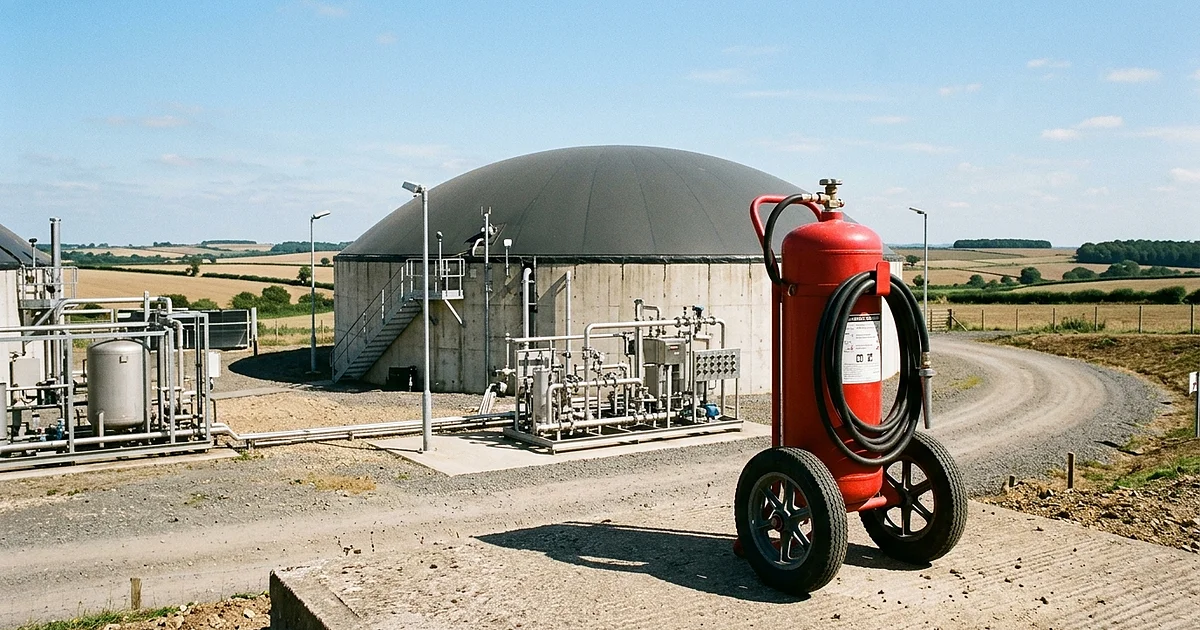
A digester pad, upgrading yard, or flare approach is a big, open footprint where the nearest handheld can be a long run away and 10 or 20 pounds of agent may not match the hazard. That is the wheeled-extinguisher use case: 50 pounds or more of agent on a cart that one person can roll to the fire. Purple K is the dry chemical of choice for fast Class B knockdown on a fuel fire; ABC covers the mixed-fuel reality of a working pad; CO2 is the residue-free option where switchgear and instrumentation are in play. Larger 65 and 150 lb Halotron wheeled units are also available for electronics-sensitive areas — see the full wheeled extinguisher collection.
Wheeled units for digester pads and gas trains
High-capacity ABC, CO2, and Purple K on a cart, for the large open areas a handheld can't cover. Made in the USA.

150 lb
UL 10-A:120-B:C
Manufacturer: Buckeye
Buckeye 150 lb Halotron Wheeled Fire Extinguisher
$16,469.00

125 lb
UL 320-B:C
Manufacturer: Buckeye
Buckeye 125 lb Purple K Wheeled Fire Extinguisher 320-B:C
$3,154.00

65 lb
UL 4-A:60-B:C
Manufacturer: Buckeye
Buckeye 65 lb Halotron Wheeled Fire Extinguisher
$8,917.00
Flammable Storage and Fuel Handling
The gas is not the only fuel on a biogas site. Diesel for gensets and loaders, lube and hydraulic oil for compressors and pumps, solvents and paints in the maintenance shop — all of it falls under NFPA 30 and OSHA 1910.106, which govern how flammable and combustible liquids are stored and handled. In practice that means listed safety cans for small quantities and rated flammable-storage cabinets for the shop and skid areas — including outdoor-rated cabinets for equipment yards. Keeping the liquid fuels contained also keeps them out of your hazardous-area calculations. Our flammable storage cabinet selection guide covers sizing and placement.
Flammable Storage Cabinets in Stock

Manufacturer: Justrite
Justrite 30 Gallon, 1 Shelf, Self Close Doors, Outdoor Flammable Storage Cabinet, Yellow - 813020
$2,085.00

Manufacturer: Justrite
Justrite 45 Gallon, 2 Shelves, 2 Doors, Self Close, Flammable Cabinet, Sure-Grip® EX, Yellow - 894520
$1,873.00

Manufacturer: Justrite
Justrite 45 Gallon, 2 Shelves, Self Close Doors, Outdoor Flammable Storage Cabinet, Yellow - 814520
$2,517.00

Manufacturer: Justrite
Justrite 90 Gallon, 2 Shelves, 2 Doors, Manual Close, Flammable Cabinet, Sure-Grip® EX, Yellow - 899000
$2,252.00
Hot Work and Non-Sparking Tools
Welding, cutting, and grinding near a gas train is the highest-stakes routine task on a biogas site, and the controls are the standard hot-work program done strictly:
- Permit and gas-test before the work. Isolate and purge the equipment, test the atmosphere with a combustible-gas meter, and issue the hot-work permit only when the work area is verified gas-free.
- A fire watch with an extinguisher at hand. Under NFPA 51B, hot work needs a trained fire watch during the work and for at least one hour after it is finished, equipped with an appropriate portable extinguisher on the spot.
- Confined-space procedures for digester entry. EPA AgSTAR and extension safety guidance cite OSHA 29 CFR 1910.146 permit-required confined-space entry for digester access, along with flame arrestors in gas piping and continuous gas monitoring as standard practice.
For the maintenance that happens near classified areas without a torch — opening flanges, scraping, chipping, driving pins — non-sparking, non-magnetic hand tools remove one more ignition source from the equation. They are a complement to gas testing and permits, not a license to skip them.


H2S Awareness
Raw biogas contains hydrogen sulfide — a toxic, flammable, heavier-than-air gas with the smell of rotten eggs at low concentrations. Depending on feedstock, raw biogas can carry H2S from a few hundred up to several thousand parts per million. Because H2S deadens the sense of smell at higher levels, odor is not a reliable warning, which is why fixed and personal H2S monitors are standard at digesters, in low spots and pits, and ahead of any confined-space entry. OSHA's general-industry ceiling limit is 20 ppm, and 100 ppm is immediately dangerous to life and health.
H2S is also the corrosion story: it aggressively attacks metal equipment, which is one reason it is scrubbed out during RNG upgrading — and one reason outdoor extinguishers and cabinets near the raw-gas side of the plant deserve a closer look at every annual service. For monitor selection, alarm setpoints, and the exposure-response detail, see our H2S gas detection guide.
The NFPA 10 Service Cycle
Site extinguishers are a recurring line item, not a one-time purchase. NFPA 10 sets the maintenance calendar, and a plant that budgets for it avoids both the compliance gap and the scramble of an unplanned replacement run:
| Interval | What happens |
|---|---|
| Monthly | Visual inspection: pressure gauge in the green where fitted (CO2 units have none), seal intact, no physical damage or corrosion |
| Annually | Professional maintenance by a certified technician, with an updated service tag |
| Every 6 years | Internal examination of rechargeable stored-pressure extinguishers |
| Every 5 years | Hydrostatic test for CO2 and water-based units |
| Every 12 years | Hydrostatic test for dry-chemical units |
| At 12 years | Non-rechargeable (disposable) extinguishers are removed from service |
Any extinguisher that has been used, even a short burst, must be recharged before it goes back into service. And a biogas plant is a harder environment than an office building — outdoor exposure plus H2S accelerate corrosion of cylinders, valves, and seals, so expect closer scrutiny at the annual service and budget for the occasional unit condemned early. The full inspection and maintenance detail is in our NFPA 10 reference.
Outfitting a Biogas or RNG Site
A digester project rarely buys one extinguisher. Commissioning a new plant, standardizing units across a portfolio of dairies, or bringing an operating site up to the fire marshal's punch list is a multi-unit order across the pad, the skid, the compressor building, and the shop — often with wheeled units and cabinets in the mix. Buying it in one order pays off on price and on consistency, and we confirm delivered pricing in the quote rather than guessing it at checkout.
Outfitting a digester, upgrading skid, or RNG site?
Volume pricing on ABC, Purple K, CO2, and wheeled extinguishers plus flammable-storage cabinets for digester pads, gas trains, and compressor buildings, with spec sheets for your fire marshal or insurer. Quotes back within one business day.
or call 714-248-6555 · email partners@usmadesupply.com
Frequently Asked Questions
What fire code applies to a biogas or RNG facility?
It depends on the facility path. Municipal wastewater digesters fall under NFPA 820, the wastewater fire-protection standard. Farm, landfill-gas, and standalone food-waste digesters are regulated through the state-adopted International Fire Code, the National Electrical Code's hazardous-location rules, and state fire-marshal requirements. An on-site CNG or LNG vehicle-fueling island falls under NFPA 52, and on-site liquefaction falls under NFPA 59A. Confirm the adopted code and edition with your authority having jurisdiction.
What class of fire is a methane or biogas fire?
Class B — the U.S. fire-class scheme puts flammable gases with flammable liquids. But the first response to a burning gas leak is shutting off the fuel supply, not extinguishing the flame: a gas fire put out while gas still flows can re-ignite as an explosive cloud. Portable Class B extinguishers (dry chemical or CO2) are for small incipient fires, energized electrical equipment, and protecting exposures — a supplement to fuel shutoff, never a substitute.
Does NFPA 820 apply to farm and landfill digesters?
Not automatically. NFPA 820 is written specifically for wastewater treatment and collection facilities. Farm digesters, landfill-gas plants, and standalone food-waste digesters are regulated through the adopted International Fire Code, the NEC's hazardous-location rules, and state fire-marshal requirements — though many engineers apply NFPA 820's classification methods by analogy. Confirm the applicable path with your AHJ.
Do I need explosion-proof equipment around a digester?
Electrical equipment near digester gas domes, upgrading skids, compressors, and flares typically sits in a hazardous (classified) location — Class I, Division 1 or 2 under the NEC — and must be rated for that classification, such as explosion-proof enclosures. The boundaries come from an area-classification study using NFPA 497 methods (or NFPA 820 at a wastewater plant), and adequate ventilation can reduce a classification. Your electrical engineer and AHJ set the final drawing.
What extinguishers belong at the digester pad and gas skid?
Class B coverage is the core: dry-chemical units around the gas-handling areas, CO2 where control panels and electronics are involved, and wheeled units where a large open pad needs more agent and reach than a handheld delivers. Count, minimum rating, and placement follow NFPA 10 and the adopted fire code, and the fire marshal has the final say.
Why is hydrogen sulfide a concern at a biogas plant?
Raw biogas contains hydrogen sulfide (H2S), a toxic, flammable, heavier-than-air gas. It deadens the sense of smell, so odor is not a reliable warning. OSHA's general-industry ceiling limit is 20 ppm, and 100 ppm is immediately dangerous to life and health, which is why fixed and personal H2S monitors are standard at digesters, in low spots, and ahead of confined-space entry. H2S also corrodes metal equipment and is scrubbed out during RNG upgrading.
How often do biogas-site extinguishers need service?
On the NFPA 10 schedule: a monthly visual check, annual professional maintenance by a certified technician, a 6-year internal exam for rechargeable stored-pressure units, and a hydrostatic test every 5 years for CO2 units or every 12 years for dry chemical. Any unit that has been used, even briefly, is recharged before it goes back into service. Outdoor exposure and H2S are hard on cylinders and valves, so expect the occasional unit condemned early at annual service.
Biogas & Gas-Train Extinguishers in Stock

Manufacturer: Buckeye
10 lb
UL 10-B:C
Buckeye 10 lb CO2 Fire Extinguisher
$264.00

Manufacturer: Buckeye
10 lb
UL 80-B:C
Buckeye 10 lb Purple K Fire Extinguisher 80-B:C
$165.00

Manufacturer: Buckeye
10 lb
UL 4-A:60-B:C
Buckeye 10 lb Short ABC Fire Extinguisher, Wall Hook, UL Listed 4-A:60-B:C, Part 11310
$128.00

Manufacturer: Buckeye
10 lb
UL 40-B:C
Buckeye 10 lb Standard BC Fire Extinguisher, Wall Hook, UL Listed 40-B:C, Part 11840
$109.00

Manufacturer: Buckeye
11 lb
UL 10-B:C
Buckeye 11 lb Halotron Clean Agent Fire Extinguisher
$1,109.00
$1,205.00
Manufacturer: Buckeye
125 lb
UL 320-B:C
Buckeye 125 lb Purple K Wheeled Fire Extinguisher 320-B:C
$3,154.00

Manufacturer: Buckeye
15 lb
UL 10-B:C
Buckeye 15 lb CO2 Fire Extinguisher
$307.00

Manufacturer: Buckeye
15.5 lb
UL 2-A:10-B:C
Buckeye 15.5 lb Halotron Clean Agent Fire Extinguisher
$1,513.00
$1,625.00
Was this page helpful?
Your feedback helps us improve our technical resources.

Recommended in this guide
Buckeye 10 lb CO2 Fire Extinguisher