
Fire Extinguisher Requirements for Self-Storage Facilities
What a self-storage operator is responsible for: which extinguishers the hallways and drive aisles need under IFC 906 and NFPA 10, how to size and place them for a Group S-1 storage occupancy, and how to outfit a whole facility at once
Last updated: July 23, 2026
Overview
If you own or manage a self-storage facility, the fire extinguishers in the hallways, drive aisles, and rental office are the facility's responsibility. Each tenant locks the contents of their own unit, but the code puts the extinguishers in the common areas the operator controls, and it is the operator who has to place them, mount them, sign them, and keep them serviced. This guide answers the practical questions: what the code requires, how many units you need and how big, where they go by area, and how to outfit a whole property at once.
A self-storage building is a storage occupancy in code terms, which drives both the extinguisher rules and, above a size threshold, the sprinkler rules. We start with who owns the obligation, then walk the facility area by area, and finish with the service calendar and the bulk-buying conversation.
The one-paragraph version: the International Fire Code (IFC §906) requires portable fire extinguishers in storage occupancies, selected and installed per NFPA 10, and the building code classifies a self-service storage facility as a Group S-1 moderate-hazard storage occupancy. Put multipurpose ABC dry-chemical units in the common areas, sized and spaced so no point a person can walk is more than 75 feet from one, keep them conspicuous and unobstructed, and service them on the NFPA 10 schedule. Your authority having jurisdiction — usually the local fire marshal — adopts the code and has the final say on the count, hazard classification, and placement.
Who's Responsible: Operator vs. Tenant
Self-storage has an unusual ownership split. The tenant controls the contents behind a padlocked door, but the operator controls the building and the common areas, and that is where the code puts the extinguishers. Keeping the two straight is the difference between a compliant facility and a surprise at inspection.
| What | Who is responsible | Governing rules |
|---|---|---|
| The building and common areas — interior hallways, drive aisles, elevator lobbies, loading bays, and the rental office | Facility owner / operator | IFC §906 and NFPA 10, under the locally adopted fire code |
| The contents inside a rented unit | The tenant | Lease terms; there is no NFPA 10 mandate for an extinguisher inside each locked tenant unit |
Because tenant units are locked and the operator cannot access them, the code's portable-extinguisher requirement is met in the accessible common areas rather than inside individual units. The extinguishers go where a person walking the corridor or drive aisle can reach one within the travel distance NFPA 10 allows.
Do not push the obligation onto tenants. A facility is not compliant because it tells renters to bring their own extinguisher. The extinguishers required by the code are the facility's, placed in the common areas the operator controls, and they must be kept conspicuous (IFC §906.5) and unobstructed and unobscured from view (IFC §906.6). A padlock over a fire extinguisher, or boxes stacked in front of one, is a common inspection finding.
What the Code Requires
Two codes work together for a self-storage facility. The International Building Code sets the occupancy classification, and the International Fire Code sets the portable-extinguisher requirement, which in turn points to NFPA 10 for the details. It helps to keep their roles straight:
- Self-storage is a Group S-1 storage occupancy. IBC §311.2 classifies moderate-hazard storage as Group S-1 and explicitly lists a self-service storage facility (mini-storage) as an example.
- Extinguishers are required and follow NFPA 10. IFC §906.1 requires portable fire extinguishers in Group S (storage) occupancies, and §906.2 requires them to be selected and installed in accordance with NFPA 10.
- They must be visible and reachable. IFC §906.5 requires extinguishers in a conspicuous location where they are readily accessible; IFC §906.6 requires them kept unobstructed and unobscured from view, with a means to indicate the location where an obstruction cannot be avoided.
- 75-foot maximum travel distance. NFPA 10 allows no more than 75 feet of travel to reach a Class A extinguisher, measured along the actual path a person would walk, not a straight line through walls or locked units.
How many do you actually need? The code does not set a fixed count per unit or per building. The number follows from the layout: the floor area, the 75-foot travel distance, and the hazard classification NFPA 10 assigns to the space. Your authority having jurisdiction adopts the fire code and has the final say on the count, the classification, and where each unit goes.
One more requirement to size for at the building level: a sprinkler trigger, and it can be lower than operators expect. Under IBC/IFC §903.2.9, an automatic sprinkler system is required in a Group S-1 fire area exceeding 12,000 square feet, with additional triggers for aggregate area over 24,000 square feet and for a Group S-1 fire area located more than three stories above grade plane. A separate, much lower trigger keys on how much such stock is stored: §903.2.9.4 requires sprinklers once the area used to store upholstered furniture or mattresses exceeds 2,500 square feet — a threshold self-storage often hits, since tenants routinely store both. The one exception is a one-story facility where every unit opens directly to the exterior (drive-up), which is exempt from the furniture rule but still subject to the general 12,000-square-foot trigger. Some state-amended codes number the furniture rule §903.2.9.3, so treat it as §903.2.9 and its subsections and confirm the adopted numbering with your local AHJ. Sprinklers do not remove the portable-extinguisher requirement — the two systems are separate, and a sprinklered building still needs its NFPA 10 extinguishers.
How Many, How Big: NFPA 10 Class A Sizing
Stored household goods, boxes, furniture, and paper are ordinary combustibles — a Class A hazard — so self-storage is sized on NFPA 10's Class A table. That table ties the minimum extinguisher rating and the maximum floor area a single unit can protect to the hazard level of the space:
| Hazard level | Minimum rating | Max floor area per unit | Max travel distance |
|---|---|---|---|
| Light (low) | 2-A | 3,000 sq ft | 75 ft |
| Ordinary (moderate) | 2-A | 1,500 sq ft | 75 ft |
| Extra (high) | 4-A | 1,000 sq ft | 75 ft |
A single extinguisher can protect no more than 11,250 square feet regardless of its rating, so on a large floor the maximum-area cap and the 75-foot travel distance both drive the count — whichever needs more units wins.
Which hazard level is self-storage? It is commonly treated as ordinary (moderate) hazard, and a widely stocked 2-A:10-B:C multipurpose ABC unit meets the 2-A minimum. But because tenants can store almost anything, some authorities classify all or part of a facility as extra hazard, which raises the minimum to 4-A and tightens the area each unit covers. A useful planning rule of thumb is one unit roughly every 75 feet of walkable corridor, but the code figure is the 75-foot travel maximum, and your AHJ makes the final hazard call.
Matching the Extinguisher to the Storage Area
NFPA 10 sets where extinguishers go and the minimum ratings; which agent you put in each spot is a selection decision. The recommendations below are ours, based on what each part of a self-storage facility is most likely to face.
Interior hallways and drive-up units: ABC dry chemical
The workhorse for a self-storage facility is a multipurpose ABC dry-chemical unit on a wall bracket. Because you never know what is behind a roll-up door — boxes and furniture, but also a motorcycle, a can of paint, or a battery — an ABC unit is the safe general choice: it covers ordinary combustibles (A), flammable liquids (B), and energized electrical equipment (C). A 5 or 10 lb unit is the common size for corridors and drive-up rows.
ABC dry-chemical units for corridors and drive-up rows
Multipurpose A:B:C handhelds on a steel wall bracket for hallways, drive aisles, and unit rows. Made in the USA.

5 lb
UL 3-A:40-B:C
Manufacturer: Buckeye
Buckeye ABC Dry Chemical Fire Extinguisher w/ Wall Hook – 5 lb.
$56.00
4+ for $51 each

10 lb
UL 4-A:60-B:C
Manufacturer: Buckeye
Buckeye 10 lb Short ABC Fire Extinguisher, Wall Hook, UL Listed 4-A:60-B:C, Part 11310
$128.00

20 lb
UL 10-A:120-B:C
Manufacturer: Buckeye
Buckeye ABC Dry Chemical Fire Extinguisher w/ Wall Hook – 20 lb.
$155.00
The rental office and security room: CO2 near electronics
An ABC unit works in the rental office, but where the office holds the security DVR, the access-control server, or other sensitive electronics, a CO2 extinguisher is the clean, residue-free choice: it is non-conductive and leaves nothing to wipe off equipment. Many operators keep an ABC unit for the office floor and add a CO2 unit at the electronics. For the tradeoffs, see our guide to extinguishers for sensitive electronics.
CO2 for the office electronics and security room
Residue-free, non-conductive Class B:C protection for DVRs, servers, and access-control gear.


Boat and RV storage bays
A boat, RV, or vehicle storage bay is still part of the Group S-1 storage facility, sized and placed on the same NFPA 10 Class A basis, with multipurpose ABC units in the drive aisles. It is worth noting what does not apply: NFPA 1194 governs recreational-vehicle parks and campgrounds, not a storage building, so it is not the standard for these bays. If the facility also fuels or services boats, that fueling activity is a separate flammable-liquid hazard — see the marina and dock fire extinguisher guide for how a fuel area is handled.
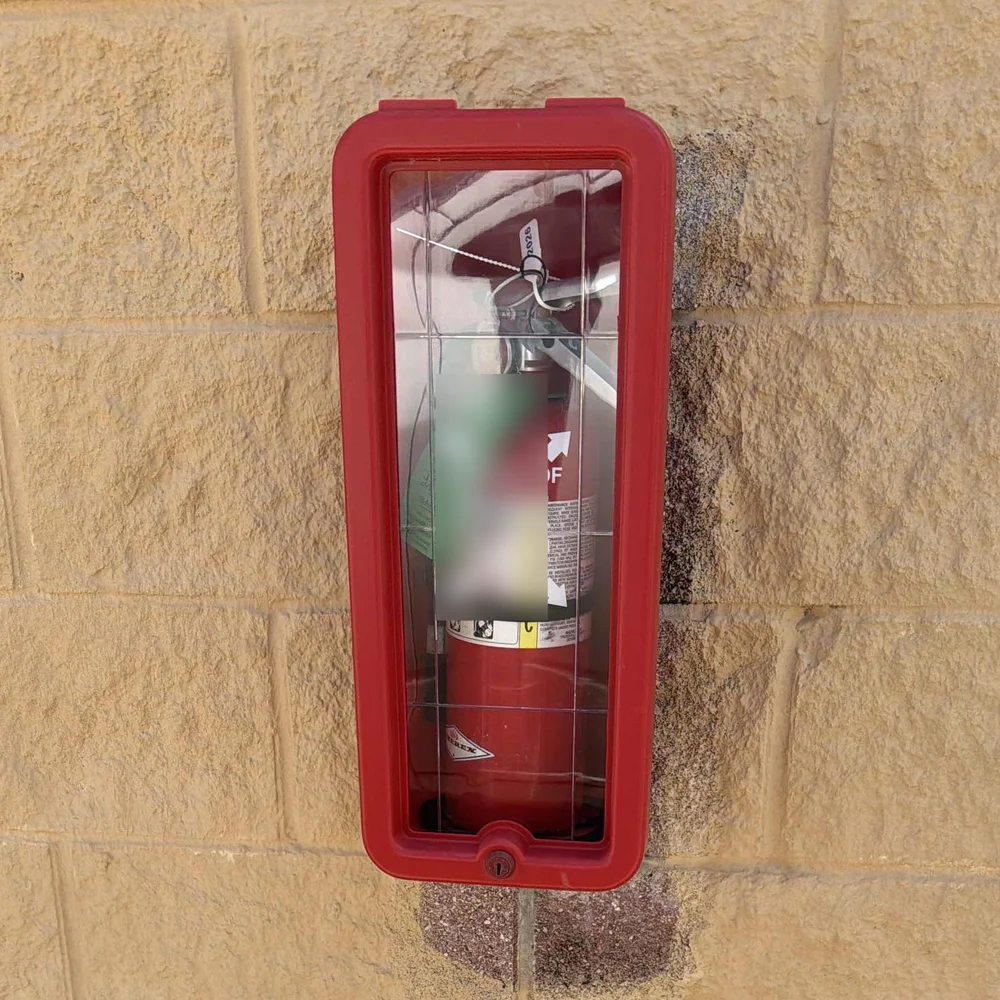
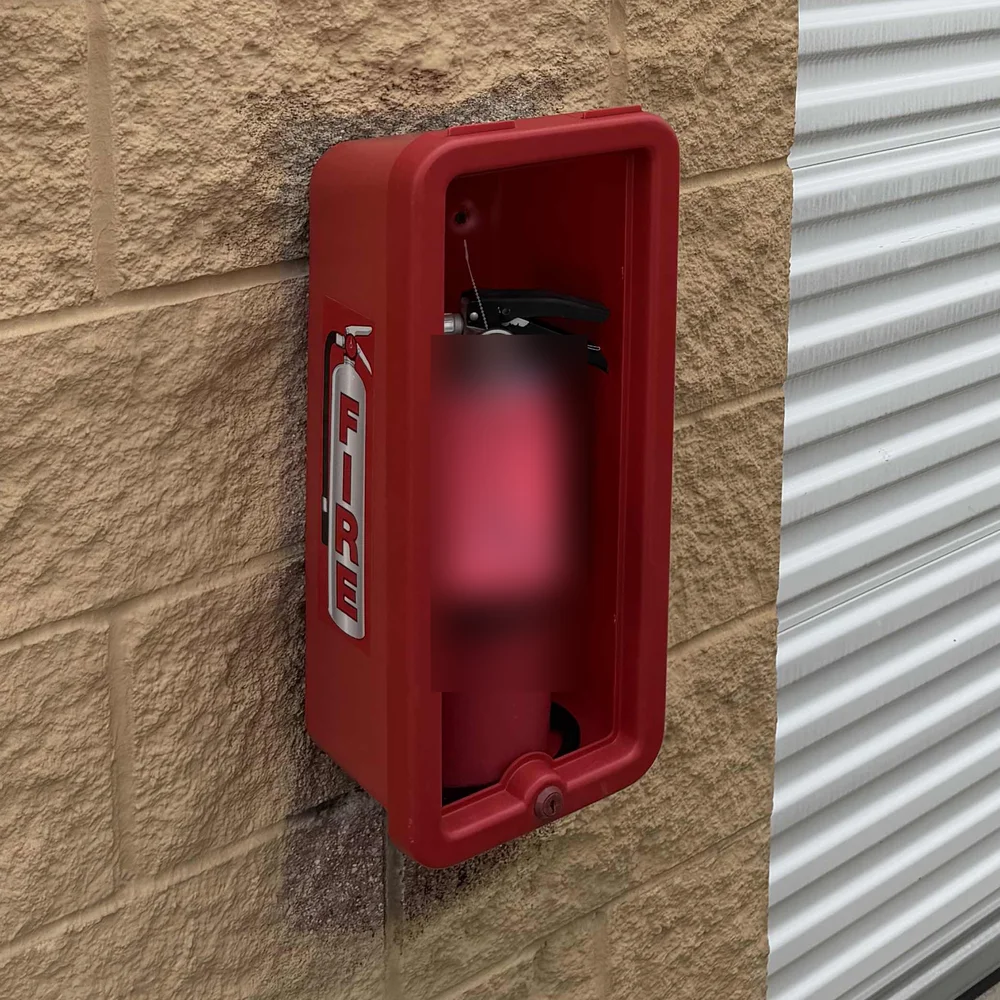
Outdoor drive-up rows: a unit exposed to weather needs to be protected from the environment and rated for the temperature swings of your climate. A weatherproof cabinet or cover is the common way to shield an outdoor unit and slow corrosion; see the fire extinguisher cabinet selection guide for choosing one.
Mounting, Signage, and Access
Having the right extinguisher is only half the job; NFPA 10 also sets how it is mounted and how it is found. The height rules turn on the unit's gross weight:
- Units up to 40 lb gross weight: the top of the extinguisher is mounted no more than 5 feet above the floor.
- Units over 40 lb gross weight (except wheeled units): the top is mounted no more than 3.5 feet above the floor.
- Floor clearance: the bottom of the extinguisher stays at least 4 inches above the floor in every case.
Every extinguisher must be securely mounted on the bracket, hanger, or in the cabinet it is listed for, and it must be conspicuous and unobstructed (IFC §906.5 and §906.6). In a self-storage building where a unit sits at the end of a long corridor or around a corner, add signage that indicates the location so a person can find it from where they are — the code specifically calls for a means to indicate the location where the extinguisher is not visible. For the full set of height, clearance, and cabinet rules, see the mounting and placement requirements.
Cabinets for outdoor rows and unstaffed corridors
Enclosures that protect an extinguisher on an exposed outdoor drive-up row or in an unstaffed corridor — keeping it operable, visible, and harder to tamper with.


When a cabinet earns its keep: a steel wall bracket ships with every extinguisher and is a compliant mount on its own. Add a cabinet where a unit is subject to tampering in an unstaffed corridor, exposed to weather on an outdoor row, or where you want to recess it to keep it out of a walking path. The fire extinguisher cabinets collection covers the options.
The Service and Replacement Cycle
Extinguishers are a recurring line item, not a one-time purchase. NFPA 10 sets the maintenance calendar, and a facility that budgets for it avoids both the compliance gap and the scramble of an unplanned replacement run. The intervals:
| Interval | What happens |
|---|---|
| Monthly | Visual inspection, which staff can do: pressure gauge in the green where fitted (CO2 units have none), seal intact, no physical damage or corrosion |
| Annually | Professional maintenance by a certified technician, with an updated service tag |
| Every 6 years | Internal examination of rechargeable stored-pressure extinguishers |
| Every 5 years | Hydrostatic test for CO2, water, and wet-chemical units |
| Every 12 years | Hydrostatic test for stored-pressure dry-chemical units |
| At 12 years | Non-rechargeable (disposable) extinguishers are removed from service |
The monthly, annual, and 6-year steps live in NFPA 10 Chapter 7; the hydrostatic tests are Chapter 8. On top of the calendar, any extinguisher that has been used, even a short burst, must be recharged before it goes back on the wall. For the full inspection and maintenance detail, see our NFPA 10 reference.
Which NFPA 10 Edition Applies
NFPA publishes NFPA 10 on a multi-year cycle, and a 2026 edition has been issued. That does not automatically make it the edition you have to follow. The enforceable edition is whichever one your jurisdiction's adopted fire code references — for example, the 2021 IFC references NFPA 10-2018. Jurisdictions adopt new code editions on their own schedule, so the version in force in your city may lag the newest published standard by several years.
The good news for planning is that the figures this guide relies on — the 2-A Class A minimum, the 75-foot travel distance, the 11,250-square-foot maximum area per unit, and the mounting heights — have been stable across recent editions, so the practical requirements above hold regardless of which edition your AHJ enforces. When a detail matters, confirm the adopted edition with your local fire marshal rather than assuming the latest one applies.
Outfitting a Whole Facility
A self-storage operator rarely buys a single extinguisher. Bringing a new build up to code, re-extinguishering an acquired property, or standardizing units across several locations is a multi-unit order, and it is where buying in volume pays off — both on price and on having one consistent, serviceable lineup across the portfolio. We confirm delivered pricing in the quote rather than guessing it at checkout, and we can provide spec sheets for your fire marshal or insurer.
Outfitting or re-extinguishering a self-storage facility?
Volume pricing on ABC and CO2 extinguishers for corridors, drive aisles, and the rental office, with spec sheets for your fire marshal or insurer. Quotes back within one business day.
or call 714-248-6555 · email partners@usmadesupply.com
Frequently Asked Questions
Are self-storage facilities required to have fire extinguishers?
Yes. The International Fire Code (§906.1) requires portable fire extinguishers in Group S storage occupancies, selected and installed per NFPA 10 (§906.2). The building code classifies a self-service storage facility (mini-storage) as a Group S-1 moderate-hazard storage occupancy, so it falls squarely within that requirement. Your local fire marshal enforces the adopted code.
Does every storage unit need its own fire extinguisher?
No. There is no NFPA 10 mandate for an extinguisher inside each locked tenant unit. The extinguishers are placed in the common areas the operator controls — the interior hallways, drive aisles, elevator lobbies, and rental office — spaced so no point a person can walk is more than 75 feet of travel from one.
What size fire extinguisher does a self-storage facility need?
Self-storage is a Class A (ordinary combustibles) hazard. NFPA 10 sets a minimum 2-A rating for light and ordinary hazard, rising to 4-A for extra hazard. At ordinary hazard NFPA 10 allows up to 1,500 square feet per unit of A, so a 2-A extinguisher covers up to 3,000 square feet, and no single unit covers more than 11,250 square feet regardless of rating. A common 2-A:10-B:C multipurpose ABC unit meets the ordinary-hazard minimum, but your AHJ makes the final hazard call.
How far apart do the extinguishers have to be?
NFPA 10 allows no more than 75 feet of travel to reach a Class A extinguisher, measured along the actual path a person would walk rather than a straight line through walls or locked units. The exact count and locations follow from the facility's layout and are approved by the local fire marshal.
Do self-storage buildings need sprinklers too?
Above a size threshold, and it can be lower than operators expect. Under IBC/IFC §903.2.9, an automatic sprinkler system is required in a Group S-1 fire area exceeding 12,000 square feet, with additional triggers for aggregate area over 24,000 square feet and for a Group S-1 fire area more than three stories above grade plane. A separate §903.2.9.4 trigger keys on the stock itself: sprinklers are required once the area used to store upholstered furniture or mattresses exceeds 2,500 square feet — common in self-storage — except in one-story, all-exterior-access (drive-up) facilities, which stay on the general 12,000-square-foot rule. Some state amendments number the furniture rule §903.2.9.3, so confirm the adopted numbering with your local AHJ. Sprinklers do not remove the portable-extinguisher requirement — a sprinklered facility still needs its NFPA 10 extinguishers.
How high do we mount the extinguishers?
Per NFPA 10, the top of an extinguisher with a gross weight up to 40 pounds is mounted no more than 5 feet above the floor; a heavier unit (except a wheeled one) is mounted with its top no more than 3.5 feet above the floor. In both cases the bottom stays at least 4 inches off the floor, and the unit must be conspicuous and unobstructed, with signage where it is not visible.
How often do the extinguishers need to be serviced?
On the NFPA 10 schedule: a monthly visual check staff can perform, annual professional maintenance by a certified technician, a 6-year internal exam for rechargeable stored-pressure units, and a hydrostatic test every 5 years for CO2 and water units or every 12 years for dry chemical. Non-rechargeable units are retired at 12 years, and any unit that has been used is recharged before it goes back out.
What about boat and RV storage areas?
A boat, RV, or vehicle storage bay is still part of the Group S-1 storage facility and is covered on the same NFPA 10 Class A basis, with multipurpose ABC units in the drive aisles. NFPA 1194 governs recreational-vehicle parks and campgrounds, not a storage building, so it is not the standard for these bays. If the facility also fuels or services boats, that fueling is a separate flammable-liquid hazard.
Self-Storage Fire Extinguishers in Stock
Manufacturer: Buckeye
10 lb
UL 4-A:60-B:C
Buckeye 10 lb Short ABC Fire Extinguisher, Wall Hook, UL Listed 4-A:60-B:C, Part 11310
$128.00

Manufacturer: Buckeye
30 lb
UL 10-A:160-B:C
Buckeye 30 lb ABC Fire Extinguisher, Wall Hook, UL Listed 10-A:160-B:C, Part 12905
$539.00

Manufacturer: Buckeye
10 lb
UL 4-A:80-B:C
Buckeye ABC Dry Chemical Fire Extinguisher w/ Wall Hook – 10 lb.
$90.00
$106.00
Manufacturer: Buckeye
20 lb
UL 10-A:120-B:C
Buckeye ABC Dry Chemical Fire Extinguisher w/ Wall Hook – 20 lb.
$155.00
$167.00
Manufacturer: Buckeye
5 lb
UL 3-A:40-B:C
Buckeye ABC Dry Chemical Fire Extinguisher w/ Wall Hook – 5 lb.
$56.00
4+ for $51 each
Was this page helpful?
Your feedback helps us improve our technical resources.
Recommended in this guide

